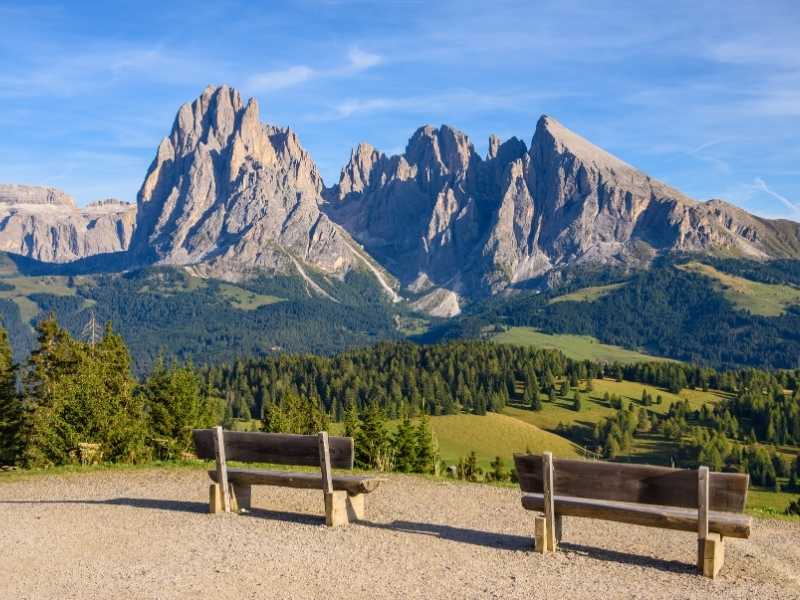
Alpe di Siusi, Italy, is a rolling green plateau sitting on top of the Dolomites in South Tyrol, and at 56 km² (22 square miles) it’s the largest high alpine meadow in Europe. Seiser Alm is its German name, and you’ll see both on the signposts. The Sciliar stands over one end of it, the Sassolungo over the other, and in between there’s almost nothing but grass, hay barns and trails.
It’s also one of the easiest places in the Dolomites to reach without a car, which is why it works just as well for a half-day visit as it does for a week. Here’s how to get there, what it’s like in each season, and what to do once you’re up on the meadow.
TL;DR
Alpe di Siusi is Europe’s largest high alpine meadow, 56 km² (22 square miles) of pasture between about 1,680 m and 2,350 m (5,510 ft and 7,710 ft) in the Italian Dolomites. It’s part of the Sciliar-Catinaccio Nature Park and part of the UNESCO World Heritage Dolomites.
How to get there
The Alpe di Siusi cable car from Siusi (Seis am Schlern) to Compaccio takes about 15 minutes. It’s the cabinovia Alpe di Siusi in Italian and the Seiser Alm Bahn in German, all the same lift. From Ortisei in Val Gardena, the Mont Sëuc gondola takes about 10 minutes. Both drop you on the plateau itself.
The road rule that catches people out
The road up from Siusi is closed to private cars from 9:00 am to 5:00 pm. You either arrive before nine, leave after five, or take a lift. Most people take a lift.
Nearest city
Bolzano, about 38 km (24 miles) away, with an hourly bus. Nearest airports are Bolzano at 40 km (25 miles), Innsbruck at 120 km (75 miles) and Verona at 200 km (125 miles).
Best time to go
Early July for the wildflowers, late September and October for golden larches and empty trails, December to early April for skiing and snowshoeing.
If you want to cross the whole plateau on foot
Our Val Gardena and Alpe di Siusi hiking tour is a 5-day self-guided trip with 3 hiking days, 36 km (22 miles) and two nights in mountain huts. It’s the gentlest multi-day hike we run in the Dolomites.
Where Is Alpe di Siusi, and What Makes It Different?
Alpe di Siusi sits in South Tyrol, the German-speaking province in Italy’s far north, about 38 km (24 miles) east of Bolzano. The plateau runs between roughly 1,680 m and 2,350 m (5,510 ft and 7,710 ft), with the main arrival point at Compaccio (Compatsch) at about 1,850 m (6,070 ft).
What makes it unusual is the shape of the land. Most of the Dolomites is vertical: towers, scree, cable cars bolted to cliffs. Alpe di Siusi is the opposite. It’s 56 km² (22 square miles) of open, gently tilting pasture with the famous peaks standing around the edge of it like an audience. That means you get the Dolomites view without the Dolomites gradient, which is why it suits families, first-time hikers and anyone who’d rather look up at the Sassolungo than down at their boots.
The plateau is protected as part of the Sciliar-Catinaccio Nature Park, and the whole range is a UNESCO World Heritage Site. The protection is the reason for the traffic rules further down this page, and it’s also the reason the meadow still looks the way it does.
One more thing worth knowing before you arrive: it sits high enough that it’s a genuine training ground. Olympic cross-country ski teams come here to work at altitude, and the Alpe di Siusi half marathon is run across the meadow every year, where recreational runners share the course with Kenyan Olympians. I once ran into the Norwegian women’s cross-country team mid-session. My dreams of becoming their new best friend lasted about four seconds, which is how long it took them to disappear over the next rise.
How to Get to Alpe di Siusi
This is the part most people get wrong on a first visit, so it’s worth two minutes now. There are four ways onto the plateau, and in high season three of them are better than driving.
| Route | From | Time | Good to know |
|---|---|---|---|
| Alpe di Siusi cable car | Siusi (Seis am Schlern) | About 15 minutes | The simplest option. Lands you at Compaccio, where the trails start. Expect a line at the valley station in August. |
| Mont Sëuc gondola | Ortisei, Val Gardena | About 10 minutes | Arrives at the northern edge of the plateau. The best choice if you’re based in Val Gardena. |
| Bus 170 | Bolzano bus station | About 40 minutes to Siusi | Runs hourly and connects with the cable car. Local buses then shuttle around the plateau itself. |
| Driving | Siusi up to Compaccio | About 20 minutes | Only before 9:00 am or after 5:00 pm, and parking at Compaccio needs to be booked ahead in summer. |
The Road Closure in Alpe di Siusi Nobody Warns You About
The road from Siusi up to Compaccio is closed to private vehicles every day from 9:00 am to 5:00 pm. It isn’t a seasonal thing or a weekend thing. It’s how the plateau has kept its quiet, and it’s enforced.
So you have three choices: arrive before nine, arrive after five, or take the cable car and forget about it. Guests staying in hotels up on the plateau get an access permit, which is one of the quiet arguments for sleeping up there rather than down in the valley.
The Alpe di Siusi Cable Car, and the Other Lifts Onto the Plateau
Most people arrive by lift, and there are two that put you on the plateau itself.
The Alpe di Siusi cable car runs from Siusi (Seis am Schlern) up to Compaccio in about 15 minutes. You’ll see it signed three ways depending on which language the sign is in: cabinovia Alpe di Siusi in Italian, Seiser Alm Bahn in German, and the Alpe di Siusi cable car in English. They’re all the same lift. It generally runs late May to early November, then again through the ski season, roughly 8:00 am to 6:00 pm with later closing in high summer. Buy cable car tickets at the valley station or online, and expect a line there on an August morning.
The Ortisei gondola, the Mont Sëuc ropeway, climbs from Ortisei in Val Gardena to the northern edge of the plateau in about 10 minutes. Italian signage calls it the telecabina or funivia Ortisei Alpe di Siusi. If you’re based in Val Gardena rather than in the Sciliar valleys, this is your lift.
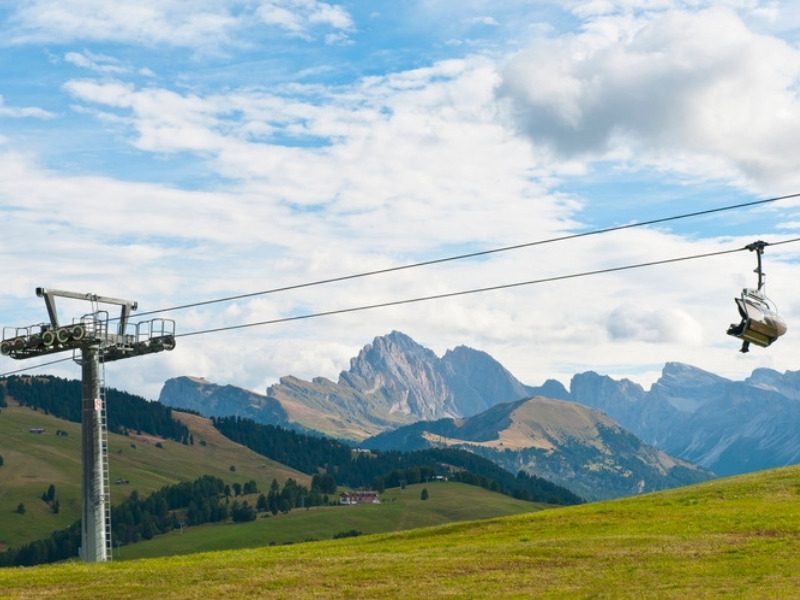
Once you’re up, the chairlifts take over. The Spitzbühl, Panorama and Bullaccia (Puflatsch) lifts move you around the plateau and save the climbing for the parts you actually want to climb. Check the lift webcams before you set off: on a plateau this exposed, the view from the top can be completely different from the one in the valley.
Getting to South Tyrol and Alpe di Siusi: Airports, Trains and Buses
Bolzano is the hub. It has the nearest mainline train station, the bus station that serves the whole valley, and a small airport about 40 km (25 miles) from Siusi. The bigger airports are Innsbruck at around 120 km (75 miles), Verona at around 200 km (125 miles), and Venice and Milan beyond those.
If you’re coming by train, get to Bolzano/Bozen, then take bus 170 from the bus station next door. The whole trip from the platform to the top of the cable car is comfortably under two hours.
What to Do in Alpe di Siusi: Things to Do on the Plateau
The short answer: hike, cycle, eat, repeat. The longer answer is that the plateau holds a surprising amount for its size, and that the right answer changes completely depending on the month you show up.
- Hiking. A dense network of marked trails, most of them gentle, linking hut to hut across the meadow. This is the main event, and if you’d rather have the huts booked and your bag moved between them, our Val Gardena and Alpe di Siusi hiking tour crosses the whole plateau over three hiking days.
- Mountain biking and road cycling. The plateau roads are quiet by design, and the climbs out of the valley are the kind cyclists plan trips around. The ride up toward Monte Piz is the classic, and in early summer you pass the first rose blossoms of the season on the way.
- Chairlifts and viewpoints. The Spitzbühl, Panorama and Bullaccia (Puflatsch) lifts get you higher without the climb, which is a fair trade on a hot day. Monte Piz is the viewpoint people come back for, and the plateau at sunset is the photograph everyone is actually here to take.
- Paragliding. The plateau’s open ground and reliable thermals make it one of the better launch areas in the Dolomites.
- Climbing and via ferrata. On the Sciliar and the Sassolungo at the edges of the meadow, not on the meadow itself.
- Eating in a mountain hut. Dumplings, speck, barley soup, apple strudel, and a terrace pointed at the Sassolungo. More on this below.
- Skiing, snowshoeing, sledding and cross-country skiing. From December to early April the whole thing turns white and the trail map changes completely. Sledding on Alpe di Siusi is the one families plan the day around.

Alpe di Siusi Weather and the Best Time to Visit, Season by Season
Alpe di Siusi weather is milder than the altitude suggests, because South Tyrol gets around 300 days of sunshine a year and the plateau sits in the rain shadow of the main Alpine ridge. That said, this is open ground at 1,850 m (6,070 ft): sun, wind and a cold front can all arrive before lunch, and the valley can be 10°C (18°F) warmer than the top of the cable car on the same afternoon.
So there isn’t a bad month here, but there are very different ones. This is the table I wish I’d had before my first visit.
| Season | What it’s like | Go if |
|---|---|---|
| Spring April to May |
Snow lingering high, cherry blossoms down in the valley, very few people | You want the valley trails and the quiet, and you don’t mind packing for two seasons |
| Summer June to August |
Wildflowers at their best in early July, every hut open, warm days | You want the full plateau experience and the longest days for hiking |
| Fall September to early November |
Golden larches, first snow dusting the peaks, clear air, chestnut season below | You want the best light and the best photographs. This is many hikers’ favorite window |
| Winter December to early April |
Ski slopes, groomed winter hiking trails, snowshoe routes, night cross-country racing | You ski, or you want a mountain that’s just as good at a slower pace |
Spring in Alpe di Siusi
Spring arrives in layers here. The higher plateau still holds good snow into early April, so you can ski in the morning while the valley below is in blossom. By early May the cherry trees around Castelrotto are out and the lower trails have dried.
The Aica farm trail is the classic spring hike, running past pastures and old farmsteads with the mountains lined up behind. The Pond of Fiè (Laghetto di Fiè) is worth the short detour for the reflections.
Pack a warm jacket. Isolated snowfall up on the plateau right into early summer isn’t unusual, and the temperature difference between the valley floor and Compaccio can be startling.
Summer in Alpe di Siusi
Summer is what the plateau is famous for. Valley temperatures can reach 30°C (86°F), but up at 1,850 m (6,070 ft) it stays comfortable, which is exactly why people head up the lifts rather than sitting it out below.
Take the Spitzbühl chairlift and you have a choice of trails fanning out from the top, most of them gentle and all of them pointed at something worth looking at. The Pond of Fiè is a good swimming stop on a hot afternoon, and the witches’ benches on the Bullaccia (Puflatsch) come with the local legends attached, which are better than they have any right to be.
Early July is the wildflower peak. If you’ve seen a photograph of Alpe di Siusi covered in flowers with the Sassolungo behind, that was early July.

Fall in Alpe di Siusi
Fall is my pick. The larches turn, the first snow touches the peaks while the meadow is still green, the air goes clear, and the summer crowds have gone home. I stayed at the Dibaita mountain hut on one trip and spent most of the evening on the terrace doing nothing in particular, which is the correct use of a fall evening up there.
Keep a rain jacket in the pack. Fall weather here swings from warm sun to cold drizzle inside an hour, and then back again.
Down in the valley it’s chestnut season, and Törggelen is in full swing: the South Tyrolean tradition of new wine, roasted chestnuts, dumplings and whatever the farmhouse kitchen is serving. The castles are good in this season too, Castel Presule in particular.
Winter in Alpe di Siusi
Winter turns the plateau into part of the Dolomiti Superski area, linked to the slopes of Val Gardena. But the quieter half is the good half: groomed winter hiking trails, snowshoe routes, tobogganing, ice skating, and cross-country skiing on some of the best terrain in the Alps, including a marathon run at night under lights.
Winter hiking here is genuinely easy. The trails are prepared, the gradients are mild, and the view of the snow-covered Sciliar on a blue day is worth the trip on its own.
Every January there’s a reenactment of a traditional South Tyrolean peasant wedding, costumes, jewelry, old recipes and all. It’s been running for decades and it is not staged for tourists, which you can tell within about a minute.

Hiking Across Alpe di Siusi on Foot, Hut to Hut
A day trip gets you a taste of Alpe di Siusi. Crossing it on foot over several days, sleeping in the huts, is a different trip entirely, and it’s the one most people wish they’d booked once they’ve seen the place.
Our Val Gardena and Alpe di Siusi hiking tour is a 5-day self-guided trip with 3 hiking days, 36 km (22 miles) in total, around 1,680 m (5,510 ft) of ascent, and about five hours on the trail each day. Two nights are in mountain huts and the rest in basecamp hotels in Val Gardena, we move your main bag between them, and the season runs from early June to early October. It’s the easiest Dolomites tour we run, and it’s the one we point first-time multi-day hikers at.
If you want more of the Dolomites in one trip, the Seiser Alm to Rosengarten tour carries on into the Catinaccio, and the Alta Via 1 is the long classic, north to south through the whole range.
A Cooking Class in an Alpe di Siusi Mountain Hut (and the Dumpling Recipe)
South Tyrolean food is its own argument for coming here: part Austrian, part Italian, and almost entirely made of things that grow or graze within a few valleys. On one visit I took a cooking class at the Gostner Schwaige mountain hut with chef Franz Muller, and the dumplings we made that afternoon are still the best I’ve had.

Franz runs the lessons in German or Italian, so bring a translator if you need one. They cost €35 to €50 per person, run for three to five hours, and need a minimum of five people. Gostner Schwaige is about 30 minutes from Compaccio on footpath no. 3, or about 60 minutes from Compatsch Joch heading toward Saltria.
What Goes Into South Tyrolean Dumplings
- 200 g (7 oz) mushrooms, or cheese or spinach instead
- 100 g (3.5 oz) onion, in small cubes
- 240 g (8.5 oz) hard white bread, in small cubes
- 40 g (1.4 oz) butter
- 4 eggs
- 50 ml (1.7 fl oz) milk, or water
- 100 g (3.5 oz) Tyrolean speck or another ham, chopped small
- 1 tbsp flour
- A handful of wild herbs: we used parsley, fennel, watercress and mustard leaf
- Salad greens: ours were flower petals picked on the meadow that morning
How to Make South Tyrolean Dumplings
- Brown the butter, then add the onions, ham, mushrooms, a pinch of salt and the bread cubes. Cook over medium heat until browned but not burnt.
- Add the herbs a minute or two before it’s done, then tip everything into a large bowl.
- Stir in the milk, flour and eggs. Leave it to sit for 10 minutes while you bring a large pot of water to the boil.
- Wet your hands and form the mixture into balls. Squeeze first, then roll. You don’t want any holes.
- Boil for about 10 minutes.
- Serve on salad greens.
- Optional but strongly recommended: eat them outside on a mountain hut terrace with the Sassolungo in front of you.

Where to Stay in Alpe di Siusi
You have two real choices, and they’re genuinely different trips.
Up on the plateau, at Compaccio or Saltria, you get the morning and the evening to yourself. Everyone else has gone back down on the last cable car, the light goes gold, and you can start hiking before the day visitors arrive. Hotels up here also come with a road access permit, so the 9-to-5 closure stops being your problem.
Down in the valley villages, in Siusi, Castelrotto, Fiè or Ortisei, you get more choice, more restaurants, better value and a village to come back to. You just trade the early start for it.
Use the map below to see what’s where. Zoom out to widen the search into the valley villages.
Know Before You Go to Alpe di Siusi
- German first, Italian second. You’re in Italy, but German is the first language of most residents here, and place names come in pairs: Alpe di Siusi and Seiser Alm, Ortisei and St. Ulrich, Castelrotto and Kastelruth. Signposts use both, so it helps to know both names for wherever you’re heading.
- Give yourself a day to acclimatize. Compaccio sits at about 1,850 m (6,070 ft). It isn’t high enough to be a problem, but it is high enough that an ambitious first afternoon feels harder than it should.
- Check the lift season before you book. The cable cars run roughly late May to early November, then again for the ski season. Between those windows the plateau is still beautiful and considerably harder to reach.
- Book Compaccio parking ahead if you’re driving up in summer. Spaces are reserved online now, and arriving without one at 8:45 am is a bad way to start a hike.
- Bring layers, always. Around 300 days of sunshine a year sounds like a packing instruction, but the plateau is open ground at altitude. Sun, wind and a sudden cold front can all happen before lunch.
- Carry some cash. Several of the smaller mountain huts still prefer it.
- Pick up a map at the valley station. There’s no Alpe di Siusi map worth downloading in advance that we’d stand behind, but the lift stations and the tourist offices in Siusi, Castelrotto and Ortisei hand out a current plateau map with every trail and lift on it, free.

Alpe di Siusi FAQs
Where is Alpe di Siusi?
Alpe di Siusi is a high alpine plateau in South Tyrol, in the Italian Dolomites, about 38 km (24 miles) east of Bolzano. It’s known as Seiser Alm in German, which is the name you’ll see on most local signposts. The plateau sits between roughly 1,680 m and 2,350 m (5,510 ft and 7,710 ft) and is part of the Sciliar-Catinaccio Nature Park and the UNESCO World Heritage Dolomites.
How do you get to Alpe di Siusi?
You get to Alpe di Siusi by cable car, gondola, bus or car. The Alpe di Siusi cable car runs from Siusi (Seis am Schlern) up to Compaccio in about 15 minutes, and the Mont Sëuc gondola runs from Ortisei in Val Gardena in about 10 minutes. Bus 170 connects Bolzano bus station with Siusi hourly in about 40 minutes. Driving up is possible only before 9:00 am or after 5:00 pm, because the road is closed to private cars in between.
Can you drive to Alpe di Siusi?
You can drive to Alpe di Siusi only outside the daily closure: the road from Siusi up to Compaccio is shut to private vehicles from 9:00 am to 5:00 pm every day. Parking at Compaccio needs to be reserved online in summer. Guests staying in hotels on the plateau are issued an access permit, so if you want your car with you, stay up top rather than in the valley.
How big is Alpe di Siusi?
Alpe di Siusi covers 56 km² (22 square miles), which makes it the largest high alpine meadow in Europe. It runs between roughly 1,680 m and 2,350 m (5,510 ft and 7,710 ft), with the main arrival point at Compaccio at about 1,850 m (6,070 ft). The Sciliar stands at one end and the Sassolungo at the other.
How does the Alpe di Siusi cable car work, and what does it cost?
The Alpe di Siusi cable car runs from Siusi (Seis am Schlern) up to Compaccio in about 15 minutes, and it is signed as the cabinovia Alpe di Siusi in Italian and the Seiser Alm Bahn in German. It generally runs from late May to early November and then again through the ski season, roughly 8:00 am to 6:00 pm with a later close in high summer. Buy cable car tickets at the valley station or online. The second lift onto the plateau is the Mont Sëuc gondola from Ortisei in Val Gardena, about 10 minutes, which Italian signage calls the telecabina or funivia Ortisei Alpe di Siusi.
What is the weather like on Alpe di Siusi?
Alpe di Siusi weather is milder than the altitude suggests: South Tyrol gets around 300 days of sunshine a year and the plateau sits in the rain shadow of the main Alpine ridge. It is still open ground at about 1,850 m (6,070 ft), though, so sun, wind and a cold front can all arrive before lunch, and the valley can run 10°C (18°F) warmer than the top of the cable car on the same afternoon. Summer days reach around 30°C (86°F) in the valley and stay comfortable up top. Snow on the plateau is possible into early summer.
What is the best time of year to visit Alpe di Siusi?
The best time of year to visit Alpe di Siusi depends on what you want. Early July gives you the wildflowers at their peak. Late September and October give you golden larches, clear air, the first snow on the peaks and far fewer people, which is why many hikers pick fall. December to early April is the ski and snowshoe season, with groomed winter hiking trails across the plateau. The lifts generally run late May to early November and then again through the ski season.
Is Alpe di Siusi the same as Seiser Alm?
Yes, Alpe di Siusi and Seiser Alm are the same place. South Tyrol is officially bilingual, so almost everywhere has an Italian and a German name: Alpe di Siusi is the Italian one and Seiser Alm the German one. The same goes for the villages around it, so Ortisei is St. Ulrich, Castelrotto is Kastelruth, and Siusi is Seis am Schlern.
Is Alpe di Siusi good for beginner hikers?
Alpe di Siusi is one of the best places in the Dolomites for beginner hikers. The plateau is rolling open pasture rather than scree and exposure, so you get full Dolomites scenery on gentle gradients, with mountain huts spaced close enough that you can stop whenever you like. Chairlifts take the climbing out of it if you’d rather skip the ascent. Our Val Gardena and Alpe di Siusi hiking tour is built around exactly that, with 3 hiking days totaling 36 km (22 miles) and about five hours on the trail a day.
How many days do you need in Alpe di Siusi?
One full day is enough to see the plateau and get a feel for it. Two to three days lets you reach the quieter corners, ride more than one lift and eat in several huts. If you want to cross it on foot and sleep in the mountain huts, plan on a 5-day trip, which is the length of our self-guided Val Gardena and Alpe di Siusi tour, including the arrival and departure days.
Where should you stay, on the plateau or in the valley?
Stay on the plateau, at Compaccio or Saltria, if you want the early mornings and late evenings to yourself and a road permit that gets around the daily closure. Stay in the valley villages of Siusi, Castelrotto, Fiè or Ortisei if you want more choice of hotels and restaurants, better value and a village atmosphere in the evening. Both work. They’re just different trips.
What food is Alpe di Siusi known for?
Alpe di Siusi food is South Tyrolean, which means Austrian and Italian cooking in the same kitchen: canederli or Knödel dumplings made with speck and old bread, barley soup, Schlützkrapfen spinach pasta, local cheeses from the plateau’s own dairies, and apple strudel. Fall brings Törggelen in the valley, the season of new wine and roasted chestnuts. You eat most of it in a mountain hut with a view attached.
Alpe di Siusi is the rare mountain destination that works in every season and asks very little of you in return. Go in July for the flowers, go in October for the light, go in February for the snow. Just go.
 |
 |