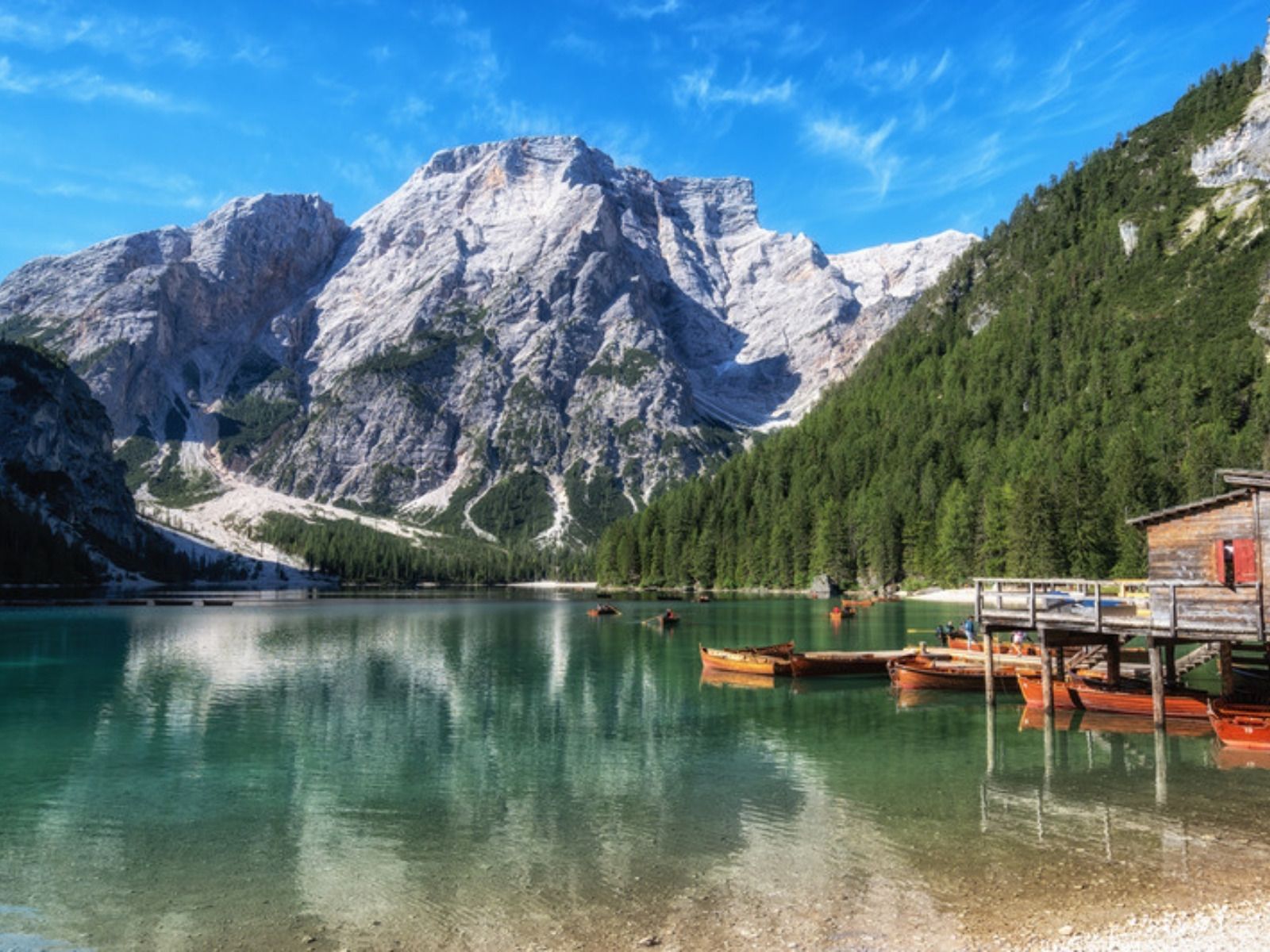
There’s no airport in the middle of the Dolomites. The valleys all point in different directions, the peak you fell for on Instagram can sit three hours from the airport that looked closest, and the quickest way in is a bus almost nobody books. How to get to the Dolomites really comes down to one question: which corner of the range are you going to?
We run self-guided hiking tours in Europe, three of them in the Dolomites: the Alta Via 1, Val Gardena and the Alpe di Siusi, and Seiser Alm to Rosengarten. It’s a question we answer regularly, so here’s every realistic way in: which airport to fly into, which trains actually go there, the direct buses most people never find, and how to reach the start of a hike without renting a car.
TL;DR: How to get to the Dolomites
Fly into Venice Marco Polo and take the direct bus to Cortina d’Ampezzo in 2 hours 10 minutes. Milan and Munich give you far more flights to choose from, and Verona has the shortest transfer of all if you can get a seat. You don’t need a car, and in high season a car is a liability at the most popular trailheads.
Best airport for the Dolomites
Venice Marco Polo (VCE). It’s the only airport that is both big enough for long-haul flights and close enough for a direct bus into the mountains. Verona (VRN) is nearest to Val Gardena and the Alpe di Siusi but has very limited flights, while Milan Malpensa (MXP) and Munich (MUC) are the major hubs, roughly 4 hours away by train.
Getting to the Dolomites by train
There are regular trains from all four gateway cities. Verona to Bolzano runs direct in as little as 1 hour 28 minutes, around 31 trains a day. Milan Centrale has around 26 a day to Bolzano, Munich has five direct EuroCity trains, and Venice has around 13 a day to Calalzo, the closest station to Cortina. From Bolzano, regional buses and the Val Pusteria railway take you the rest of the way.
Getting to the Dolomites by bus
Cortina Express runs straight from Venice Marco Polo airport to Cortina d’Ampezzo in about 2 hours 10 minutes, five times a day. From Verona, Milan or Munich you take the train to Bolzano first, then the hourly 350 bus up to Val Gardena. FlixBus runs long-distance coaches into the valley towns from Italian and German cities.
The cheapest way to get to the Dolomites
A regional train plus a South Tyrol Mobilcard, which covers buses, regional trains and some cable cars for €22 a day, €32 for three days or €52 for seven.
If you’re hiking with us
Alta Via 1 hikers arrive in Toblach (Dobbiaco) or Cortina d’Ampezzo. Our two Val Gardena tours, Val Gardena and the Alpe di Siusi and Seiser Alm to Rosengarten, start in Ortisei, Santa Cristina or Selva.

Where Are the Dolomites, and Which Side Are You Heading For?
The Dolomites sit in northeastern Italy, spread across three provinces: South Tyrol in the northwest, Trentino in the southwest and Belluno in the southeast. They’re a UNESCO World Heritage site, they cover about 1,420 square km (550 square miles), and they are nobody’s idea of a single destination. Cortina d’Ampezzo and Val Gardena are both “the Dolomites” and they’re a two hour drive apart, on opposite sides of the range, usually reached from different airports.
So before you book a flight, pin down the valley. It decides your airport and your base in the Dolomites both. Three choices cover almost everyone:
- Val Gardena, Alpe di Siusi and the Seiser Alm (northwest, South Tyrol). The gentlest hiking in the range, German and Ladin speaking, easiest from Verona or Bolzano.
- Val Pusteria, Lago di Braies and the Tre Cime (north). Where the Alta Via 1 starts, and the easiest side to reach by train, coming south from Munich or north from Venice.
- Cortina d’Ampezzo and the Belluno Dolomites (east and south). Closest to Venice, and the only part of the range with a direct airport bus.
Which Airport Is Best for the Dolomites?
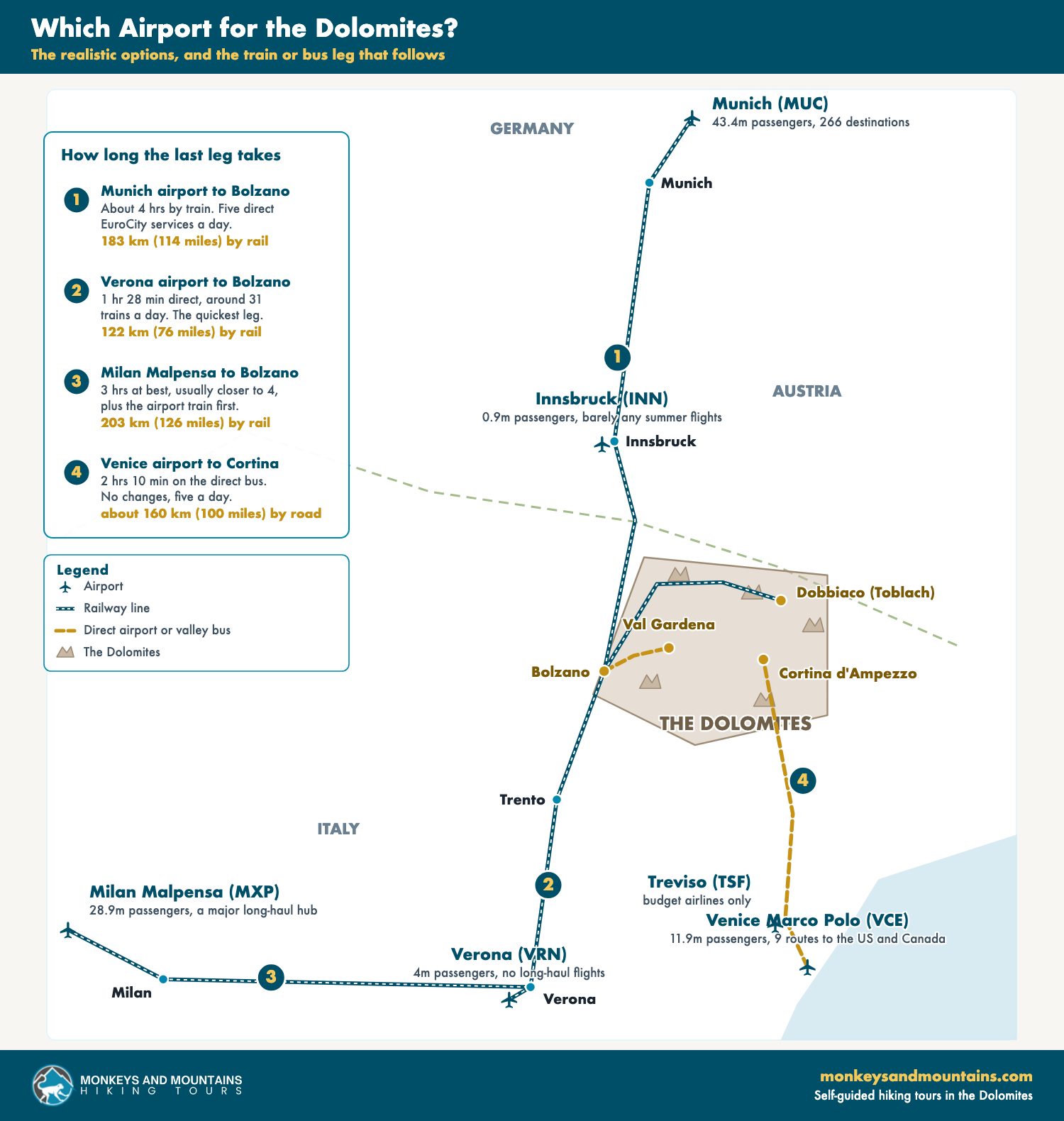
If you’re wondering where to fly into for the Dolomites, there’s a trade-off nobody mentions: the airports closest to the mountains are the smallest ones. Venice Marco Polo (VCE) is the best all-round answer, because it’s the only airport that is both properly big and properly close. It handled 11.9 million passengers in 2025, it has nine routes to the US and Canada, and it’s the one airport in the region with a direct bus into the mountains.
After that it depends on what you’re optimizing for. Verona (VRN) has the shortest transfer of any airport, 1 hour 28 minutes by direct train to Bolzano, but flights into it are limited: 4 million passengers a year, mostly European budget and seasonal routes, and nothing long-haul. Milan Malpensa (MXP) and Munich (MUC) are the heavyweights, and worth a serious look even though they sit about 4 hours out. Innsbruck (INN) is very small, and in summer it barely flies at all.
| Airport | Getting to the mountains | Best for |
|---|---|---|
| Venice Marco Polo (VCE) | 2 hours 10 minutes by direct bus to Cortina d’Ampezzo | The best all-round choice. 11.9 million passengers a year and nine routes to the US and Canada, and it is the only airport with a direct bus into the mountains |
| Milan Malpensa (MXP) | About 4 hours, by airport train into Milan and then on to Bolzano | The widest choice of flights, and often the cheapest. Italy’s second-busiest airport and sixth in Europe for the number of countries it reaches non-stop, so the choice of flights is wider than anything in northern Italy |
| Munich (MUC) | About 4 hours by train to Bolzano, or 3 hours 30 minutes by car | Long-haul arrivals, especially from the US and Canada. 43.4 million passengers and 266 destinations, with five direct trains a day south over the Brenner Pass |
| Verona Villafranca (VRN) | 1 hour 28 minutes by direct train to Bolzano | The shortest transfer of any airport, if you can get a flight. 4 million passengers a year, mostly European budget and seasonal routes, and no long-haul service at all |
| Treviso (TSF) | About 2 hours | Budget airlines from around Europe, and it is a stop on the Cortina Express route to Cortina |
| Innsbruck (INN) | About 2.5 hours, roughly 170 km (106 miles) | Winter, mostly. A very small airport at 0.9 million passengers a year, with one year-round scheduled route and a schedule built around the ski season |
| Bolzano (BZO) | 20 to 45 minutes | The closest airport of all, but tiny, with a short list of routes. Check it has a flight from where you live before you plan around it |
Don’t write Milan off. Malpensa is a full-size intercontinental hub, Italy’s second-busiest airport and sixth in Europe for the number of countries it reaches non-stop, which is exactly why flights into it are often more frequent and cheaper than anything into Venice or Verona. The catch is the ground leg: the airport train into Milano Centrale first, then 3 hours to Bolzano on the fastest service and nearer 4 on most of them. If the fare saving is real and you’ve got the time, it’s a sensible trade.
Munich is the one most people never consider, and it’s the best northern option. It’s a Lufthansa hub with 43.4 million passengers a year and 266 destinations, so the long-haul choice from the US and Canada is far wider than anything in northern Italy. The run south is easy too: five direct EuroCity trains a day from Munich Hauptbahnhof to Bolzano in about 4 hours, or 288 km (179 miles) by car over the Brenner Pass in about 3 hours 30 minutes. If you’re heading for the Val Pusteria or starting the Alta Via 1, Munich is the one to book.
And a word about Innsbruck. It looks ideal on a map, and it genuinely is close. But it’s a very small airport, 0.9 million passengers a year against Munich’s 43.4 million, with a single year-round scheduled route and a schedule built around the ski season. In summer there’s very little flying into it. Check there’s actually a flight from where you live before you build a trip around it.
How to Get to the Dolomites by Train
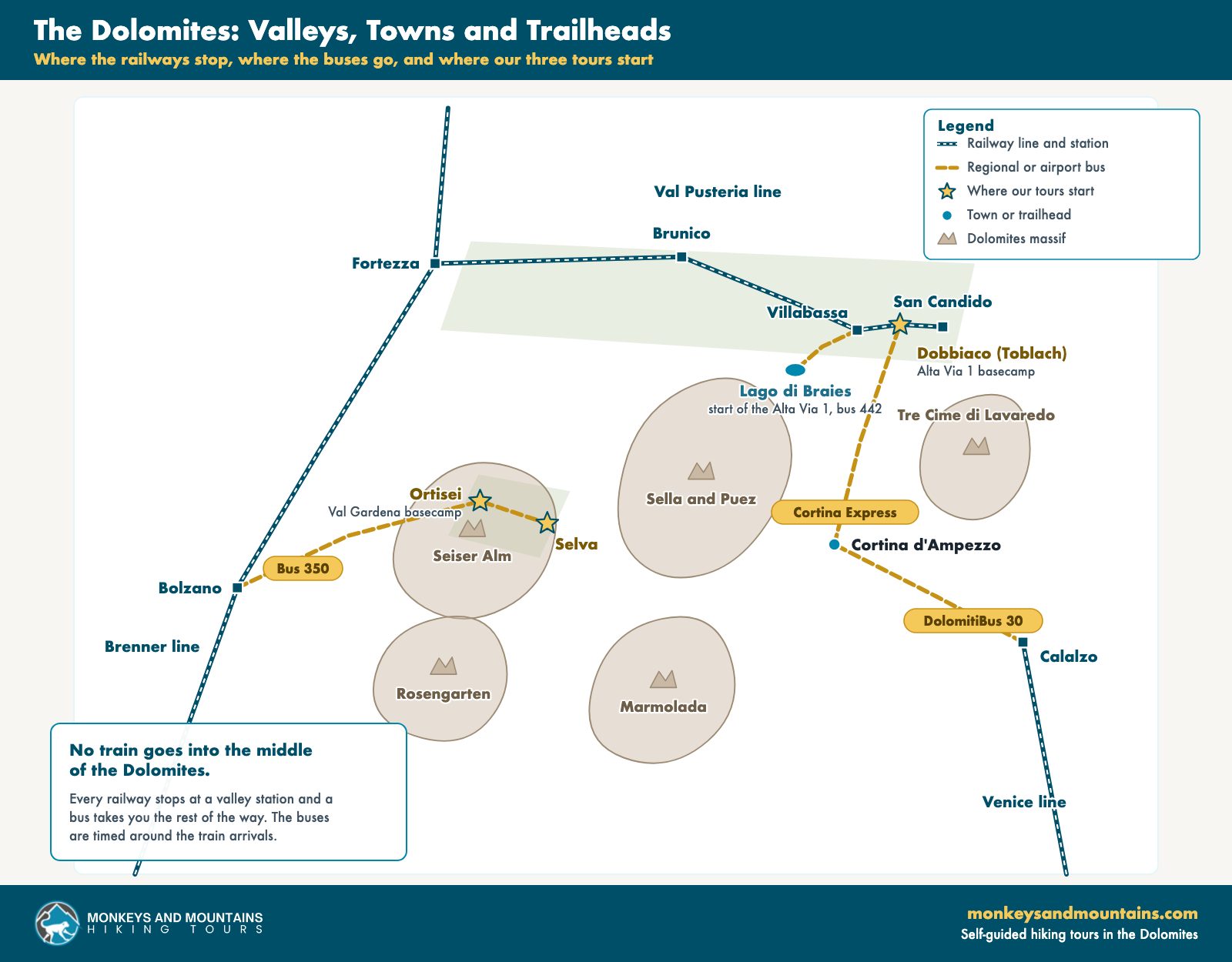
You can get to the Dolomites by train, and it’s the most relaxing way in, but no train goes into the heart of the range. Trains take you to a valley station, and a bus takes you up. Three railway lines matter.
The Brenner Line: Verona to Bolzano for the Western Dolomites
This is the main artery, running from Verona north through Trento and Bolzano to the Brenner Pass and on into Austria. Verona Porta Nuova to Bolzano is direct, takes as little as 1 hour 28 minutes (around 2 hours on a regional train), and runs about 31 times a day. From Milano Centrale there are around 25 trains a day to Bolzano, two of them direct, the fastest in about 3 hours and most in around 4. Coming the other way, five direct EuroCity trains a day run from Munich Hauptbahnhof over the Brenner Pass to Bolzano in about 4 hours.
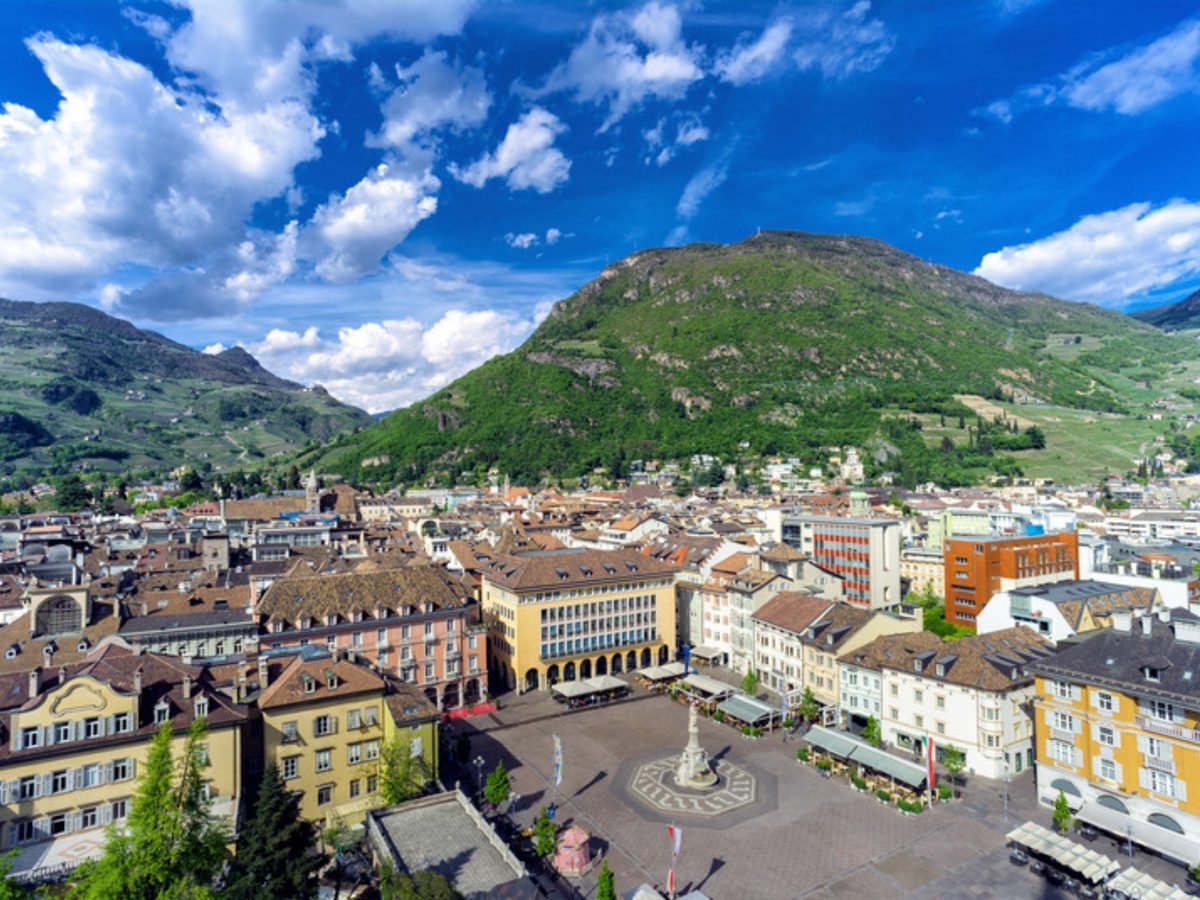
Bolzano is where most people switch to a bus. For Val Gardena, the 350 runs to Ortisei, Santa Cristina and Selva in 60 to 90 minutes depending on the village. You can also shorten the bus leg by staying on the train to Ponte Gardena, 18 km (11 miles) from Val Gardena, or Chiusa, 23 km (14 miles) away. Bolzano itself is 40 km (25 miles) out.
The Val Pusteria Line: Fortezza to Dobbiaco for the Northern Dolomites
At Fortezza (Franzensfeste), a second line branches east along the Val Pusteria to Brunico, Villabassa, Dobbiaco and San Candido. This is the line to know if you’re hiking the Alta Via 1 or heading for the Tre Cime. Bolzano to Fortezza takes about 40 minutes and runs hourly; Fortezza to Dobbiaco is about another 1.5 hours, so allow close to 3 hours from Bolzano once you’ve changed trains.
Coming from the north, this line is the reason Munich is worth a look. The Brenner main line runs Munich to Innsbruck to Fortezza, and at Fortezza you turn right. That makes Munich the easiest airport of all for the Alta Via 1, Dobbiaco and the Tre Cime.
The Calalzo Line: the Closest Station to Cortina d’Ampezzo
Cortina d’Ampezzo hasn’t had a railway station since 1964. The nearest one is Calalzo-Pieve di Cadore-Cortina, about 2 hours 51 minutes from Venezia Santa Lucia at best and 3 hours 18 minutes on average, with around 13 departures a day and one change. Tickets start at roughly €13. From Calalzo, DolomitiBus line 30 covers the last stretch to Cortina in about an hour, timed around the train arrivals.
Honestly, for Cortina the bus beats the train, which brings us to the part most people miss.
Getting to the Dolomites by Bus: the Easiest Route Nobody Books
There’s a direct bus from Venice Marco Polo airport to Cortina d’Ampezzo. It takes about 2 hours 10 minutes, runs five times a day, and costs around €30 one way. There’s no published fare table, so check the operator’s site for the current price. It’s run by Cortina Express, it stops in Venice Mestre and Treviso on the way, and it will get you from baggage claim to the mountains faster than any train and most rental cars.
The buses worth knowing:
- Cortina Express, Venice to Cortina. Venice airport, Venice Mestre and Treviso to Cortina d’Ampezzo. It runs year-round, with the summer schedule starting in mid-June, so the whole hiking season is covered.
- Cortina Express, Cortina to Dobbiaco and San Candido. The link between the eastern and northern Dolomites, and a handy one if you’re starting or finishing the Alta Via 1.
- Line 350, Bolzano to Val Gardena. Hourly most of the day, via Ponte Gardena, to Ortisei, Santa Cristina and Selva.
- Line 442, Villabassa and Dobbiaco to Lago di Braies. About 20 minutes, and the only sensible way to the Alta Via 1 trailhead in summer. See the access rules below before you plan around it.
- FlixBus runs long-distance coaches from Italian and German cities into the valley towns, and it’s usually the cheapest way in if you’re not in a hurry.
How Far Are the Dolomites From Venice, Milan, Verona and Florence?
| From | Fastest realistic trip | How |
|---|---|---|
| Venice | About 2 hours 10 minutes | Direct bus from the airport to Cortina d’Ampezzo |
| Verona | About 1 hour 30 minutes to Bolzano | Direct train, then a valley bus |
| Milan | About 3 hours to Bolzano | Train, around 201 km (125 miles) as the route runs |
| Innsbruck | About 2.5 hours | Car over the Brenner Pass, or train to Fortezza and the Val Pusteria line |
| Munich | About 4 hours to Bolzano | Five direct trains a day over the Brenner Pass, or 3 hours 30 minutes by car |
| Florence | Half a day | Fast train to Verona or Venice, then onward. Not a day trip, whatever the search results say |
Driving to the Dolomites: What to Know Before You Rent a Car
A car gives you the most freedom between valleys, and the roads are a pleasure, with the Sella and Pordoi passes among the best driving in the Alps. But two things surprise first-timers, and both of them land exactly where hikers want to be.
The road up to the Alpe di Siusi is closed to cars from 9am to 5pm. That restriction runs the whole time the cable car is operating, which in 2026 means May 22nd to November 2nd. You can drive up before 9am or after 5pm, and you can drive down any time, but in the middle of the day the plateau belongs to the cable car and the shuttle buses. The Seiser Alm cableway from Siusi covers 4.4 km (2.7 miles) and 800 m (2,625 ft) of ascent in 15 minutes, running 8am to 6pm in summer, and to 7pm from early June to early September.

Lago di Braies has to be booked. In 2026, from July 1st to September 15th, you can’t drive into the Braies valley between 9am and 4pm without a reservation or a transit permit. The combined ticket costs €44 and includes valley access, a guaranteed parking space and a €22 voucher for local restaurants and shops. Buses 442 and 439 need a prepaid reservation in that window too, with your return time booked. If you arrive on foot or by bike you never need a reservation, at any time of year, which is one of the small perks of being a hiker. Outside the regulated dates, you just pay the driver, in cash. Check the current year’s dates on the official Braies valley site before you travel, because they shift each season.
There’s a wider point here. The Dolomites are managing their most famous spots with permits and timed access now, and most of those rules are aimed at cars. Arrive by bus and they mostly don’t apply to you.
How to Get Around the Dolomites Without a Car (and the Cheapest Way to Do It)
The cheapest way to get to the Dolomites is a regional train to a valley station and a regional bus from there, and in South Tyrol one card covers both. The Mobilcard gives you unlimited travel on buses, regional trains as far south as Trento, and some cable cars:
- 1 day: €22 adult, €11 for children aged 6 to 14
- 3 days: €32 adult, €16 child
- 7 days: €52 adult, €26 child
It doesn’t cover long-distance trains, so the EuroCity or Frecciarossa leg that gets you to Bolzano needs its own ticket. Buy it at any transport ticket office or tourist office, and validate it each time you board.
Better still, check what your accommodation gives you. Many hotels in South Tyrol hand guests a Guest Pass that covers regional public transport for the whole stay, including your arrival and departure days. In Val Gardena that’s standard at participating hotels, and it quietly makes the whole trip car-free.
Not sure which part of the Dolomites suits you?
Answer a few questions about your fitness, your dates and the kind of hiking you like, and our hike finder matches you to a trip in the Dolomites or anywhere else in Europe.
How to Get to the Start of Our Three Dolomites Hiking Tours
Every one of our Dolomites tours starts in a town you can reach on public transport, which is deliberate. Here’s how each one works.
Getting to the Alta Via 1: Arrive in Toblach or Cortina d’Ampezzo
The self-guided Alta Via 1 hiking tour runs from Lago di Braies (Pragser Wildsee) to Belluno, 111 km (69 miles) with 6,640 m (21,780 ft) of ascent on the full 11-day route. You don’t start at the lake, though. Day 1 is an arrival day in Toblach (Dobbiaco) or Cortina d’Ampezzo, at the basecamp hotel.
- To Toblach: fly into Munich or Venice. From Munich, take the train over the Brenner Pass and change at Fortezza onto the Val Pusteria line. From Venice, the Cortina Express runs once a day straight through to Dobbiaco, leaving the airport in the early afternoon.
- To Cortina d’Ampezzo: fly into Venice Marco Polo and take the Cortina Express, about 2 hours 10 minutes, straight from the airport.
Getting to Val Gardena for the Alpe di Siusi and Seiser Alm Tours
Both our western Dolomites tours start in Val Gardena, at a basecamp hotel in Ortisei, Santa Cristina or Selva: the 5-day Alpe di Siusi and Val Gardena hiking tour, which is our easiest Dolomites trip with three hiking days, and the Seiser Alm to Rosengarten hiking tour, which crosses the Seiser Alm at 1,700 to 2,200 m (5,577 to 7,218 ft) before heading for the Schlern.
Fly into Verona, take a direct train to Bolzano, then bus 350 up the valley. From Venice, Milan or Munich it’s the same idea with a longer train leg. If you’d rather skip the bus, a private transfer from Bolzano station takes about an hour.
Hiking the Dolomites without the logistics?
On our self-guided Dolomites hiking tours we book the hotels and mountain huts, move your luggage, and send you GPS routes and detailed route notes. You get WhatsApp support the whole way, and a free custom training plan valued at €300. You handle the flights; we handle everything after that.
The Best Way to Get to the Dolomites, Based on Where You’re Starting
| If you’re… | Best way in |
|---|---|
| Flying long-haul and want the simplest arrival | Venice Marco Polo, then the Cortina Express direct from the airport |
| Headed for Val Gardena or Alpe di Siusi | Verona, direct train to Bolzano, bus 350 |
| Hiking the Alta Via 1 | Munich or Venice, then the Val Pusteria line to Toblach |
| Watching the budget | Regional trains plus a Mobilcard, or FlixBus into the valley towns |
| Combining the Dolomites with other parts of Italy | Fast train to Verona, then north. Verona connects to Florence, Rome and Milan |
| Planning to drive between valleys daily | Rent a car, but check the access rules for Lago di Braies and the Alpe di Siusi first |
Once you’ve worked out how you’re getting there, the next two questions are usually where to base yourself and what to hike. We’ve covered where to stay in the Dolomites and the Alpe di Siusi in their own guides, and the Dolomites sit near the top of our list of the best hikes in Europe.
Where to Stay When You Arrive in the Dolomites
If you’re only booking one night before the hiking starts, book it in Cortina d’Ampezzo. It’s the only base in the range you can reach from an airport without changing, the Cortina Express drops you in the middle of town, and it’s within reach of both the eastern Dolomites and the Val Pusteria. Bolzano is the better choice if you’re heading west to Val Gardena, and the box further up this page has the stations and the walking distances.
Use the map to see what’s available in Cortina and what it costs on your dates. Zoom out to pull in Dobbiaco, San Candido and the valley villages.
How to Get to the Dolomites: FAQs
What is the best way to get to the Dolomites?
The best way to get to the Dolomites is to fly into Venice Marco Polo and continue by direct bus or train. For the eastern Dolomites and Cortina d’Ampezzo, the Cortina Express runs from the airport to Cortina in about 2 hours 10 minutes with no changes. For Val Gardena and the Alpe di Siusi, take a train to Bolzano and then bus 350 up the valley. Verona gives the shortest train leg at 1 hour 28 minutes, but it is a small airport, so Milan Malpensa and Munich are often easier to fly into even though they are about 4 hours out.
Which airport should you fly into for the Dolomites?
Venice Marco Polo (VCE) is the best all-round choice, because it is the only airport that is both large and close: 11.9 million passengers a year, nine routes to the US and Canada, and a direct bus to Cortina d’Ampezzo in 2 hours 10 minutes. Verona (VRN) has the shortest transfer, 1 hour 28 minutes by train to Bolzano, but only 4 million passengers a year and no long-haul flights. Milan Malpensa (MXP) and Munich (MUC) are major hubs with more frequent and often cheaper flights, about 4 hours from the mountains. Innsbruck (INN) is very small, with 0.9 million passengers a year and almost no summer schedule.
Can you get to the Dolomites by train?
Yes, you can get to the Dolomites by train, but no railway runs into the middle of the range, so every trip ends with a bus. The Brenner line serves Bolzano from Verona and Milan, the Val Pusteria line branches east at Fortezza for Brunico, Villabassa and Dobbiaco, and the Venice line ends at Calalzo-Pieve di Cadore-Cortina, about 2 hours 51 minutes from Venezia Santa Lucia at best.
Do you need a car in the Dolomites?
No, you don’t need a car in the Dolomites, and in high season it can work against you. The road up to the Alpe di Siusi is closed to cars from 9am to 5pm while the cable car runs, and from July 1st to September 15th 2026 you can’t drive into the Braies valley between 9am and 4pm without a booked parking space or permit. Hikers arriving on foot, by bike or by bus avoid both restrictions.
What is the cheapest way to get to the Dolomites?
The cheapest way to get to the Dolomites is a regional train to a valley station and a regional bus from there. In South Tyrol the Mobilcard covers buses, regional trains as far as Trento and some cable cars for 22 euro a day, 32 euro for three days or 52 euro for seven. Long-distance trains like the Frecciarossa and EuroCity aren’t included, and many South Tyrol hotels give guests a pass that covers regional transport for the whole stay.
How do you get to Lago di Braies, the start of the Alta Via 1?
Get to Lago di Braies on bus 442 from Villabassa or Dobbiaco, which takes about 20 minutes, or bus 439 from Monguelfo station in high season. From July 1st to September 15th 2026, both buses need a prepaid reservation with a booked return time, and driving in between 9am and 4pm requires a permit or a booked parking space. Arriving on foot or by bike never needs a reservation.
How far are the Dolomites from Venice?
The Dolomites are about 2 hours 10 minutes from Venice Marco Polo airport to Cortina d’Ampezzo on the direct Cortina Express bus. By train, Venezia Santa Lucia to Calalzo-Pieve di Cadore-Cortina takes 2 hours 51 minutes at best and 3 hours 18 minutes on average, with one change, and DolomitiBus line 30 covers the last hour to Cortina.
How do you get to the start of a Monkeys and Mountains Dolomites hiking tour?
Alta Via 1 hikers arrive on their own in Toblach (Dobbiaco) or Cortina d’Ampezzo, where the basecamp hotel is, before the hiking starts at Lago di Braies. The Alpe di Siusi and Seiser Alm to Rosengarten tours both start at a basecamp hotel in Ortisei, Santa Cristina or Selva in Val Gardena, reached by train to Bolzano and bus 350. We send detailed arrival instructions with your route notes.
Is Milan a good airport for the Dolomites?
Yes, as long as you plan for the ground leg. Milan Malpensa is a full-size intercontinental hub, Italy’s second-busiest airport and sixth in Europe for the number of countries it reaches non-stop, which is why flights into it are often more frequent and cheaper than flights into Venice or Verona. It is about 4 hours from the Dolomites: the airport train into Milano Centrale, then 3 hours to Bolzano at best and closer to 4 on most services.
Can you get to the Dolomites from Munich?
Yes, and it is one of the easiest routes. Five direct EuroCity trains a day run from Munich Hauptbahnhof over the Brenner Pass to Bolzano in about 4 hours, and the same line carries on to Fortezza for the Val Pusteria, Dobbiaco and the start of the Alta Via 1. By car it is 288 km (179 miles) and about 3 hours 30 minutes. With 43.4 million passengers and 266 destinations, Munich offers far more long-haul flights than any airport in northern Italy.
Ready to Hike the Dolomites?
Getting there is the fiddly part, and now you’ve got it. The rest, the hotels, the mountain huts that book out a year ahead, the luggage, the route notes, is what we do. Pick the trip and we’ll take it from there.
Three self-guided hiking tours in the Dolomites
The Alta Via 1 hut to hut, the gentle Alpe di Siusi crossing, or Seiser Alm to Rosengarten. All self-guided, all with your accommodations booked, your luggage moved and WhatsApp support the whole way.