You don’t have to care about architecture to be stopped in your tracks by a Gaudi building. That’s the strange thing about Gaudi architecture: it doesn’t ask you to know anything. You turn a corner in Barcelona, see a roofline that looks like the spine of a dragon, and you know exactly who built it.
People call Barcelona the city of Gaudi for a reason: Antoni Gaudi left seven UNESCO-listed works here, and you can see the best of them in a single day if you plan it right. Here’s what each one is, what it costs in 2026, how long to give it, and which ones are worth the ticket.
TL;DR
Antoni Gaudi (1852 to 1926) was the leading figure of Catalan Modernism, and his architecture is defined by curves instead of straight lines, color, broken-tile mosaic and forms borrowed directly from nature. Seven of his works are UNESCO World Heritage Sites, and all of them are in or near Barcelona.
The one to see if you only see one
The Sagrada Familia. It’s now the tallest church in the world, and the central Tower of Jesus Christ was completed in 2026, the centenary of Gaudi’s death.
The best Gaudi house
Casa Batlló, for sheer invention at a scale you can take in. Casa Milà (La Pedrera) is the architectural landmark; Casa Vicens was his first major commission.
The best value
Park Güell at €18, if you book a timed slot. The park is capped at 1,400 visitors an hour, so it sells out.
Book ahead, always
Every one of these sells out in high season. Fast-track or timed tickets aren’t an upsell here, they’re the difference between seeing three buildings in a day and seeing one.
Hiking after Barcelona?
Catalonia starts about an hour outside the city. Our Mountains of Catalonia and Costa Brava self-guided tours both begin within reach of Barcelona.
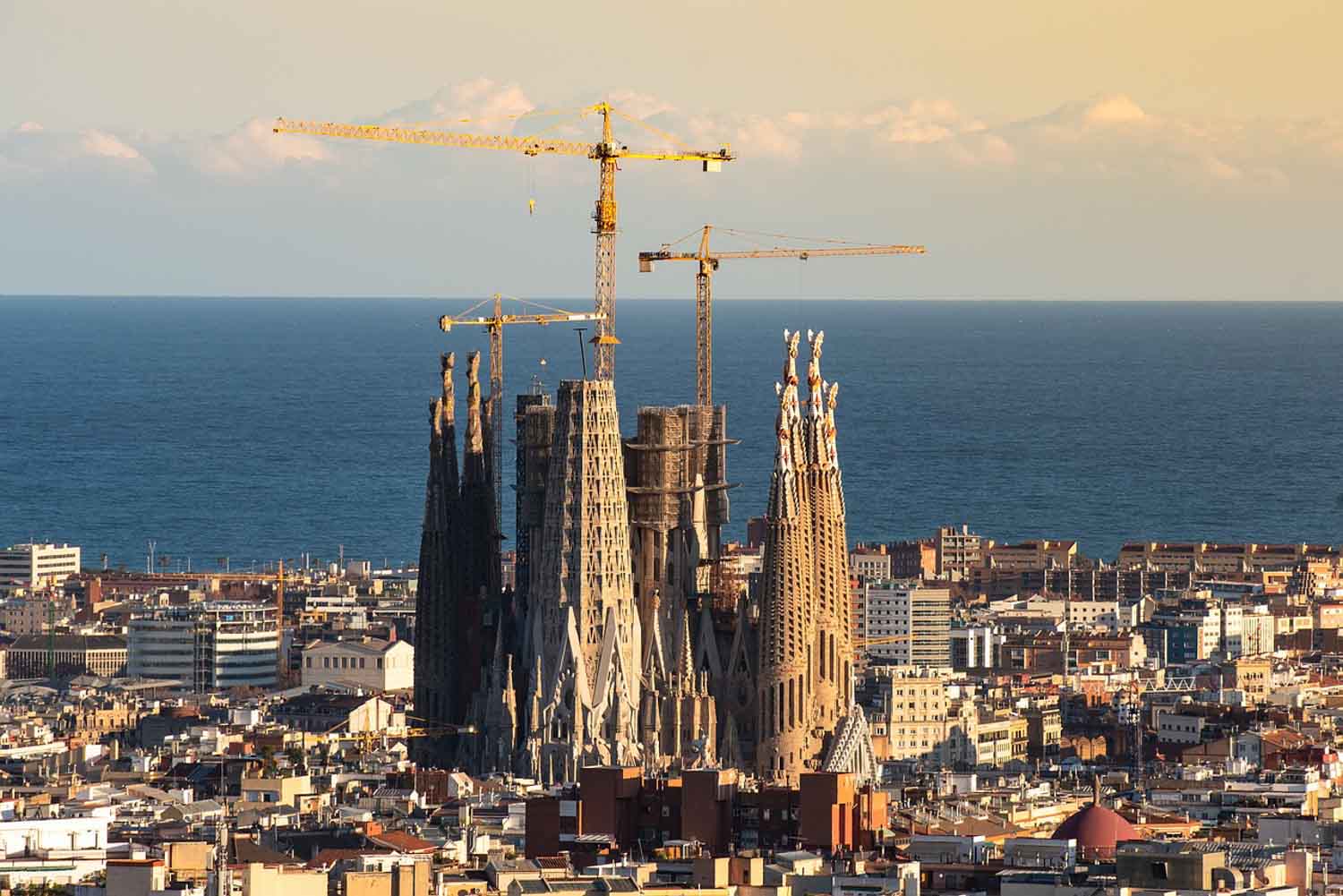
Who Is Gaudi, and What Makes Gaudi Architecture So Distinctive?
Antoni Gaudi was a Catalan architect, born in 1852 and killed by a tram in Barcelona in 1926. He was the defining figure of Catalan Modernism, the Catalan strand of Art Nouveau, and no architect before or since has produced a body of work this recognizable.
If you want the short version of what Gaudi architecture actually is, it comes down to five things:
- Almost no straight lines. Gaudi believed the straight line belonged to people and the curve to God, and he built accordingly. In Casa Batlló you can make a game of trying to find one.
- Structure copied from nature. Columns that branch like trees, ceilings that spiral like shells, balconies shaped like bone and seaweed. He studied how plants and skeletons hold themselves up and then built the same way.
- Trencadis mosaic. The broken-tile surfaces all over Park Güell and Casa Batlló. Cheap, colorful, and completely his.
- Light and color as building material. The interior of the Sagrada Familia changes color through the day because he designed the glass to do it.
- Religion and Catalonia. Catholic symbolism and Catalan identity run through almost everything he made, which is part of why the city has taken such care of it.
Gaudi had rheumatism as a child, which kept him out of the games other children were playing and left him sitting outside drawing for hours on end. He said later that it was where he learned to look at nature properly. You can see that childhood in every building he made.

The 7 Gaudi Buildings in Barcelona With UNESCO World Heritage Status
Seven of Gaudi’s works are inscribed by UNESCO as the Works of Antoni Gaudi, and every one of them is in the province of Barcelona:
- Park Güell
- Palau Güell
- Casa Milà (La Pedrera)
- Casa Vicens
- The Nativity facade and crypt of the Sagrada Familia
- Casa Batlló
- The crypt at Colònia Güell
Five of those sit inside the city and can be done on foot and by metro in a long day. Colònia Güell is a short train ride out of town, and it’s the one most visitors miss.
Gaudi Buildings in Barcelona at a Glance: Prices and Timings
Prices below are 2026 online adult rates and go up at the door. Check the official site before you book, because they move every year.
| Gaudi site | What it is | From (2026) | Give it | Worth it for |
|---|---|---|---|---|
| Sagrada Familia | Basilica, still under construction | €26, or €36 with a tower | 2 to 3 hours | The interior. Nothing prepares you for it |
| Park Güell | Public park with a mosaic monumental zone | €18 | 2 hours | Mosaic, the dragon fountain, views to the sea |
| Casa Batlló | Remodeled townhouse, 1904 to 1906 | €29 | 1.5 hours | The best Gaudi interior you can walk through |
| Casa Milà (La Pedrera) | Apartment building, 1906 to 1912 | €25 | 1.5 hours | The rooftop chimneys and the stone facade |
| Casa Vicens | Gaudi’s first major house, now a museum | €21 | 1 hour | Seeing where the whole style started |
| Gaudí Experiència | 4D film near Park Güell | About €9 | 30 minutes | Kids, and a rainy half hour |
Why a Gaudi Tour Is Worth It When You Visit Barcelona
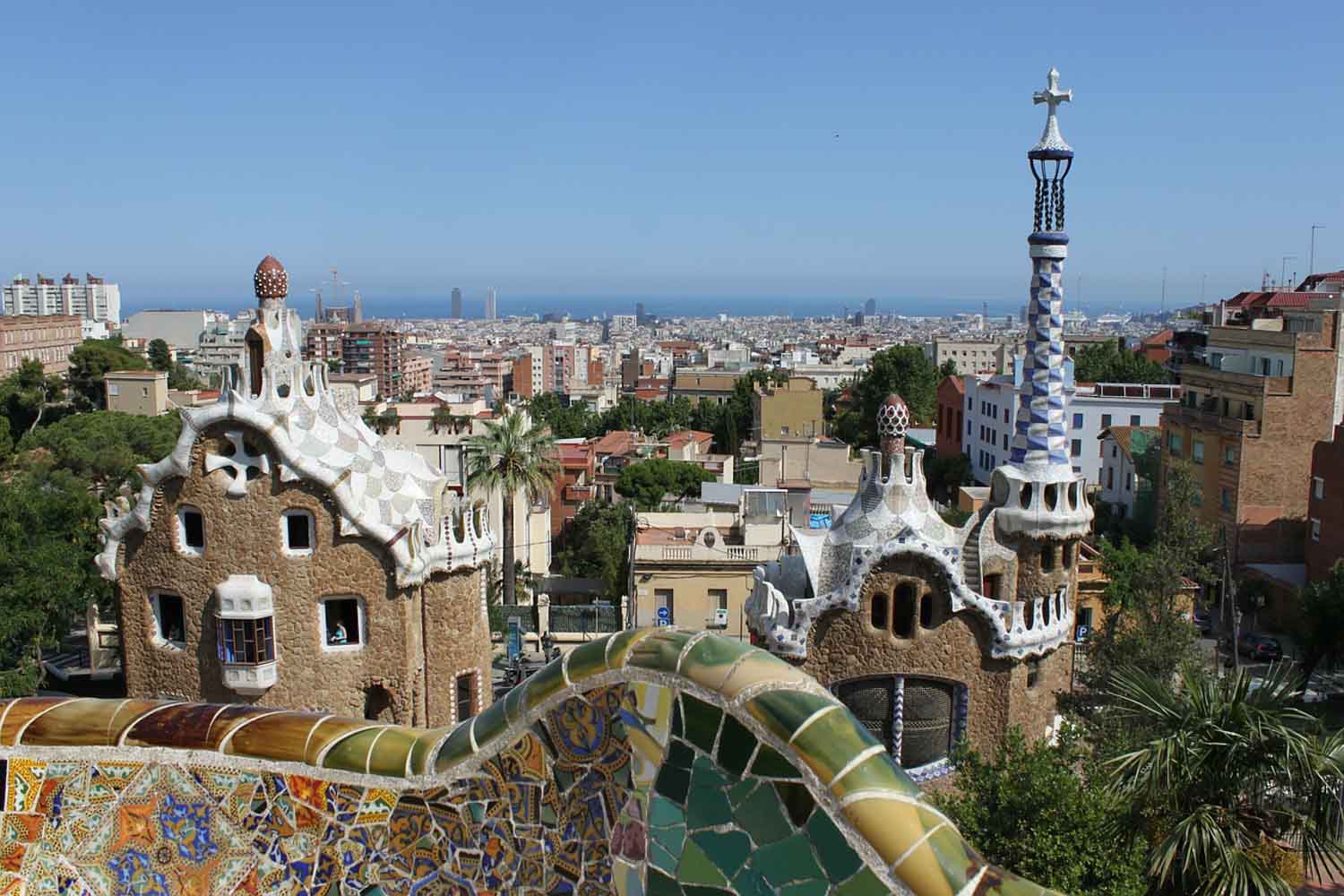
Even on a short trip, see at least two Gaudi buildings rather than one. One gives you a photograph. Two gives you the idea, because you start seeing the same thinking solved in different ways, and that’s where it gets interesting.
His work is also the clearest window into Catalan culture you’ll find in a day. The Catalan flag colors, the national symbolism, the local materials and craftspeople: it’s all deliberate, and a guide will show you things you’d walk straight past.
Fair warning: Gaudi’s buildings are addictive. People come planning to see one and leave having seen four.
Gaudi Tours in Barcelona: Guided Tours, Walking Tours and Skip-the-Line Tickets
A Gaudi tour of Barcelona is the efficient way to do this, because the guide handles the queues and the ticket windows while you look at buildings. These cover the main Gaudi sights and attractions in Barcelona, and these are the ones worth the money:
- Park Güell and Sagrada Familia guided tour, about two and a quarter hours with skip-the-line access to both. The efficient option if Barcelona is one day of a longer trip.
- Complete Gaudi Tour: Sagrada Familia and Park Güell, which adds entry to one of his houses. This is the one I’d pick for a proper day of Gaudi.
- The 3 Gaudi Houses Tour, three hours covering Casa Vicens, Casa Batlló and Casa Milà. The best way to see the houses in sequence and watch the style develop.
- Fast Track Sagrada Familia and Barcelona full-day tour, eight hours taking in the Sagrada Familia, La Pedrera, Park Güell, Montjuïc and the Gothic Quarter. Good if you want the city as well as the architecture.
A Self-Guided Gaudi Tour of Barcelona
Doing it yourself is straightforward, and cheaper. The route that works best geographically is this one:
- Morning: Sagrada Familia, first entry slot, with a tower if you want the view.
- Late morning: metro or a 25-minute stroll to Passeig de Gràcia for Casa Milà and Casa Batlló, which are four blocks apart.
- Lunch: anywhere in the Eixample. You’re surrounded by Modernist facades, so look up.
- Afternoon: Casa Vicens in Gràcia, then uphill to Park Güell for the late light.
Book every timed slot before you leave the hotel. That’s the whole trick.
Where the Gaudi Buildings Are, Neighborhood by Neighborhood
Gaudi’s work isn’t scattered randomly, which is what makes a one-day route possible. The Gaudi places in Barcelona group into three pockets:
- Eixample: Casa Batlló (Passeig de Gràcia 43) and Casa Milà (Passeig de Gràcia 92) are four blocks apart on the same avenue, about 7 minutes on foot. Metro Passeig de Gràcia or Diagonal.
- Sagrada Familia: Carrer de Mallorca 401, its own metro stop, about 20 minutes on foot from Casa Milà.
- Gràcia and the hill: Casa Vicens (Carrer de les Carolines 20), then Park Güell and the Gaudi House Museum above it, with the Gaudi Experiència next door on Carrer de Larrard. Metro Lesseps or Vallcarca, then a climb.
- Off the route: Palau Güell is just off the Ramblas in the Raval, and the crypt at Colònia Güell is a short train ride out of the city.
Do them in that order and you’re never backtracking. We don’t have a drawn map of the Gaudi buildings in Barcelona to hand you, but every address is above and every one of them has a metro stop within a few minutes.
Gaudi’s Sagrada Familia
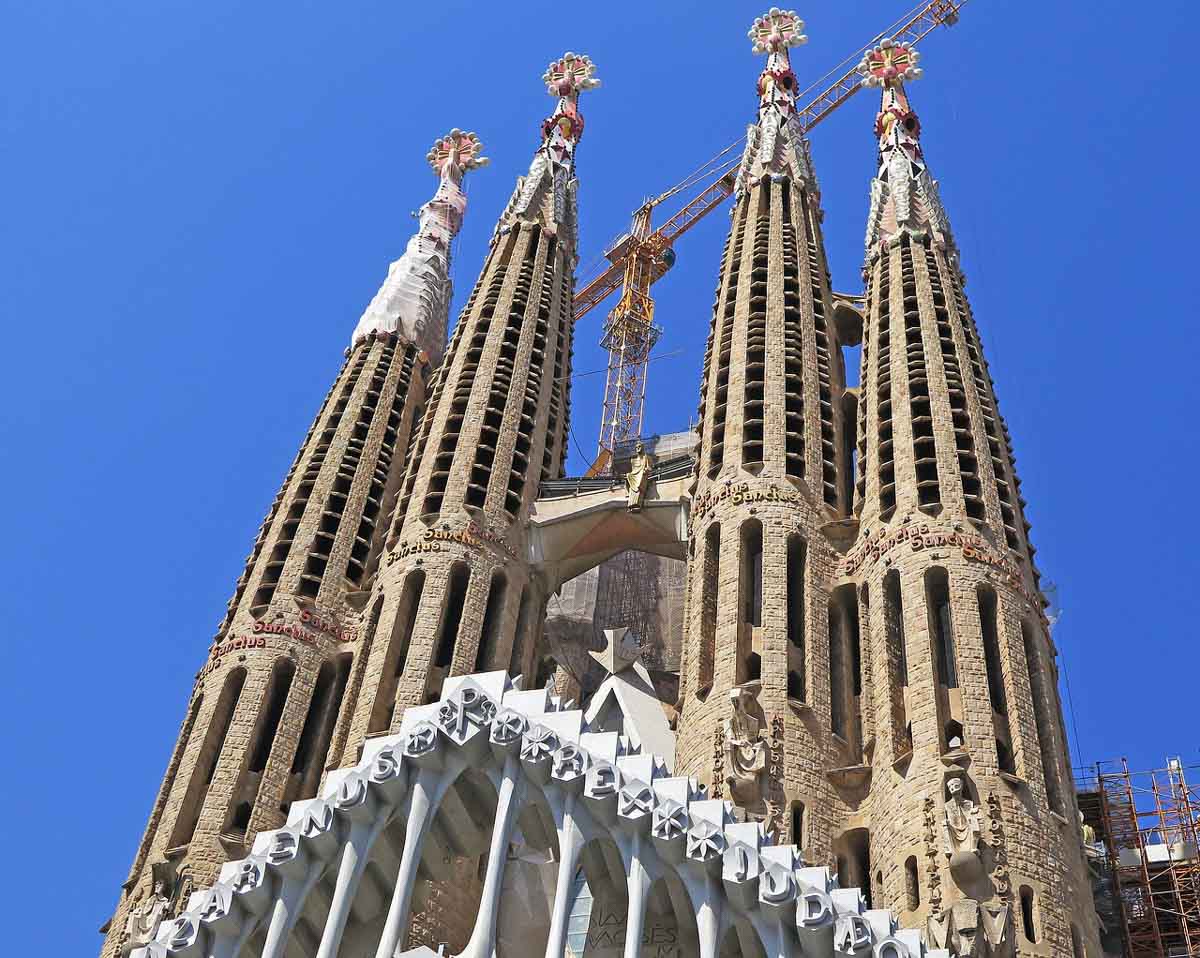
The Sagrada Familia is a Catholic basilica that has been under construction since 1882 and is still not finished, which has become part of its character. It’s the most visited monument in Spain and the most extraordinary personal interpretation of Gothic architecture anyone has attempted since the Middle Ages.
It’s also now the tallest church in the world, having passed Ulm Minster in Germany. The central Tower of Jesus Christ was completed in 2026, the centenary year of Gaudi’s death, taking the basilica to roughly 172 m (564 ft). The interior is due to be finished in 2028, and work on the Glory facade and the decoration will carry on well past that.
Gaudi spent the last years of his life living on the site and is buried in the crypt. When people asked him about the timeline, he reportedly said his client was in no hurry.
Travel Tips for Visiting the Sagrada Familia
Go inside. The facades are famous, but the interior is the reason people come out looking slightly stunned: a forest of branching columns and colored light that shifts from cool to warm as the sun crosses the building. The extra few euros for a tower is money well spent for the view over Barcelona.
Buy ahead. On one visit I arrived 15 minutes before opening and still waited 90 minutes, and the line was longer when I came out. A skip-the-line entry ticket with a guide saves you most of a morning, and in high season tickets sell out two to four weeks out.
If you can time it, visit during La Mercè, Barcelona’s city festival around September 24th, when there’s a light show projected onto the basilica. There are also Christmas concerts inside in December.
Sagrada Familia Location, Opening Hours and Admission
Carrer de Mallorca 401. Open daily from 9:00 am, closing between 6:00 and 8:00 pm depending on the season and always at 6:00 pm on Saturdays. Last entry is 30 minutes before closing. 2026 tickets: €26 for the basilica with the audio guide app, €36 with access to one tower, €30 for a guided tour. Under 11s go free.
Gaudi’s Casa Batlló
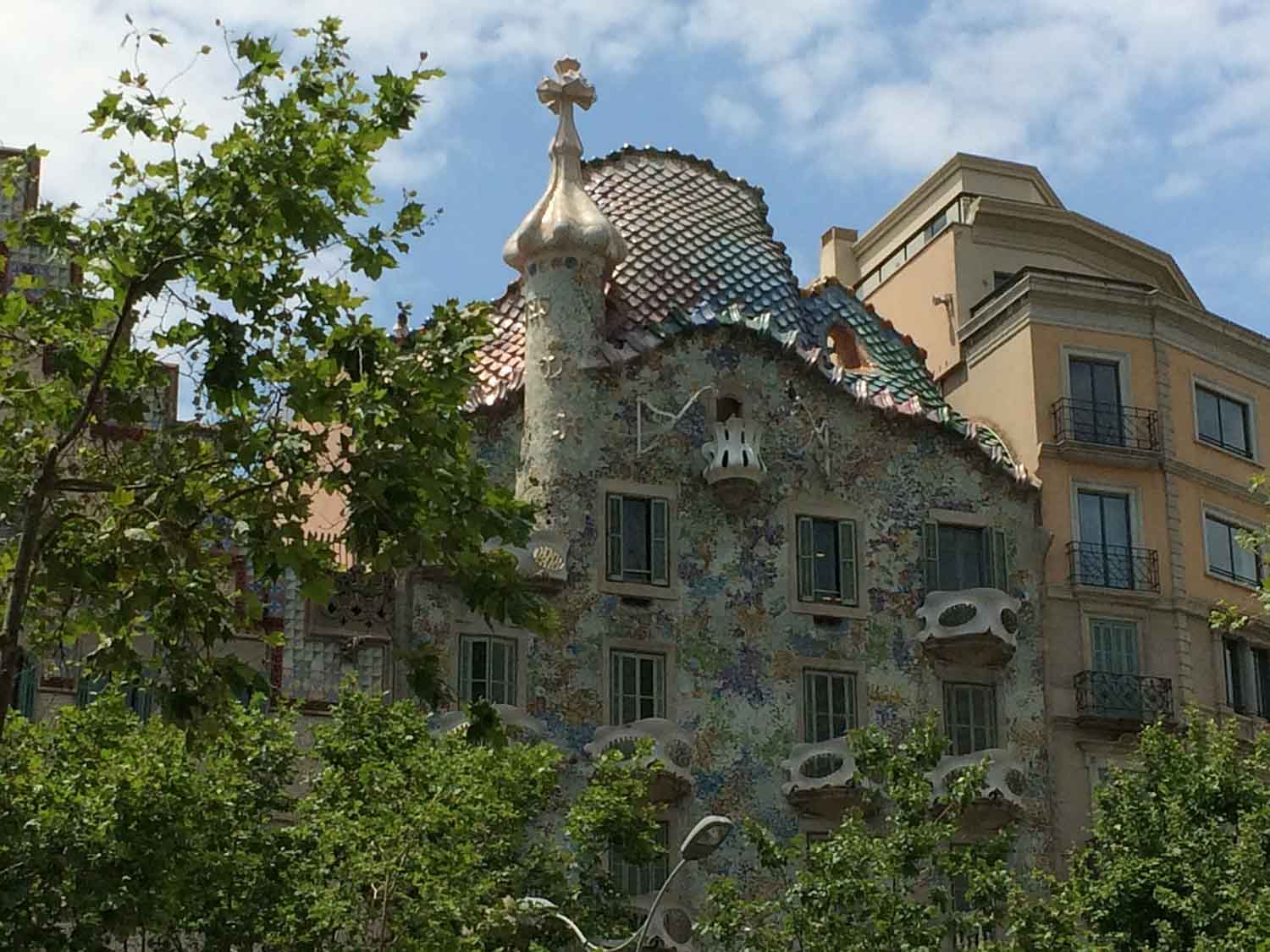
Casa Batlló is my favorite Gaudi house. It was a remodel rather than a new build: the Batllo family handed Gaudi a fairly ordinary house from the 1870s and let him do what he liked with it between 1904 and 1906.
What he did was remove almost every straight line in the place. The facade reads as bone and scale, the roof as the back of a dragon, and the light well is tiled in a gradient of blues so the top and bottom floors get the same quality of light. Try to find a straight line inside. It’s harder than it sounds.
It broke a stack of city building regulations and was deeply controversial. Barcelona came round: in 1906 the city council named it one of the three best buildings of the year, and today it’s a UNESCO World Heritage Site. The rooftop is the best part. There’s also an official virtual tour if you want a look first.

Travel Tip for Visiting Casa Batlló
Lines here swing wildly. On a Saturday in November I was inside in a few minutes. At peak times I’ve waited over an hour. Book a timed ticket in advance and the question never comes up.
If you want all three houses in one go, the 3 Gaudi Houses tour covers Casa Vicens, Casa Batlló and Casa Milà in about three hours with skip-the-line entry, which is less expensive than three separate tickets and far better organized than doing it yourself.
Casa Batlló Location, Opening Hours and Admission
Passeig de Gràcia 43. Open 365 days a year, roughly 8:30 am to 10:30 pm, with last entry an hour before closing. 2026 tickets start at €29 online for the general visit with audio guide, rising to about €43 for the version with the terrace and the extras.
Related reading: a coastal hike in Catalonia, Spain.
Gaudi’s Park Güell

Park Güell is Gaudi at his most playful. It was meant to be a housing estate, it failed commercially, and the city ended up with a park instead, which in hindsight was the better outcome.
You come in past the mosaic dragon fountain, up a staircase into a hall of leaning columns, and out onto a terrace edged by the famous serpentine bench, the longest of its kind in the world and covered end to end in trencadis. From up there Barcelona runs all the way to the sea.
The Gaudi House Museum, Inside Park Güell
Most people walk straight past the one building in Barcelona where Gaudi actually lived. The Gaudi House Museum, Casa Museu Gaudi, sits inside Park Güell, and it was his home from 1906 until the end of 1925. A few months before he died he moved into the workshop at the Sagrada Familia, and the house opened as a museum in 1963.
It holds furniture he designed for Casa Batlló, Casa Milà and Casa Calvet, plus his own rooms more or less as he left them. Entry to the museum on its own is around €7.50, or you can take a combined Park Güell and Gaudi House Museum ticket. For a man whose buildings are this theatrical, the house is startlingly plain, and that contrast is the reason to go in.
Travel Tip for Visiting Park Güell
Entry to the monumental zone used to be free and is now €18, with timed slots and a cap of 1,400 visitors an hour. That cap is why it sells out: book before you go, not at the gate.
Go on a clear day and go early if you’re visiting in summer, both for the light and for the temperature on the terrace. A skip-the-line guided tour is about an hour and gets you the stories behind the symbolism, which you will not get from the signage.
Park Güell Location, Opening Hours and Admission
Carrer d’Olot, 08024 Barcelona. Opens between 8:00 and 9:30 am depending on the season. 2026 adult admission to the monumental zone is €18, with reduced rates for children aged 7 to 12 and over 65s, and free entry under 7. The wider park around the monumental zone is free.
Gaudi’s Casa Milà (La Pedrera)

Casa Milà, known to everyone in Barcelona as La Pedrera, the stone quarry, is the high point of Modernist design and was the last private house Gaudi built. The self-supporting stone facade and the wrought-iron balconies were considered an outrage at the time and are now on every postcard in the city.
It’s an apartment building, and people still live in part of it. Gaudi put the elevators on every second floor on purpose: he thought neighbors ought to pass each other on the stairs and actually speak. The roof terrace, with its helmeted chimney sculptures, is the part everyone photographs.
Travel Tip for Visiting Casa Milà
Both day and night visits are offered, and the night one is the more unusual: projections across the rooftop sculptures, lighting through the stairwells and the Eixample spread out below. A fast-track guided tour is the simplest way in, and the guide matters more here than at the other houses, because most of what’s interesting about this building is structural and invisible until someone points it out.
Casa Milà Location, Opening Hours and Admission
Passeig de Gràcia 92. Open roughly 9:00 am to 8:30 pm, with last entry 30 minutes before closing, and night sessions after that. 2026 tickets start at about €25 online and €29 at the box office, with the night experience and the sunrise tour priced higher.
Gaudi’s Casa Vicens

Casa Vicens was Gaudi’s first important commission, and it’s the one to see if you want to understand where the rest of it came from. The Moorish influence is unmissable, and the detail is relentless: green and white tile below the patios, ironwork modeled on palm fronds, nothing left unconsidered from any angle you might look at it.
For years it was a private residence and all you could do was stand on the street and photograph the outside, which I did, at length. It opened as a museum in 2017, so you can now go in.
Travel Tip for Visiting Casa Vicens
It’s the quietest of the Gaudi houses and the cheapest, which makes it the easiest one to fit into an afternoon. A skip-the-line entrance ticket lets you go at your own pace through the house and the garden.
Casa Vicens Location, Opening Hours and Admission
Carrer de les Carolines 20, in Gràcia. Open daily, 9:30 am to 8:00 pm from April to October and 9:30 am to 6:00 pm from November to March. 2026 tickets start at €21 online, a euro more at the door, and under 10s go free.
Related reading: a day trip to Girona from Barcelona.
The Gaudí Experiència 4D Movie
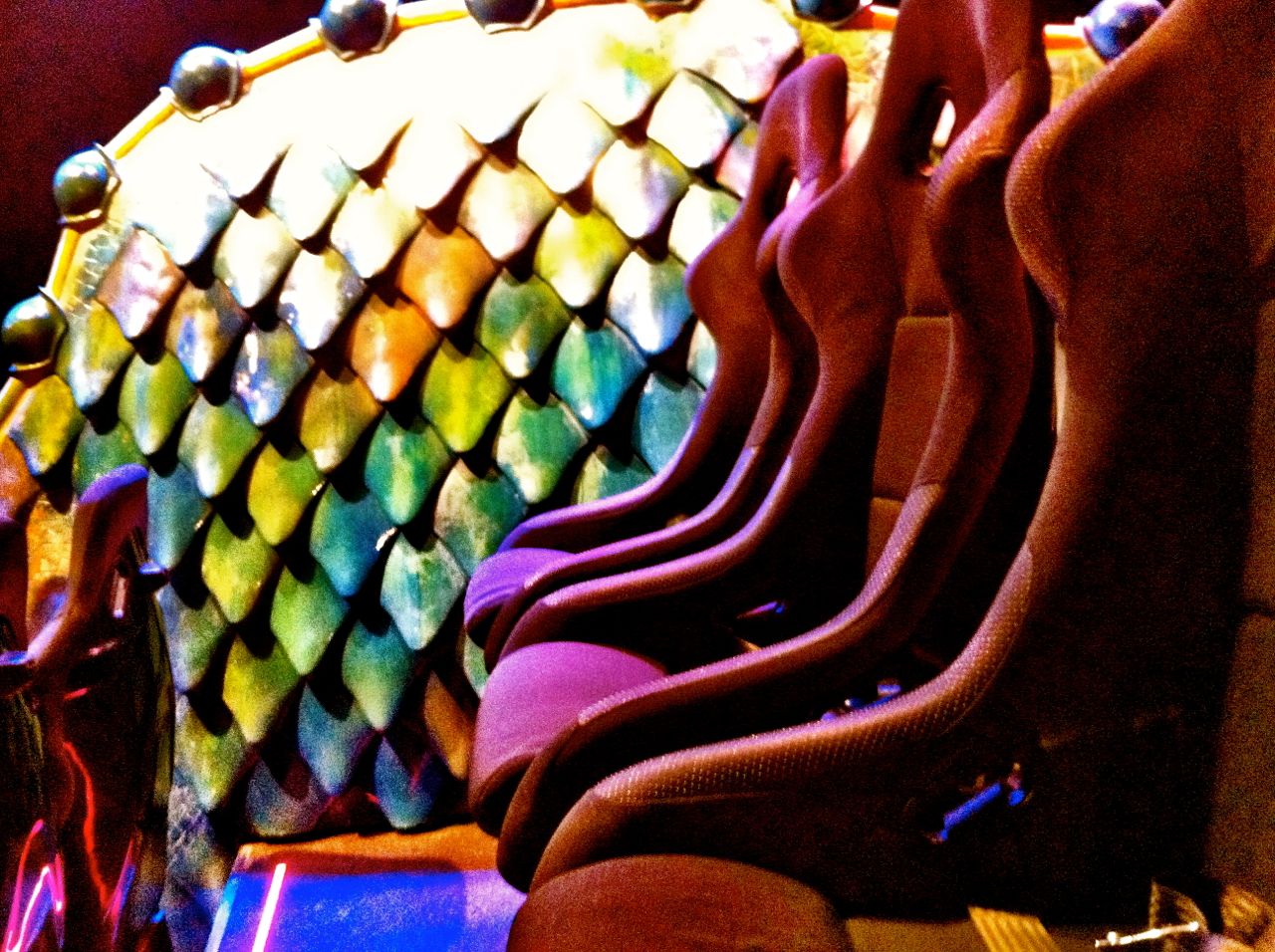
A 10-minute 4D film about Gaudi’s life and work, a few minutes from Park Güell. It’s entertaining, and it was the first time I’ve had to wear a seat belt in a movie theater.
Travel Tip for Visiting the Gaudí Experiència
Pair it with Park Güell, since it’s right there, and book the ticket in advance. It’s a good half hour with kids or in the rain. If you’re counting euros, though, put the money toward going inside one more Gaudi building instead. The real thing wins.
Gaudí Experiència Location, Opening Hours and Admission
Carrer de Larrard 41. October 1 to March 31, 11:30 am to 4:00 pm; April 1 to September 30, 10:30 am to 7:00 pm, with the last show 30 minutes before closing. Tickets about €9.
Where to Stay in Barcelona for Gaudi Architecture

If you’re in Barcelona for the architecture, the Gaudi Hotel is the obvious pick, and not only for the name. Its rooftop terrace looks directly onto Palau Güell, chimneys and all, which is a view you can’t get from the street. Ask for one of the Art Nouveau rooms when you book.
Use the map below to see what else sits near each Gaudi site. Move it toward Passeig de Gràcia for the houses, or toward the basilica for the Sagrada Familia.
After Barcelona: Hiking in Catalonia, Spain and Andorra
Here’s the thing most people don’t realize while they’re standing in line for Casa Batlló: Barcelona is about an hour from some of the best hiking in Spain. Gaudi took his forms from Catalan rock, and you can go see the originals.
- Mountains of Catalonia, an 8-day self-guided tour through three protected ranges that arrives at Montserrat on foot. Montserrat is the serrated massif you can see from Barcelona, and Gaudi worked on its rosary monuments.
- Costa Brava, 8 days of coastal hiking north of Barcelona on old fishermen’s paths, between coves, pine and medieval villages.
- Spanish Pyrenees in Catalonia, high mountain hiking in the Catalan Pyrenees, with lakes, granite and a lot of sky.
- Alpujarras and Sierra Nevada, Granada, at the other end of Spain: white villages on the southern flank of the Sierra Nevada, and the Moorish south that influenced Casa Vicens.
- Andorra, just over the border in the Pyrenees, with glacial lakes, high valleys and a UNESCO World Heritage valley to hike through.
Related reading: Catalonia, Spain: why you need to experience adventure here.
Gaudi in Barcelona FAQs
What is Gaudi architecture?
Gaudi architecture is the style developed by the Catalan architect Antoni Gaudi (1852 to 1926), the leading figure of Catalan Modernism. It’s defined by curved forms instead of straight lines, structures copied from nature such as branching columns and shell-like ceilings, broken-tile mosaic known as trencadis, colored light used as a building material, and Catholic and Catalan symbolism throughout. Seven of his works are UNESCO World Heritage Sites, all of them in the province of Barcelona.
Which Gaudi buildings in Barcelona are worth visiting?
The Gaudi buildings in Barcelona worth visiting are the Sagrada Familia first, then Casa Batlló for the best interior you can walk through, Park Güell for the mosaic and the view over the city, Casa Milà (La Pedrera) for its stone facade and rooftop chimneys, and Casa Vicens for Gaudi’s first major house. If you have only a day, do the Sagrada Familia in the morning and pair Casa Batlló and Casa Milà in the afternoon, since they’re four blocks apart on Passeig de Gràcia.
How much does it cost to visit Gaudi sites in Barcelona?
In 2026 it costs about €26 to enter the Sagrada Familia with an audio guide, or €36 including one tower; €18 for the monumental zone of Park Güell; from €29 online for Casa Batlló; from €25 online for Casa Milà; and from €21 online for Casa Vicens. Combined tickets covering the three Gaudi houses work out cheaper than buying them separately, and every price rises if you buy at the door.
Is the Sagrada Familia finished?
The Sagrada Familia is not completely finished, but it reached a major milestone in 2026: the central Tower of Jesus Christ was completed in the centenary year of Gaudi’s death, bringing the basilica to roughly 172 m (564 ft) and making it the tallest church in the world. The interior is due to be finished in 2028, and work on the Glory facade and the decorative program will continue for years after that. Construction started in 1882.
Do you need to book Gaudi tickets in Barcelona in advance?
You need to book Gaudi tickets in Barcelona in advance, especially in high season. Sagrada Familia tickets commonly sell out two to four weeks ahead, and Park Güell admits only 1,400 visitors an hour on timed slots, so walk-up entry is often impossible. Casa Batlló and Casa Milà both use timed entry too. Booking ahead is what makes it realistic to see three or four Gaudi buildings in one day instead of one.
How many Gaudi buildings are UNESCO World Heritage Sites?
Seven Gaudi works are UNESCO World Heritage Sites, inscribed as the Works of Antoni Gaudi: Park Güell, Palau Güell, Casa Milà, Casa Vicens, the Nativity facade and crypt of the Sagrada Familia, Casa Batlló, and the crypt at Colònia Güell. All seven are in the province of Barcelona, and five of them are inside the city itself and can be seen on foot and by metro in a long day.
Is the Sagrada Familia the cathedral of Barcelona?
The Sagrada Familia is not the cathedral of Barcelona. It is a basilica, a title Pope Benedict XVI gave it in 2010, and it has never been the seat of the city’s bishop. Barcelona’s actual cathedral is the Catedral de Barcelona in the Gothic Quarter, a 13th to 15th century Gothic building with no connection to Gaudi. Almost everyone searching for the Gaudi cathedral in Barcelona means the Sagrada Familia, so if that is what you are looking for, you are in the right place.
Is there a Gaudi pass for Barcelona that covers all the sites?
There is no single Gaudi pass in Barcelona that covers every site, because the buildings are run by different owners. What does exist is combined tickets: the three Gaudi houses (Casa Batlló, Casa Milà and Casa Vicens) can be bought together for less than three separate tickets, and Park Güell pairs with the Gaudi House Museum on one ticket. The Sagrada Familia always sells its own. Buying the combinations that exist saves money and, more usefully, locks in your timed slots.
Is a Gaudi tour of Barcelona worth it, or should you go on your own?
A Gaudi tour of Barcelona is worth it if your time is tight, because the guide handles the queues and the ticket windows and you get the Catalan symbolism that the signage leaves out. Going on your own is cheaper and works fine if you book every timed slot in advance. The middle route most people take: a guided tour for the Sagrada Familia and Park Güell, where the lines are worst, and the houses on Passeig de Gràcia on your own with skip-the-line tickets.
How long do you need to see Gaudi architecture in Barcelona?
You need one full day to see the main Gaudi architecture in Barcelona and two days to do it comfortably. Allow 2 to 3 hours for the Sagrada Familia, 2 hours for Park Güell, and about 1.5 hours each for Casa Batlló and Casa Milà, plus an hour for Casa Vicens. Travel between them is short, since Casa Batlló and Casa Milà are four blocks apart and Casa Vicens and Park Güell are both in Gràcia.
Is Barcelona a good base for hiking in Catalonia?
Barcelona is an excellent base for hiking in Catalonia, with trails starting about an hour outside the city. Montserrat, the serrated massif visible from Barcelona on a clear day, is reachable by train and rack railway. For something longer, the Monkeys and Mountains Mountains of Catalonia hiking tour is an 8-day self-guided trip through three protected ranges that arrives at Montserrat on foot, and the Costa Brava tour hikes the coast north of the city.
Gaudi was genuinely one of a kind, and a century after his death his buildings still don’t look like anyone else’s. See one and you’ll want the rest. That’s the whole problem with Barcelona.

Thank you to Vueling and NH Calderon for hosting me in Barcelona.