Montserrat is the serrated pink massif you can see from Barcelona on a clear day, and it’s the rare famous mountain where the trails start a few minutes past where the train sets you down. That’s the whole appeal of a Barcelona Montserrat hike: you can do the entire day on public transportation. Train, rack railway, boots on.
It’s also a mountain that rewards you for going a little further than the monastery terrace. Hiking Montserrat can mean a 25-minute out-and-back under the cliffs, or a 7 km (4.3 miles) climb to Sant Jeroni at 1,236 m (4,055 ft) with the whole of Catalonia laid out below you and the Pyrenees on the skyline. Here’s how to get there, which trails are worth your day, and what else is waiting at the top.
TL;DR
A Montserrat hike is the easiest big mountain day you can have from Barcelona. Take the FGC R5 train from Barcelona-Plaça Espanya, about an hour to the foot of the mountain, then the rack railway or the cable car up to the monastery. Every marked trail starts from there.
The classic route
Monastery to Sant Jeroni, the highest point of the massif at 1,236 m (4,055 ft). The official route from the Montserrat mountain trust is 7 km (4.3 miles) and about 2 hours 30 minutes, graded moderate, using the Sant Joan funicular for the first climb.
The short one
Camí dels Degotalls, 1.6 km (1 mile) and 25 minutes each way, flat, easy, and straight under the cliffs. The Santa Cova path is the other short classic, with modernista rosary monuments by Gaudí and Puig i Cadafalch along it.
The long one
The GR 6 from Barcelona to the monastery, 57 km (35.4 miles) in three stages, finishing with a 15 km (9.3 miles) day and 1,216 m (3,990 ft) of climbing out of Olesa de Montserrat.
What to do at Montserrat besides hiking
The Benedictine monastery founded in 1025, the Black Madonna, the Escolania boys’ choir, and the museum. Most people give it a morning. It deserves one.
If a day isn’t enough (and trust us, it isn’t)
Our Mountains of Catalonia hiking tour spends eight days crossing three protected ranges and arrives at Montserrat on foot on Day 7, then sleeps in the monastery grounds.
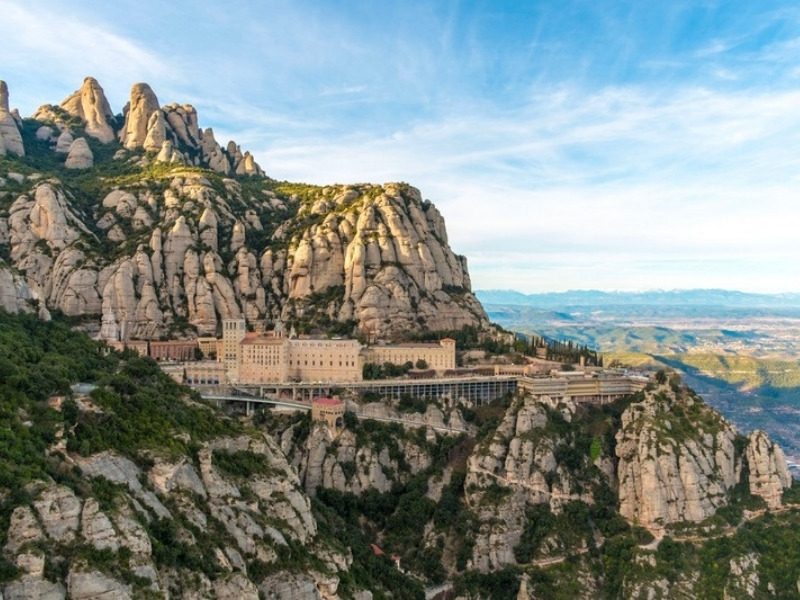
What to Do at Montserrat: the Monastery, the Rock Towers and the Trails
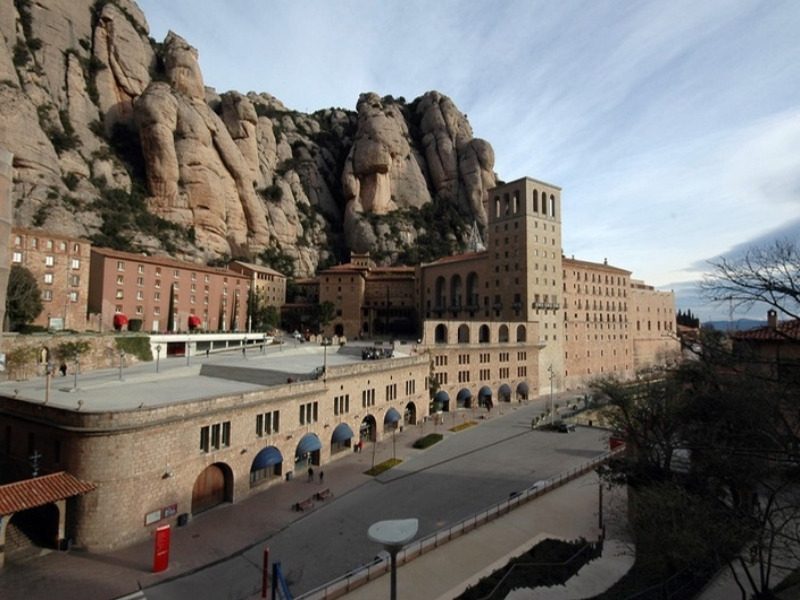
Montserrat means “serrated mountain” in Catalan, which is the most literal place name in Spain. It’s a single lump of pink conglomerate rock that has weathered into hundreds of rounded stone fingers, standing straight up out of otherwise flat farmland. Wedged into a ledge halfway up it is a Benedictine monastery founded in 1025 by Abbot Oliba, and that combination is why the mountain gets the visitors it does.
So when people ask what to do in Montserrat, the honest answer is that there are two mountains here and you want both. There’s the monastery complex, which takes a comfortable morning, and there’s the trail network above it, which can take anything from half an hour to a full day.
At the monastery: the basilica, with its single nave 68.32 m (224 ft) long and 33.33 m (109 ft) high, and the Virgin of Montserrat, the dark-wood statue known as La Moreneta that people line up to file past. Legend puts her discovery in a cave on the mountain around 880. There’s also the Escolania, the monastery’s boys’ choir, which has been singing here for seven hundred years and still sings in the basilica. The schedule shifts through the year, so check it before you build your day around it. And there’s the Museum of Montserrat, plus a very good market of local cheese and honey outside.
On the mountain: the whole massif has been a protected natural park since 1987, and it’s laced with marked paths that connect the ruins of medieval hermitages perched in improbable places. Sant Jeroni is the summit at 1,236 m (4,055 ft). El Cavall Bernat, 1,111 m (3,645 ft), is the free-standing rock tower that climbers have been testing themselves on since the 1930s. Montgrós is 1,120 m (3,675 ft), and Les Agulles, “the needles”, top out at 903 m (2,963 ft).
Here’s the thing worth knowing before you go: most visitors see Montserrat from the monastery square and the viewpoint beside it. The trails start just past that, and within ten minutes of setting off you’ve got the rock towers to yourself. It’s one of the best value-for-effort ratios of any mountain in Europe.
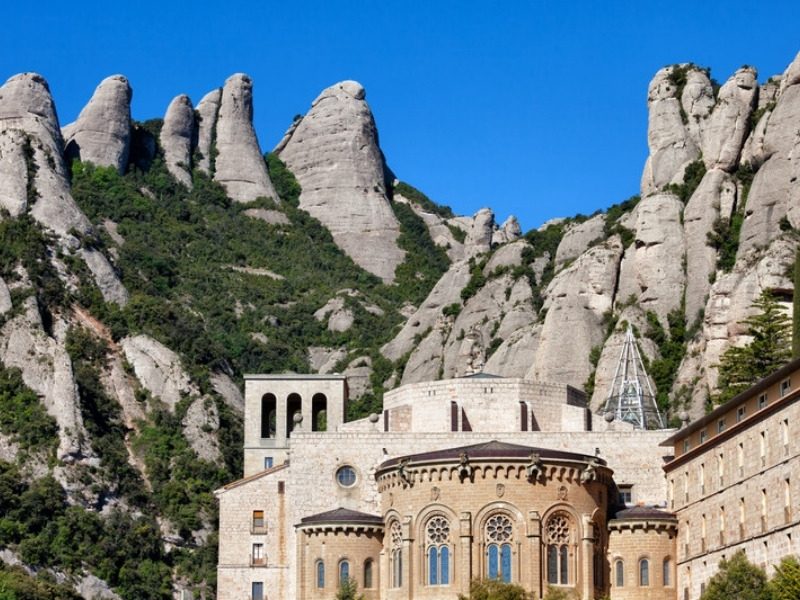
Getting to Montserrat From Barcelona for a Hike: Train, Rack Railway and Cable Car
You don’t need a rental car for this one. The Montserrat Barcelona hike works on public transportation better than almost any mountain day in Europe.
Take the FGC R5 line toward Manresa from Barcelona-Plaça Espanya. Trains run roughly hourly, with the first at 8:26 am, and it’s about an hour to the foot of the mountain. Then you pick your way up:
| Way up | Get off the R5 at | How it goes |
|---|---|---|
| Rack railway (Cremallera) | Monistrol de Montserrat | 5 km (3.1 miles) and 15 minutes, climbing more than 600 m (1,969 ft) to the monastery. Departures every 20 minutes from Monistrol Vila. There’s a free 900-space parking lot at the station if you do drive. |
| Cable car (Aeri) | Montserrat-Aeri | About 5 minutes straight up the cliff face. It opened in 1930, which makes it the oldest cable car in Spain and the most characterful way to arrive. |
| On foot over six days, with us | We pick you up | The longest way in, and the only one that ends with a night on the mountain. Six hiking days from Viladrau, arriving at the monastery on foot on Day 7. Full route below. |
| On foot from Monistrol | Monistrol de Montserrat | The Camí de les Canals i de l’Aigua (GR 5 and GR 96) is the historic Montserrat pilgrimage path. The Drecera dels Tres Quarts climbs over 525 m (1,722 ft). PR-C 19 follows stretches of the old Royal Road. |
| On foot from Collbató | Not on the R5 | The Coves del Salnitre route climbs about 250 m (820 ft) and passes the Salnitre caves. The Graus, Voltes and Sant Miquel paths climb over 450 m (1,476 ft) on the traditional route up to the sanctuary. |
The two funiculars on the mountain itself are separate again, and they’re the reason a Montserrat mountain hike can be as short or long as you like. The Sant Joan funicular climbs 248 m (814 ft) in 503 m (1,650 ft) of track at a maximum gradient of 65.2%, making it the steepest funicular in Spain. It takes six minutes, it’s been running since 1918, and it hands you the first climb of the Sant Jeroni route for free. The Santa Cova funicular goes the other way, dropping 118 m (387 ft) in 262 m (860 ft) of track in about two and a half minutes, and it’s been in service since 1929.
The One Hotel in Montserrat, Spain: Where to Stay on the Mountain
Almost everybody rides back down to Barcelona, which is 50 km (31 miles) away. Stay instead and you get the mountain in the evening light and again at breakfast, before the first rack railway of the day arrives. There is exactly one Montserrat Spain hotel actually on the mountain, and the other hotels in Montserrat, Spain sit down in the valley towns below it.
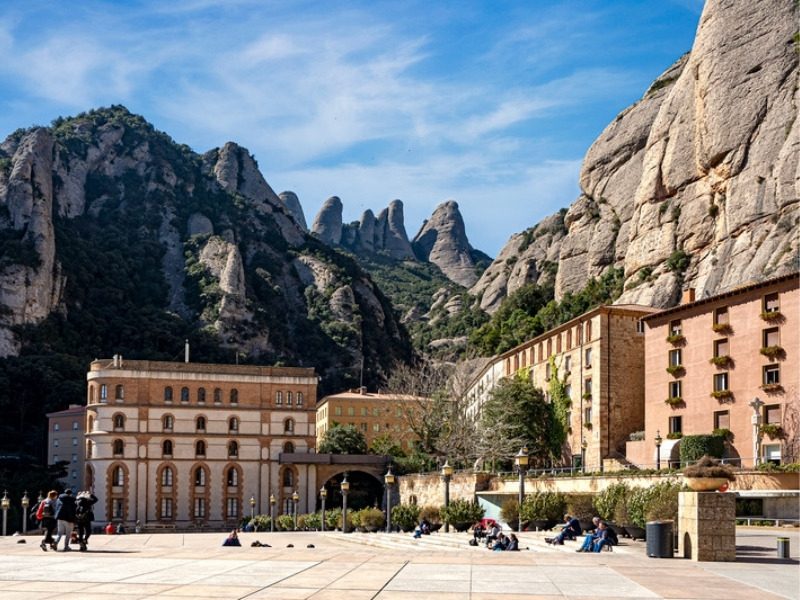
The Best Montserrat Hikes, Trail by Trail
Five routes, from 25 minutes to three days. Every one of them starts from the monastery except the last.
Sant Jeroni: the Highest Point of the Montserrat Massif (1,236 m / 4,055 ft)
Sant Jeroni is the summit, and it’s the one to do if you’re doing one. Unusually for Montserrat, it isn’t a rock spire that needs ropes: it’s a proper hiking summit with a marked path to the top and a viewing platform on it. On a clear day you can see across the Catalan lowlands to the Pyrenees.
The official route published by the Montserrat mountain trust is 7 km (4.3 miles), about 2 hours 30 minutes, graded moderate. It takes the Sant Joan funicular up to Pla de les Taràntules, then follows marked paths past the rock formations called Les Gorres and the Serra de les Paparres and Mossèn Cinto viewpoints, crosses the Santa Maria stream, and reaches the Sant Jeroni chapel just below the summit. You can come back the same way, or take Sant Jeroni’s old path all the way down to the monastery, which is longer and much nicer.
Skip the funicular and hike the whole thing from the monastery and you get a longer day with a good deal more climbing, which is the version that earns the summit photo. Our free 6-week hiking training plan is built for exactly this kind of ascent, even if you live somewhere flat as a table.
Camí de les Ermites: a 7 km (4.3 miles) Montserrat Hike Past the Hermitages
The hermitages route is the one people underrate. It’s 7 km (4.3 miles), about 2 hours, graded low difficulty, and it strings together the strange little buildings that monks wedged into the rock over the centuries.
It starts at the Abat Oliba apartments and climbs a paved road past the lower Sant Joan funicular station to the Sant Miquel chapel. About twenty minutes in you reach the Sant Miquel cross viewpoint, which is the postcard shot of the monastery from above and costs you almost nothing to get to. From there it continues to Pla de Sant Miquel, where paths branch off toward Santa Cova and Les Bateries, then climbs steeply to Pla de les Taràntules and the Nature Hall. Bear left for the Sant Joan chapel, and if you keep going you reach the remains of the old Sant Joan and Sant Onofre hermitages, both built into a long crack in the rock. Come back the way you came or take the funicular down.
Santa Cova: the Short Montserrat Hike With Gaudí On It
The Santa Cova is the cave where, according to the legend, shepherds found the Virgin of Montserrat around 880. The path down to it, the Camí de la Santa Cova, was cut along the ridge between 1691 and 1704, which makes it older than most countries.
What makes it worth an hour of your day is what happened later. Between 1896 and 1916 a series of sculptures went up along the path, one for each of the fifteen mysteries of the rosary, and the artists included Antoni Gaudí and Josep Puig i Cadafalch. So you get modernista sculpture, a thousand-year-old legend and a cliff-edge path, all within sight of the monastery. Take the Santa Cova funicular back up if your legs have opinions.
Camí dels Degotalls: the Easiest Hiking Trail at Montserrat
If you have an hour and you’d rather save your legs, this is the one. The Camí dels Degotalls is 1.6 km (1 mile) and about 25 minutes each way, graded low, running out from the monastery along the base of the walls that drop from the Pla de la Trinitat.
The name comes from the water that seeps continuously through the limestone and drips off the rock at certain points along the path, which is both the explanation and the whole experience. There are monuments to Catalan figures and ceramic tiles of Marian devotions set along it, and the woodland is oak with boxwood and hawthorn, so it’s shaded and cool. Perfect for a first afternoon, for hiking in Montserrat with kids, or for the flat recovery hike after Sant Jeroni.
GR 6: Hiking Montserrat From Barcelona the Long Way, in Three Days
You can also hike to Montserrat from Barcelona itself. The GR 6, marked as the Montserrat Trail, runs 57 km (35.4 miles) in three stages from the Horta Labyrinth in Barcelona to the monastery door, signed with the standard red and white GR waymarks:
- Stage 1: Horta Labyrinth to Les Fonts, 22.3 km (13.9 miles), +601 m (1,972 ft) / -564 m (1,850 ft)
- Stage 2: Les Fonts to Olesa de Montserrat, 19.9 km (12.4 miles), +800 m (2,625 ft) / -904 m (2,966 ft)
- Stage 3: Olesa de Montserrat to the Montserrat monastery, 15 km (9.3 miles), +1,216 m (3,990 ft) / -602 m (1,975 ft)
Stage 3 is the one that earns the arrival: 1,216 m (3,990 ft) of climbing in 15 km (9.3 miles), finishing on the mountain itself. The route crosses four counties and passes Sant Cugat monastery and the Salnitre caves at Collbató on the way. If you have one day and you want the big finish, start at Olesa de Montserrat and do stage 3 on its own.
Worth knowing: “camí de Montserrat” turns up a lot in Catalan signage and it isn’t one single trail. Several historic pilgrim routes converge on the mountain, including the stretch that pilgrims on the Catalan Way to Santiago have used for centuries, and the GR 5 and GR 96 paths up from Monistrol. Check which one your route notes mean before you commit to a day.
Hike In to Montserrat Over Six Days: Our Mountains of Catalonia Tour
The GR 6 comes in from Barcelona. Our Mountains of Catalonia hiking tour comes in from the other side, and it’s the longest way there is to arrive at Montserrat on foot: 6 hiking days from Viladrau in the Montseny UNESCO Biosphere Reserve, over the Cingles de Bertí cliffs and through Sant Llorenç del Munt, 117.5 km (73 miles) with 4,549 m (14,925 ft) of climbing.
Day 7 is the Montserrat day: 17 km (10.6 miles) with 831 m (2,726 ft) of ascent, climbing past El Cavall Bernat and reaching the monastery from the back, on stone worn smooth by a thousand years of pilgrims. Then you stay the night in the monastery grounds, with the rock towers lit and the mountain to yourself. If you’d rather a shorter day, take the train from Monistrol de Montserrat and hike the final 12 km (7.5 miles).
It’s self-guided and 8 days in total. We book all 7 nights, move your luggage between them and meet you in person on Day 1, and it starts from €1045 per person for 2027. Every booking includes a free custom training plan built for this route and your current fitness.
Hiking Trails at Montserrat, Spain: What the Terrain Is Actually Like
The Montserrat Spain hiking trails are grippy conglomerate and well-marked paths, and hiking Montserrat, Barcelona’s closest real mountain, is a lot more approachable than that skyline suggests. Here’s what you’re actually dealing with.
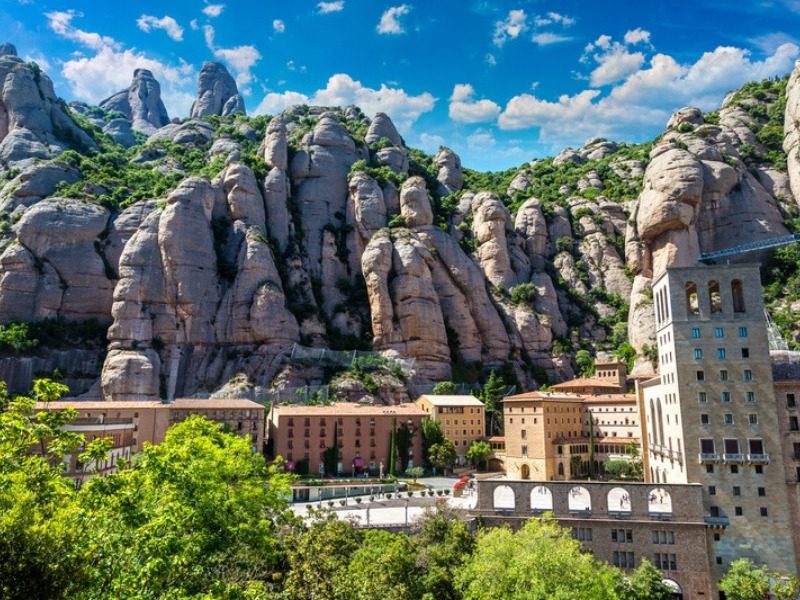
The rock is conglomerate, pebbles cemented together by calcite, which weathers into those rounded fingers rather than sharp alpine ridges. Underfoot it means grippy, knobbly stone on the climbs and worn-smooth stone on the old paved sections, where a thousand years of pilgrims have polished it. Poles help on the descents.
Everything is marked. The main routes carry PR waymarks, the long-distance paths carry GR red and white, and junctions are signed. This is a hikeable mountain with an official park behind it, so navigation is straightforward.
The ascents are short and satisfying. The monastery already sits partway up, so the summit day gains a few hundred meters rather than a few thousand, and you’re on top before lunch. Large stretches of the upper mountain are open rock with holm oak scrub, so this is sunshine hiking in Mediterranean Catalonia. Carry plenty of water and you’ll love it.
It’s a natural park, declared in 1987, with a nature reserve at its core. Stay on the marked paths, which is also simply the best way to see it.
A Montserrat Hiking Map and How to Plan Your Route
You want a Montserrat hiking map for two reasons: the junctions come thick and fast on the upper mountain, and the funiculars change what’s possible in a day.
Start with the official one. The Montserrat mountain trust’s own visitor site publishes the marked itineraries and the access routes on foot from Monistrol and Collbató, and it’s the source we’d trust over any aggregator. Print or screenshot what you need before you set off, since the far side of the massif is out of phone signal.
Then build the day backward from your last train. A workable first visit looks like this:
- Arrive on the R5, up by rack railway or cable car
- Sant Joan funicular up, hike to Sant Jeroni and back down the old path to the monastery (the official 7 km / 4.3 miles route, about 2 hours 30 minutes, plus your stops)
- Monastery, basilica and the Escolania if the timing lands
- Camí dels Degotalls or the Santa Cova path with whatever is left
That’s a full, satisfying day of hiking in Montserrat, Spain, and you’ll be back in Barcelona for a late dinner, which is the only kind Barcelona serves anyway.
The Best Time for a Montserrat Mountain Hike
Spring and fall are the sweet spot for a Montserrat hike. Spain’s Mediterranean side runs warm and dry well into October, and Catalonia’s shoulder seasons give you comfortable temperatures on exposed rock, long enough daylight for a summit and a monastery in the same day, and the clearest air for the Pyrenees view from Sant Jeroni.
Midsummer is hot and the upper trails are open to the sun, so start early, carry plenty of water and save the Degotalls path for the afternoon shade. Winter is genuinely good here: the mountain is low enough that snow is rare, and the light on pink conglomerate in January is something else. Days are shorter, so check the last train before you plan the route.
More Self-Guided Hiking Tours in Catalonia and Spain
Montserrat is one day in one corner of Catalonia. Here are four more self-guided weeks from the same part of the map:
Not sure which one fits? Our free AI Hike Finder asks about your fitness, your dates and the scenery you’re after, and matches you to a route in a few minutes instead of a few weekends.
Hiking Montserrat From Barcelona: FAQs
How do you get from Barcelona to Montserrat for a hike?
To get from Barcelona to Montserrat for a hike, take the FGC R5 line toward Manresa from Barcelona-Plaça Espanya station. Trains run roughly hourly, with the first at 8:26 am, and the journey to the foot of the mountain takes about an hour. From there you either stay on to Monistrol de Montserrat and take the rack railway, which covers 5 km (3.1 miles) and more than 600 m (1,969 ft) of ascent in 15 minutes with departures every 20 minutes from Monistrol Vila, or get off at Montserrat-Aeri for the cable car, which takes about 5 minutes and has been running since 1930. Every marked hiking trail starts from the monastery at the top.
How long is the Montserrat hike to Sant Jeroni?
The Montserrat hike to Sant Jeroni is 7 km (4.3 miles) and takes about 2 hours 30 minutes on the official route published by the Montserrat mountain trust, graded moderate. That route uses the Sant Joan funicular for the first climb, starting from Pla de les Taràntules and following marked paths past Les Gorres and the Mossèn Cinto viewpoint to the summit at 1,236 m (4,055 ft). Add time if you hike up from the monastery instead of taking the funicular, and add time again for the old path descent, which is longer than the direct return but considerably more enjoyable.
How hard is hiking Montserrat, and do you need to be fit?
Hiking Montserrat is moderate rather than hard, and normal hiking fitness is enough for the main routes. The monastery already sits partway up the mountain, so the summit route to Sant Jeroni gains a few hundred meters rather than a few thousand, and the official grading for it is moderate. Large stretches of the upper mountain are open conglomerate rock with holm oak scrub, so it is sunny hiking and worth carrying plenty of water. If you want an easy option, the Camí dels Degotalls is 1.6 km (1 mile), 25 minutes each way and graded low.
Do you need a guide to hike the Montserrat hiking trails?
You don’t need a guide to hike the Montserrat hiking trails. The main routes are waymarked with PR markers, the long-distance paths through the massif carry the red and white GR waymarks, and junctions are signed, because the mountain has been a protected natural park since 1987 with a trust maintaining the paths. Download or print the official itineraries before you go, since the far side of the massif is out of phone signal, and stay on the marked paths inside the nature reserve.
What is the best hiking trail at Montserrat for a first visit?
The best hiking trail at Montserrat for a first visit is the route to Sant Jeroni, the highest point of the massif at 1,236 m (4,055 ft), because it’s the only summit on the mountain reachable on a marked hiking path rather than by climbing. At 7 km (4.3 miles) and about 2 hours 30 minutes it also leaves you most of a day for the monastery. If you have less time, the Camí de les Ermites is 7 km (4.3 miles) and about 2 hours at low difficulty and takes you past the old hermitages, and the Sant Miquel cross viewpoint on it is only about twenty minutes from the start.
Can you hike up to Montserrat instead of taking the rack railway or cable car?
Yes, you can hike up to Montserrat instead of taking the rack railway or cable car, and there are marked routes from both sides. From Monistrol de Montserrat the Camí de les Canals i de l’Aigua follows the GR 5 and GR 96 and is the historic Montserrat pilgrimage path, the Drecera dels Tres Quarts climbs over 525 m (1,722 ft), and PR-C 19 follows stretches of the old Royal Road. From Collbató, the Coves del Salnitre route climbs about 250 m (820 ft) past the Salnitre caves, and the Graus, Voltes and Sant Miquel paths climb over 450 m (1,476 ft). For a much longer approach, the GR 6 runs 57 km (35.4 miles) from the Horta Labyrinth in Barcelona to the monastery in three stages.
What is there to do at Montserrat besides hiking?
Besides hiking, what there is to do at Montserrat is the Benedictine monastery founded in 1025 by Abbot Oliba, the basilica with its single nave 68.32 m (224 ft) long and 33.33 m (109 ft) high, and the Virgin of Montserrat, the dark statue known as La Moreneta that legend says was found in a cave on the mountain around 880. The Escolania, the monastery’s boys’ choir, has been singing here for seven hundred years and still sings in the basilica, though the schedule shifts through the year, so check it before you go. There is also the Museum of Montserrat and a market of local cheese and honey in the square.
Is there a hotel in Montserrat, Spain, up at the monastery?
Yes, there is one hotel in Montserrat, Spain, on the mountain itself: Hotel Abat Cisneros Montserrat, in the monastery square about 200 m (660 ft) from the basilica, in a building dating from 1563. It sits inside the Montserrat Natural Park, with views over the mountains and the Llobregat valley, a restaurant, a bar and 24-hour reception, and guests rate it 9.6 out of 10 for location. Every other option is down in Monistrol de Montserrat, Collbató or along the R5 line toward Barcelona, 50 km (31 miles) away.
Is Montserrat worth visiting on a trip to Barcelona?
Montserrat is worth visiting on a trip to Barcelona, and it is the easiest big mountain day you can have from the city: about an hour on the FGC R5 train, then a rack railway or cable car to the monastery, where every marked trail starts. You get a Benedictine monastery founded in 1025, the Black Madonna and the Escolania choir, and a summit at Sant Jeroni, 1,236 m (4,055 ft), reachable on a marked path in about 2 hours 30 minutes. Few mountains in Europe give back that much for that little travel.
Is there a multi-day hiking tour in Catalonia that finishes at Montserrat?
Yes. The Monkeys and Mountains Mountains of Catalonia hiking tour is a self-guided 8-day trip that finishes at Montserrat, with 6 hiking days covering 117.5 km (73 miles) and 4,549 m (14,925 ft) of climbing across three protected ranges, starting in the Montseny UNESCO Biosphere Reserve. On Day 7 you hike 17 km (10.6 miles) with 831 m (2,726 ft) of ascent and arrive at the monastery on foot from the far side, then stay the night in the monastery grounds. We book all 7 nights, move your luggage between them and meet you in person on Day 1, and the tour starts from €1045 per person for 2027.
When is the best time of year to hike Montserrat in Spain?
The best time of year to hike Montserrat in Spain is spring or fall, when temperatures on the exposed conglomerate rock are comfortable, daylight is long enough for a summit and the monastery in one day, and the air is clearest for the Pyrenees view from Sant Jeroni. Midsummer is hot with the upper trails open to the sun, so start early and carry plenty of water. Winter works too, since the mountain is low enough that snow is rare, though days are shorter, so check the last train before you plan the route.
Map of Hotels in Montserrat, Spain, and the Valley Towns Below
One hotel sits on the mountain itself. Everything else is down in Monistrol de Montserrat, Collbató or along the R5 toward Barcelona, which is worth knowing if you want an early start on the trails. Move the map to see what is where.