
Alpujarras Hiking Tour: Self-Guided Hiking in Southern Spain’s Sierra Nevada
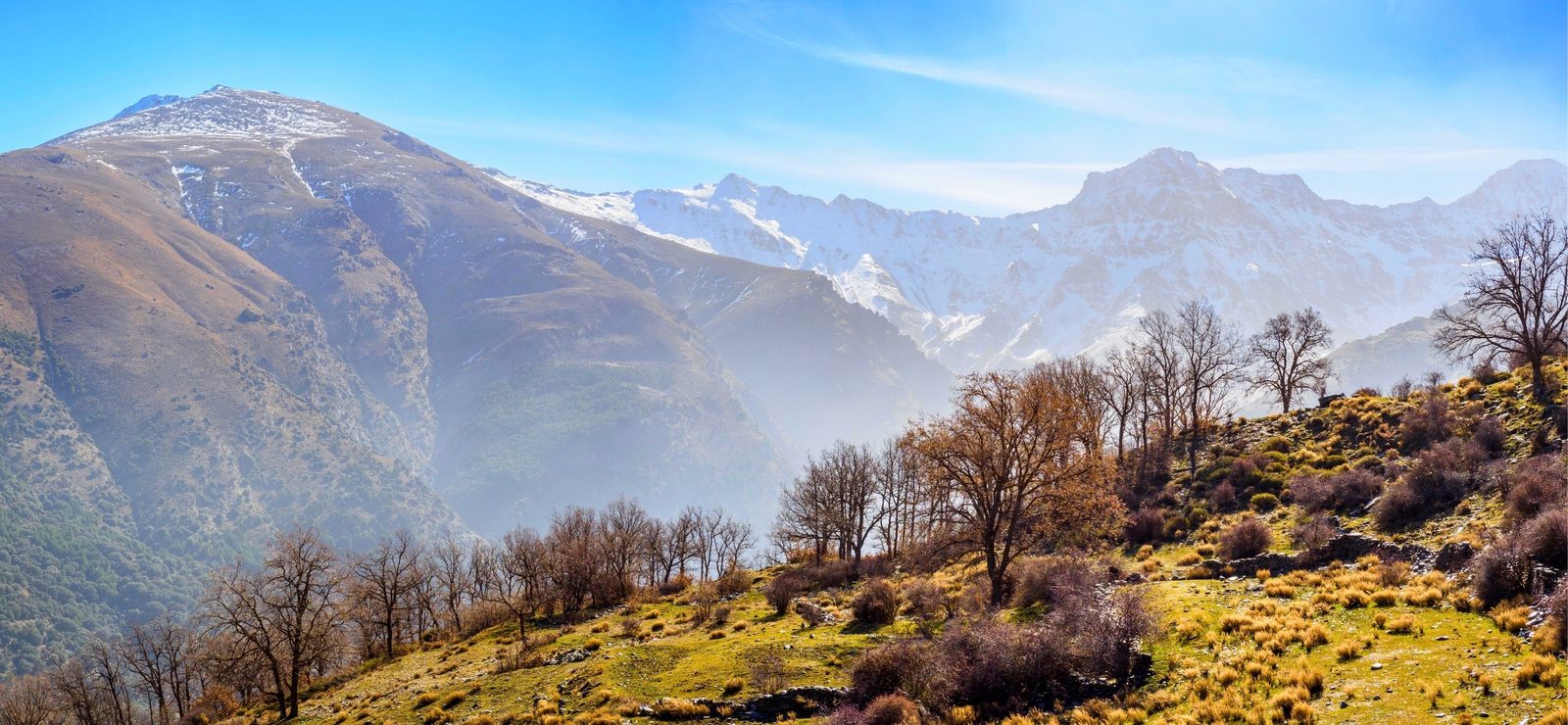
The last corner of Spain the Moors held, and it still looks it: white villages with flat roofs and clay chimneys, stacked under the highest peak in mainland Spain.
What it is: a self-guided Alpujarras hiking tour on the southern slopes of the Sierra Nevada in Andalusia. 8 days, 7 nights and 6 hiking days: 82.2 km (51 miles) and 4,461 m (14,636 ft) of climbing, between whitewashed Moorish villages that look like nothing else in Spain.
Where you sleep: three villages, not eight. Two nights in Trevélez, one of the highest villages in Spain at 1,476 m (4,842 ft), two in tiny Mecina Fondales in the Taha valley, and three in Capileira above the Poqueira gorge. Your bags move between them without you.
The finish: on day 7 you choose. Either the Poqueira Gorge Circuit, tracing old mountain water channels under Mulhacén and La Veleta, or the summit of Mulhacén itself at 3,479 m (11,414 ft), the highest point in mainland Spain.
What it costs: from €1,050 per person, and that includes all 7 nights with breakfast, luggage transfers, your route app, an in-person welcome briefing, a free custom training plan (valued at €300) and WhatsApp support throughout your trip.

Hiking in Andalusia: Our 8-Day Alpujarras and Sierra Nevada Tour at a Glance | |
| Tour length | 8 days, 7 nights, 6 hiking days |
| Start and finish | Trevélez to Capileira, in the Alpujarras, Granada province |
| Distance | 82.2 km (51 miles), about 14 km (8.5 miles) a day |
| Ascent | 4,461 m (14,636 ft) in total, from 479 m (1,572 ft) to 937 m (1,572 to 3,074 ft) a day |
| Highest point | Optional: Mulhacén, 3,479 m (11,414 ft), the highest peak in mainland Spain |
| UNESCO | The whole route sits inside the Sierra Nevada, a UNESCO Biosphere Reserve since 1986 |
| Difficulty | Moderate to Challenging |
| Accommodation | 7 nights in rural hotels in three villages: 2 in Trevélez, 2 in Mecina Fondales, 3 in Capileira |
| Luggage | Moved between hotels, so you carry a daypack only |
| Season | March to November, no July or August. Best in April, May, September and October |
| Support | WhatsApp support throughout your trip |
| Training | Free custom training plan (valued at €300) |
| Price | From €1,050 per person |

Alpujarras Hiking Tour Map: The Whole Route, Day by Day
Here is the whole tour on one map: the six hiking days, the three villages you sleep in, and both options for your last day. The route runs north up the valley from Trevélez, through the Taha to Mecina Fondales, and finishes in Capileira above the Poqueira gorge, with Mulhacén and La Veleta above you the whole way.
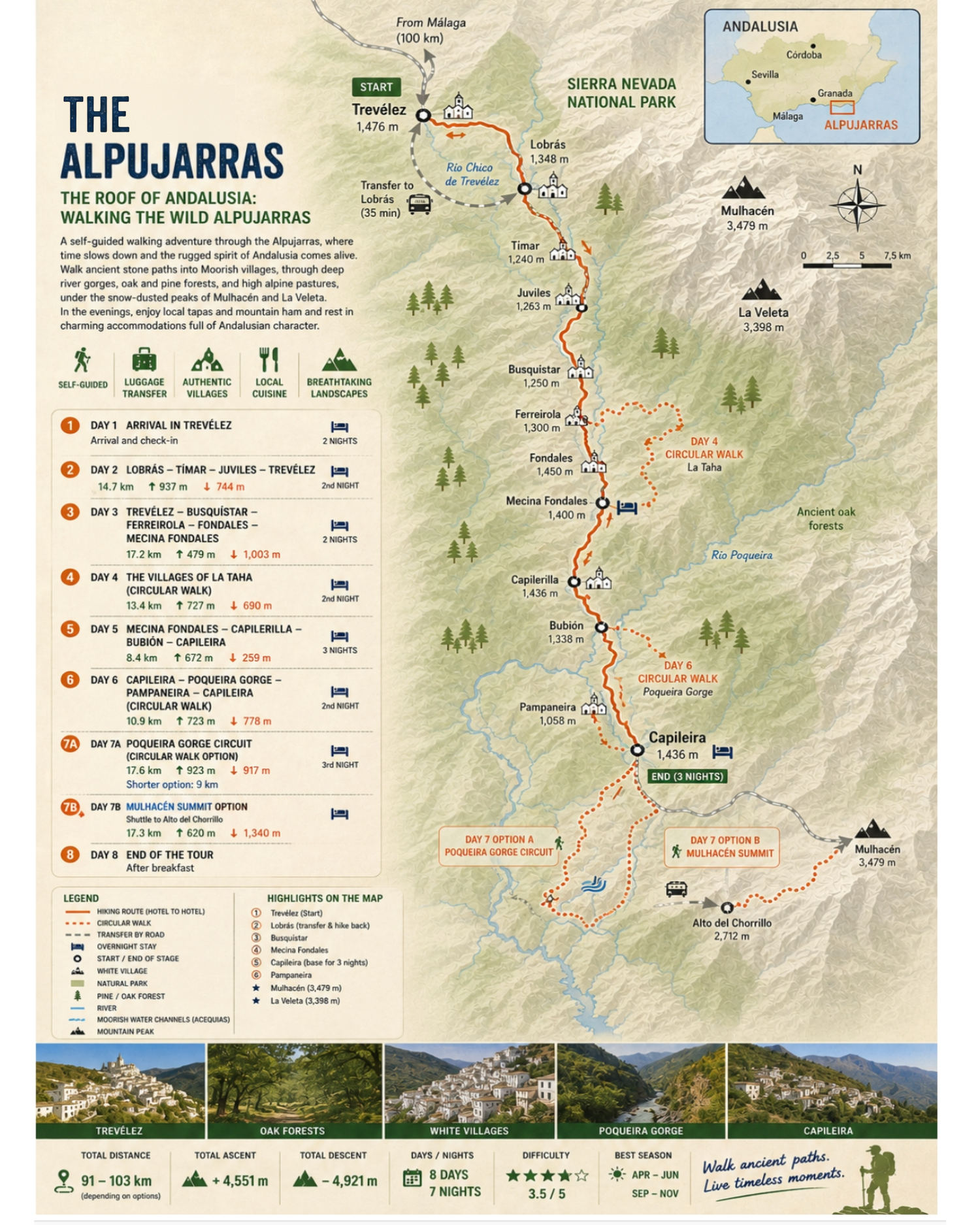
Click the map to open it full size, with the distance and climb for every day.

Highlights of Hiking in Southern Spain’s Alpujarras
- Sleep in three Moorish villages rather than passing through them: Trevélez at 1,476 m (4,842 ft), one of the highest villages in Spain and the home of Spain’s most famous mountain-cured jamón; Mecina Fondales, deep in the Taha valley; and Capileira, above the Poqueira gorge.
- Follow the acequias: irrigation channels the Moors cut into these slopes over 1,000 years ago, still carrying snowmelt and maintained by hand by the villages. You hear them long before you see them.
- Choose your last day. The Poqueira Gorge Circuit runs 17.6 km (10.9 miles) under Mulhacén and La Veleta, or you take a morning shuttle to 2,712 m (8,898 ft) and climb Mulhacén itself, 3,479 m (11,414 ft), the highest point on the Iberian Peninsula.
- Hike the GR7, the long-distance trail that runs from Tarifa to Greece, on the two days it threads through the highest villages in the Alpujarras.
- Drop into the Taha, a cluster of hamlets so quiet and so intact that the whole valley is a protected historic site, and cross a river gorge on a bridge that has been there for centuries.
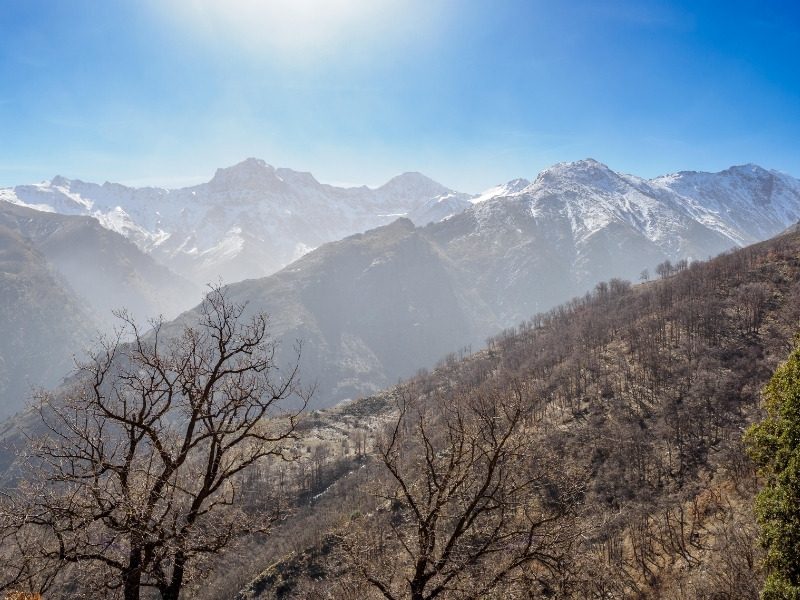
- Look up at the snow on Mulhacén and La Veleta most days you hike, even in May, even in a T-shirt.
- Carry a daypack and nothing else. Your luggage moves between your three hotels for you.
- Do all of it from €1,050. That is less than a third of what a guided group week in southern Spain typically costs, and it is well under our own Alps tours: our 7-day Tour du Mont Blanc with private rooms is €1,649.
Hiking in Andalusia: What Our Self-Guided Alpujarras Hiking Tour Is Actually Like
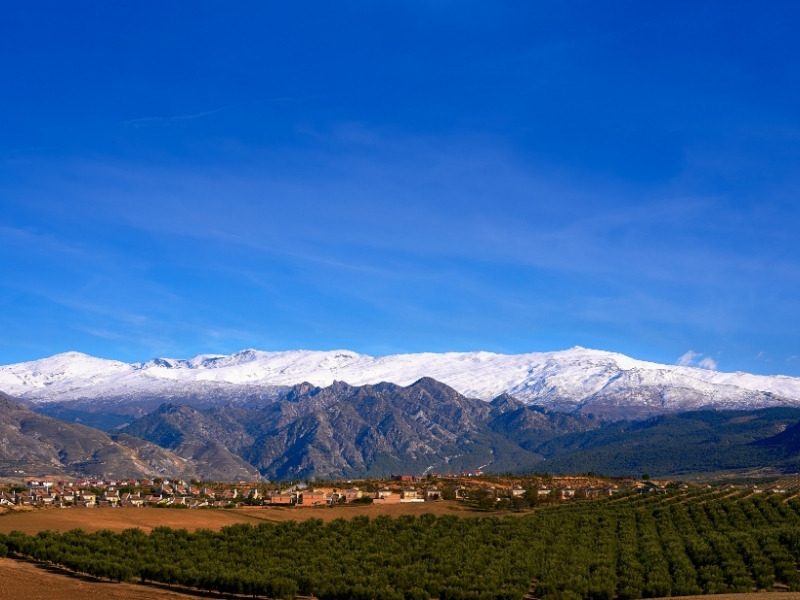
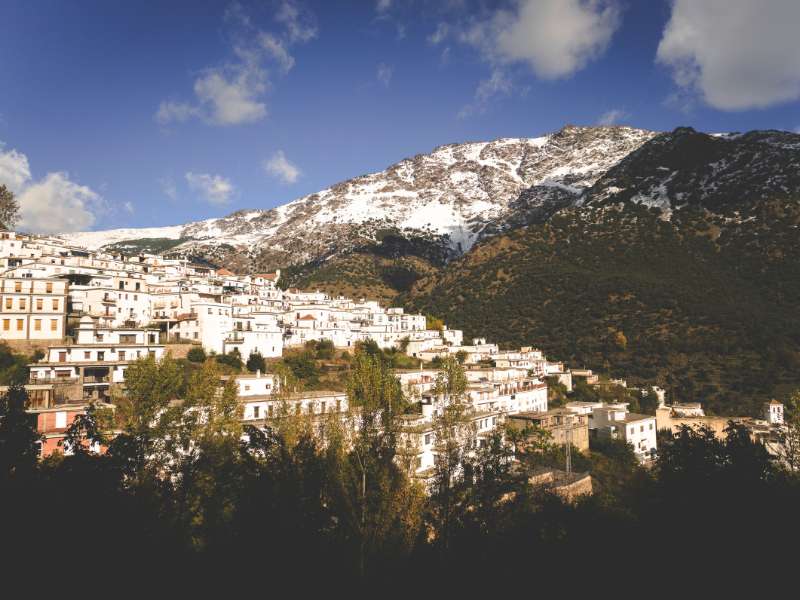
Most people picture Andalusia at sea level: Seville, Granada, the coast. The Alpujarras are the other Andalusia. They hang off the southern face of the Sierra Nevada between about 900 m (2,953 ft) and 1,500 m (2,953 to 4,921 ft), close enough to the Mediterranean to see it on a clear day and high enough that the village above you still has snow on it in May.
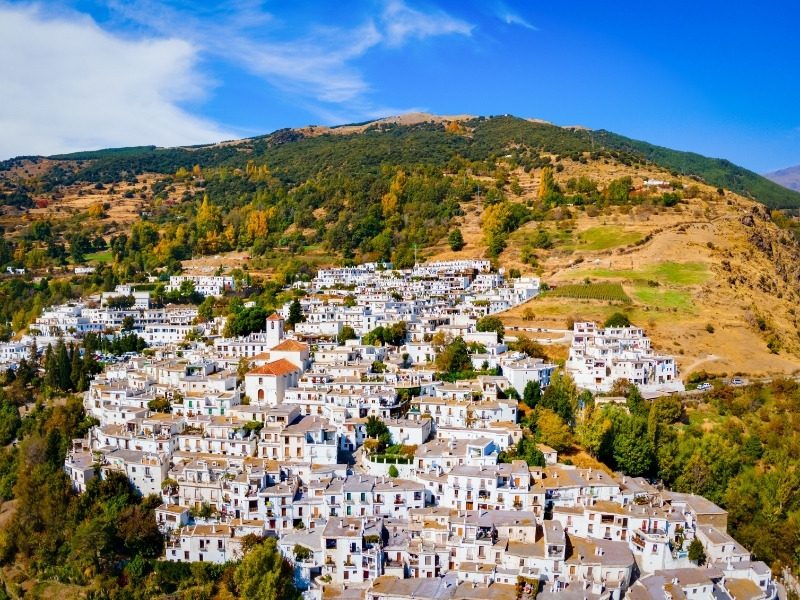
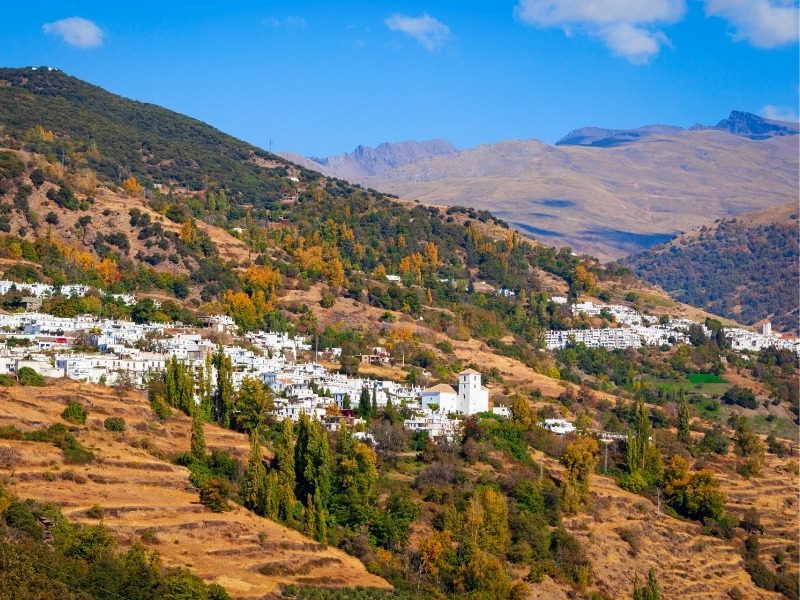
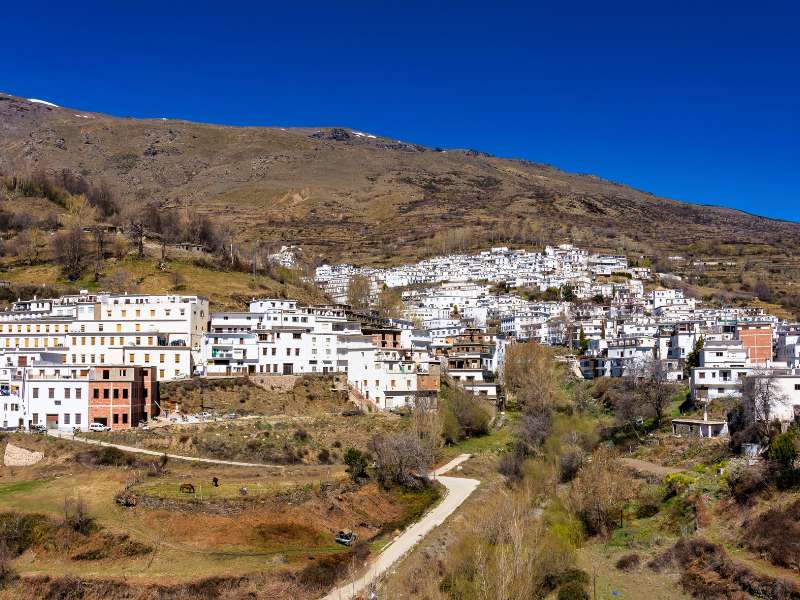
The villages here were built by Berber settlers and they still look it: whitewashed walls, flat clay terrao roofs instead of the tiled roofs you see everywhere else in Spain, and squat round chimneys. When the Moors were expelled from Granada in the 16th century, the Alpujarras were the last place they held out, and the architecture, the terracing and the water system never changed.
Our Alpujarras hiking tour gives you 6 days on those trails: 82.2 km (51 miles) and 4,461 m (14,636 ft) of climbing, on a mix of GR7 waymarked trail, old stone caminos between villages, forest track and one genuinely rough riverbed. You sleep in three villages rather than a different one every night, so two of the six days are circular hikes that finish where your bag already is.
Who is it for? Hikers who are comfortable on their feet for 5 to 7 hours and happy with a 900 m (2,953 ft) climb. Nothing on the route is technical, but the gradients here are Andalusian: paths go straight up the terracing rather than politely zigzagging. If you want to add the Mulhacén summit on day 7, that is a step up again, and it needs both good fitness and clear weather. Your free training plan is built for exactly this.
And the evenings are a large part of the point. You finish in a village square, you eat jamón de Trevélez that has been curing in this mountain air for two years, and nobody is waiting for you to be anywhere.
Your Free Personalized Alpujarras Fitness Plan (€300 Value)
Every booking includes a training plan built for this route, your current fitness and where you live, even if it’s flat as a table. It gets you ready for back-to-back days with 700 to 900 m (2,297 to 2,953 ft) of climbing, so day 4 feels as good as day 2. Arrive strong and the whole week is better.
You bring the legs. We handle the Andalusian logistics.
Book your Alpujarras hiking tour
Pick any start date from March to November, skipping July and August, and fill in our booking form. A 30% deposit holds your dates.
We book all 7 nights
We reserve your rooms in Trevélez, Mecina Fondales and Capileira, arrange the transfer to your first trailhead, and set up your luggage moves.
Your route app arrives
GPS tracks and route notes for all 6 hikes in an app personalized for your trip, plus your free fitness plan (€300 value).
You hike
You get an in-person welcome briefing in Trevélez, where we answer any last-minute questions and give you the latest trail conditions. Then you start when you want and stop where you want. WhatsApp support is there throughout your trip.
As a small company, we actually remember your name and genuinely care about your trip. Just check out our reviews: happy hikers, repeat adventurers, and rewards when you refer friends. That’s the Monkeys and Mountains difference.
Self-Guided Alpujarras Hiking Tours With Us vs. Planning It Yourself vs. a Guided Group Tour
| DIY / Self-Planned | Guided Group Tour | Monkeys and Mountains Alpujarras Hiking Tour | |
| Accommodation booked for you | No. You book all 7 nights yourself, in Spanish, in villages with a handful of rooms each | Yes | Yes, all 7 nights in three villages |
| Luggage moved between hotels | No. You carry everything, up every climb | Usually | Yes, included |
| Trailhead transfer | You work out the Alpujarras bus schedule, which is not generous | Yes | Yes. The transfer to Lobrás on day 2 is included |
| Latest trail conditions and closures | You research this yourself, in Spanish | Guide briefs the group | Yes. An in-person welcome briefing in Trevélez, plus WhatsApp support if conditions change |
| Freedom to hike your own pace | Yes | No. You move with the group | Yes |
| Personalized fitness plan | No | Rarely | Yes, free, €300 value |
| Best value for money | Cheapest, but time consuming | Most expensive | ⭐ Best value |
| Support if something goes wrong | You’re on your own | Guide present at all times | WhatsApp support throughout your trip |
| Route planning & navigation | You research and plan all 6 hikes, and some of these paths take some finding | Guide navigates for you | Offline app with GPS tracks |
Swipe left to see the full comparison →
Planning an Alpujarras hiking trip yourself is the cheapest way to do it, and it’s genuinely fiddly: seven nights to book in villages where the hotel has fifteen rooms and no online booking, one trailhead to reach by a bus that runs twice a day, and a route stitched together from GR7 notes and a few blog posts. A guided group tour solves all that, and costs the most, and you hike at the group’s pace. Our self-guided Alpujarras tours sit in between: we book the rooms, move your bags and arrange the transfer, and you hike at your own pace with your own people, with GPS tracks, a free training plan and WhatsApp support.
Best Hikes in Southern Spain: Our 8-Day Alpujarras Itinerary, Day by Day
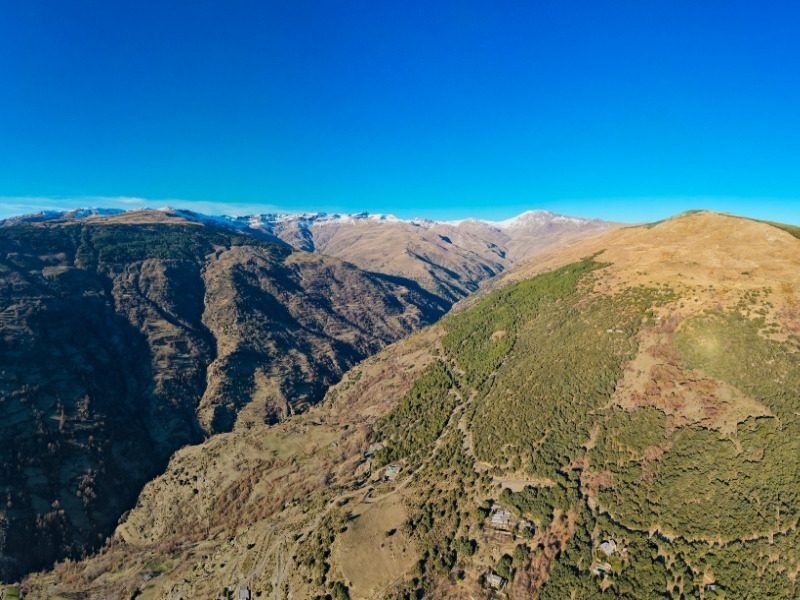
Six hikes, three villages, one mountain range. Two of the six days are circular, starting and finishing at your hotel, and on the last day you pick between a long gorge circuit and the highest summit in mainland Spain.
All times, distances and elevations are approximate, and the times don’t include breaks. Allow more time than you think you need.
You make your own way up to Trevélez, at 1,476 m (4,842 ft) on the southern flank of the Sierra Nevada. It sits in three tiers stacked up the hillside, and the lanes between them are narrow enough that everything arrives on foot or by small van.
We meet you in person here to answer any last-minute questions and give you the latest trail conditions. After that the afternoon is yours: wander the upper barrio, look up at tomorrow’s ridge, and find a tavern.
Because you have to try the ham. Trevélez is famous across Spain for jamón serrano cured in these secaderos at altitude, where the cold dry mountain air does the work slowly, sometimes for two years. It is the reason a village this remote is on the map.
- Accommodation: Hotel La Fragua in Trevélez or similar, breakfast included, 2 nights
A 35 minute transfer drops you down the valley in Lobrás, and from there you hike the whole way home. This is the GR7, the long-distance trail that starts at Tarifa on the Strait of Gibraltar and eventually reaches Greece. Today you get the stretch that threads the highest villages of the Alpujarras.
The climb is long and steady rather than brutal, up across high open plains through Tímar and Juviles, two villages most visitors to Granada have never heard of. The views are the payoff: deep canyons dropping away on one side, the Sierra Nevada rising on the other, and white villages pinned to the slopes in between.
The last stretch drops through thick forest back into Trevélez, which is a good way to finish a first day: shaded, cool, and downhill.
- Hiking today: 14.7 km (9.1 miles), 937 m (3,074 ft) ascent, 744 m (2,441 ft) descent, 5 to 6 hours
- Accommodation: Hotel La Fragua in Trevélez or similar, breakfast included
Pack your bag for transport this morning: it goes to Mecina Fondales while you hike there.
You leave Trevélez on foot on the GR7, climbing gently through pine woods and open meadow onto the high mountain plains. This is the quiet part of the day, with the whole range above you on the right and very little else going on.
Then the trail tips over and winds down through a magnificent holm oak forest, the kind that has been coppiced and grazed for centuries and still looks ancient. You come out at Busquístar, and from there the path runs on through Ferreirola and Fondales into the Taha valley, where Mecina Fondales is waiting.
It’s a long day on the map, and a kind one underfoot: there’s far more downhill in it than up.
- Hiking today: 17.2 km (10.7 miles), 479 m (1,572 ft) ascent, 1,003 m (3,291 ft) descent, 5 to 6 hours
- Accommodation: Hotel de Mecina in Mecina Fondales or similar, breakfast included, 2 nights. Luggage transferred for you
No bag to pack and no hotel to find: today is a loop from the door.
La Taha is a single municipality made of seven tiny hamlets scattered across one valley, and it is the most intact corner of the Alpujarras. The name is Arabic, from the administrative districts the Nasrids used, and the layout has barely moved since.
You start on an old stone camino that drops steeply into the river gorge and cross it on a bridge that has been carrying mules across this water for centuries. Then you climb the far side past old farmhouses, with the whole valley opening up behind you.
The turn is Ferreirola, which is the one people remember: eleven or so houses, a spring in the square, no through road, and a silence that is genuinely startling after ten minutes of standing still. Then back round to Mecina Fondales in time for a long lunch.
- Hiking today: 13.4 km (8.3 miles), 727 m (2,385 ft) ascent, 690 m (2,264 ft) descent, 4 to 5 hours
- Accommodation: Hotel de Mecina in Mecina Fondales or similar, breakfast included
The shortest day of the week and the one that climbs the most per kilometer. 8.4 km (5.2 miles) with 672 m (2,205 ft) of ascent is a steep average, and it starts straight away with the pull up to Capilerilla, where you turn round and see the whole Taha valley you spent yesterday in.
From there you’re into dense oak forest, then out at Bubión, the middle of the three Poqueira villages, where steep mountain meadows lead you up the last stretch to Capileira.
Capileira is the highest of the three and the prettiest: whitewashed, terraced, full of flowers on the walls, looking straight down the Poqueira gorge. You have three nights here, so unpack properly.
- Hiking today: 8.4 km (5.2 miles), 672 m (2,205 ft) ascent, 259 m (850 ft) descent, 3 to 4 hours
- Accommodation: Hotel Finca Los Llanos in Capileira or similar, breakfast included, 3 nights. Luggage transferred for you
Another circular day, and the one that shows you the gorge you’ve been looking down into.
You drop off the edge of Capileira into the Poqueira river gorge, then climb out the other side into terraced olive groves stacked high above the riverbed. These terraces are Moorish too, and they are still worked.
The trail runs down to Pampaneira, the lowest and liveliest of the three villages, where the main street is all craft shops, woven rugs and jarapa weavers, and where you will want a coffee before the climb home. Then it’s back up the valley slopes to Capileira, about 700 m (2,297 ft) of it, which is a real climb but a well-graded one.
- Hiking today: 10.9 km (6.8 miles), 723 m (2,372 ft) ascent, 778 m (2,553 ft) descent, 4 to 5 hours
- Accommodation: Hotel Finca Los Llanos in Capileira or similar, breakfast included
Last hiking day, and it’s your call. Both routes start and finish in Capileira.
Option 1: the Poqueira Gorge Circuit. Straight from the hotel onto a wide pasture trail, tracing the old acequias, the mountain water channels, with Mulhacén and La Veleta filling the sky ahead of you. The path gets satisfyingly rough further in, crossing the river gorge a few times on stones, before the final climb home. This is the one people photograph most.
Not feeling 17.6 km (10.9 miles)? There is a 9 km (5.6 mile) version of the same route. You decide over breakfast, which is how these decisions should be made.
Option 2: the summit of Mulhacén, 3,479 m (11,414 ft). If the weather up high is clear, you catch a morning shuttle up to Alto del Chorrillo at 2,712 m (8,898 ft) and climb from there. There’s nothing technical about it, but it is physically demanding, and then you hike the whole way back down through the Poqueira gorge to Capileira, 1,340 m (4,396 ft) of descent with the gorge opening up in front of you the whole way.
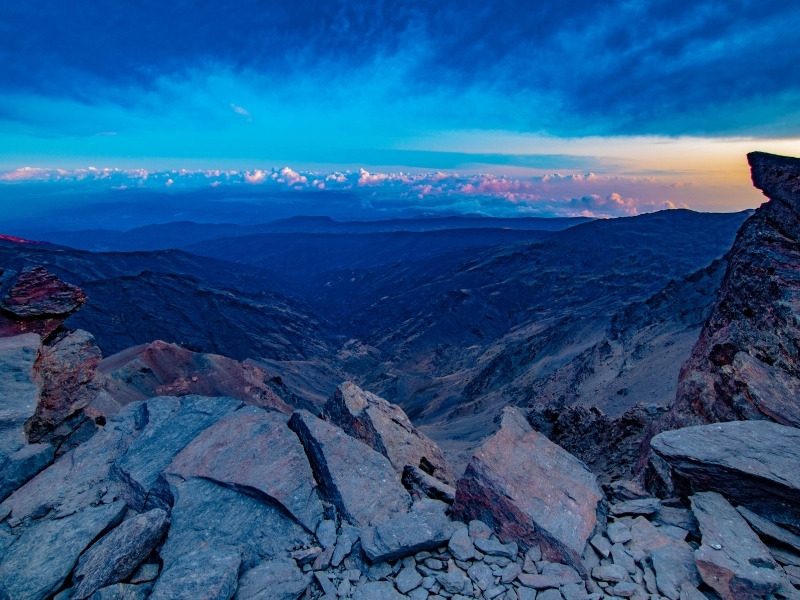
At the top you are standing on the highest point in mainland Spain, and on a clear day you can see the Mediterranean, and sometimes the Rif mountains of Morocco across it. This option is for experienced hikers in very good condition, and it only runs when conditions up there allow it.
- Option 1, Poqueira Gorge Circuit: 17.6 km (10.9 miles), 923 m (3,028 ft) ascent, 917 m (3,009 ft) descent, 6 to 7 hours
- Shorter version of option 1: 9 km (5.6 miles)
- Option 2, Mulhacén summit: 17.3 km (10.7 miles), 620 m (2,034 ft) ascent, 1,340 m (4,396 ft) descent, 7 to 8 hours, for experienced hikers in very good condition and only in clear weather
- Accommodation: Hotel Finca Los Llanos in Capileira or similar, breakfast included
In 6 hiking days you covered 82.2 km (51 miles) and climbed 4,461 m (14,636 ft), slept in three Moorish villages, hiked a stretch of a trail that runs to Greece, and, if you took option 2 yesterday, stood on the roof of mainland Spain.
After breakfast the tour ends. There’s a bus from Capileira down to Órgiva and on to Granada, or we can arrange a private transfer for you. Granada is an hour and a half away and has the Alhambra in it, so stay there for a couple of extra nights if time allows.

DATES & PRICES FOR THE 8-DAY ALPUJARRAS SELF-GUIDED HIKING TOUR
THE ALPUJARRAS AND SIERRA NEVADA:
8-day self-guided tour
PRICE:
From €1,050
AVAILABILITY:
March – November
(no July or August)
30% is due when you book. The remainder is due 40 days in advance.
- Price per person: €1,050 based on double accommodation with breakfast, for start dates in March (outside Easter week), April and November.
- Mid season: €1,155 per person for start dates in May, and from October 1st to 30th.
- High season: €1,225 per person for start dates during Spanish Easter Week, March 19th to 28th, 2027, in June, and in September.
- Single supplement: €300, which covers your own room every night.
- Solo hikers: €1,500 in total in the base season, €1,605 in mid season and €1,675 in high season. All include your own room every night.
- Private transfers, one way, up to 4 people: Málaga Airport to Trevélez €290, Capileira to Granada €170. Add them when you book.
- Extra nights in Granada before or after your tour are quoted for your dates. Contact us and we will price them.
Book with confidence
A 30% deposit holds your dates, balance due 40 days before you hike
We book every night of your trip, and if we can’t secure your accommodation, you get a full refund
WhatsApp support throughout your trip
Rated 4.9/5 from 187 hiker reviews
See our cancellation policy.
When Is the Best Time to Go Hiking in Andalusia’s Alpujarras?
The best months to hike in the Alpujarras are April, May, September and October. You get warm days, cool nights, long light and snow still sitting on Mulhacén above you. May and October are the sweet spot for temperature, which is why they carry a mid season supplement.
June and September give you the clearest high-mountain weather of the year, and September in particular is the best window if you want the Mulhacén summit on day 7, because the high trails are reliably free of snow and ice. June brings the longest days, though the afternoons get properly warm lower down.
March and April are green, quiet and full of wildflowers, with water in every acequia and the highest peaks still white. Spanish Easter Week, March 19th to 28th, 2027, is a wonderful time to be in an Andalusian village if you want the processions and the atmosphere, though the mountain temperatures are crisper and spring showers are likely. November is the quietest month of all, with clear air and empty trails.
We don’t run this tour in July or August. Andalusia in high summer is simply too hot for a week of long climbing days, and we would rather you enjoyed it.
Accommodation: Your Three Villages in the Alpujarras
You stay 7 nights in family-run rural hotels, and in three villages rather than seven. That’s deliberate, and it changes the week.
You unpack once and stay put for two or three nights, so there’s no repacking your bag before breakfast and no checking in somewhere new when you’d rather be in the shower. It means two of your six hiking days are circular, starting and finishing at the door. And it gives you long enough in one village to actually know it: the same square, the same bar, the same faces saying hello by your second evening. That’s the bit people come home talking about.
Your nights are 2 in Trevélez at Hotel La Fragua, 2 in Mecina Fondales at Hotel de Mecina, and 3 in Capileira at Hotel Finca Los Llanos. Rooms are doubles or twins as standard, all with a private bathroom, and breakfast is included every morning. These are small mountain hotels rather than resorts, which is exactly the point: whitewashed walls, terraces looking down the valley, and owners who will tell you where to eat. Alternatives in the same category are available if you prefer, and final hotel selections depend on availability at the time of booking.
Alpujarras Hiking Tour Inclusions
WHAT’S INCLUDED
✔ 7 nights in rural hotels in Trevélez, Mecina Fondales and Capileira
✔ In-person welcome briefing in Trevélez, in English, Spanish, French or German
✔ 7 breakfasts
✔ 6 days of hiking, 82.2 km (51 miles) in total
✔ The transfer to Lobrás on day 2, where your first hike starts
✔ Luggage transfer between your hotels, so you carry a daypack only
✔ GPS tracks, route descriptions and local information in an app personalized for your trip
✔ Unlimited email support before you go
✔ WhatsApp support throughout your trip
✔ Personalized Training Plan for the Alpujarras (valued at €300), free with your booking
WHAT’S NOT INCLUDED
- Travel and trip cancellation insurance. Our free Adventure Travel Insurance Finder will match you with the right policy.
- Flights.
- Getting to Trevélez at the start and away from Capileira at the end. You can add a private transfer when you book, or take the bus.
- Lunches and dinners, so you eat where you want, when you want.
- Extra drinks.
- Hotel and tourist taxes, paid locally.
- Accommodation the night before your tour starts and on the last day of your trip.
- Anything not indicated above.
NOTE:
All times, distances and elevations are approximate. The times indicated above don’t include breaks. Allow more time than you think you’ll need. The itinerary may change slightly depending on accommodation availability. The minimum age for this tour is 18.
Bookings that straddle a rate change are priced proportionally, according to the number of days falling in each rate period.
Watch: Hiking the Alpujarras and the Sierra Nevada in Southern Spain
Alpujarras Hiking Tour Info: Accommodation, Luggage, Season and Getting There
Our Alpujarras hiking tour runs from March to November, with the exception of July and August, when Andalusia is too hot for a week of long climbing days.
April, May, September and October are the best hiking months: warm days, cool nights and snow still on the high peaks. June and September give the most reliable high-mountain weather, and September is the strongest window for the Mulhacén summit option. March and April are green and full of flowers, with Spanish Easter Week (March 19th to 28th, 2027) worth planning around if you want the village processions. November is the quietest month, with clear air and almost nobody on the trails.
You stay 7 nights in family-run rural hotels across three villages: 2 nights in Trevélez at Hotel La Fragua, 2 nights in Mecina Fondales at Hotel de Mecina, and 3 nights in Capileira at Hotel Finca Los Llanos. Breakfast is included every morning.
Rooms are doubles or twins as standard, each with a private bathroom. Staying two and three nights in one place is deliberate: it means two of your hiking days are circular, you unpack properly, and you get to know a village rather than passing through it. Alternatives in the same category are available if you prefer, and hotels may vary depending on availability at the time of booking.
Your luggage is moved between hotels for you on the two hotel-change days, days 3 and 5, so you never hike with more than a daypack.
In your daypack: water, and more of it than you think, lunch, sun protection, a warm layer and a waterproof. The Alpujarras are hot in the valleys and genuinely cold on the tops, and if you are doing the Mulhacén summit on day 7 you want proper layers, a hat and gloves even in June.
We grade this tour Moderate to Challenging. Across 6 hiking days you cover 82.2 km (51 miles) and climb 4,461 m (14,636 ft).
The terrain is a classic high-mountain mix: wide dirt tracks, narrow singletrack, old Moorish stone caminos between villages, and one rough riverbed section. Nothing is technical. What it does ask for is sure footing and legs that don’t mind a steep gradient, because paths here were built to get between two villages, not to flatter a hiker.
Daily distances run from 8.4 km (5.2 miles) to 17.6 km (5.2 to 10.9 miles), with 479 m (1,572 ft) to 937 m (1,572 to 3,074 ft) of climbing. You should be comfortable hiking 5 to 6 hours with 700 to 900 m (2,297 to 2,953 ft) of ascent on consecutive days before you book.
The Mulhacén summit on day 7 is a separate question. It is not technically difficult, but it is physically demanding, it is at altitude, and it finishes with 1,340 m (4,396 ft) of descent. It is for experienced hikers in very good condition, and it only goes ahead when conditions up there allow. The Poqueira Gorge Circuit is the other option that day, and it is a wonderful day’s hiking in its own right.
Not sure whether you’re ready? Ask us. We’ll tell you honestly, and your free custom training plan (€300 value) is built to get you there.
Included: the transfer to Lobrás on day 2, where your first hike starts.
Not included: getting to Trevélez at the start and away from Capileira at the end, so your travel schedule stays yours rather than ours. You can add a private transfer when you book: Málaga Airport to Trevélez is €290 and Capileira to Granada is €170, both one way for up to 4 people.
Getting there by bus. There is no direct bus from Málaga Airport into the high Alpujarras, so Granada is your hub. From Málaga Airport or Málaga bus station, ALSA runs frequent direct buses to Granada bus station, about 1 hour 45 minutes. From Granada, ALSA runs daily mountain buses up through Órgiva and the Poqueira gorge to Trevélez, about 2.5 to 3 hours on winding roads, usually with a morning and an afternoon departure. If you are already in the south of the city you can also catch these from the Hospital Campus de la Salud stop.
Getting home. ALSA runs direct daily buses from the main square in Capileira back to Granada bus station, roughly 2 to 2 hours 15 minutes, and you can connect straight on to Málaga or Málaga Airport from there.
Mountain schedules change between weekdays, weekends and Spanish holidays, so check the live times and book your seats in advance on the ALSA website.
You will hear them before you notice them. Running water, beside the path, on a dry brown hillside in southern Spain, all day.
These are acequias: narrow irrigation channels cut into the contours of these slopes during the Moorish period, more than a thousand years ago in places. They take snowmelt off the Sierra Nevada and lead it along the mountain at a shallow angle, so that instead of rushing down the gorges and away, the water soaks into the mountain, feeds the springs lower down and keeps the terraces green through an Andalusian summer.
The part that makes them worth explaining is that they still work, and they are maintained by hand. Villages hold a limpieza, a communal clearing day, and irrigation turns are still shared out between families. It is the oldest working piece of engineering on this tour, and you hike along it on day 7.
Breakfast is included every morning at your hotel. Lunches and dinners aren’t, which is deliberate: you eat where you want, when you want, and you are not waiting for a group of fourteen to decide.
This is a good region to be hungry in. Trevélez ham, which is cured for up to two years in the mountain air, plato alpujarreño, which is the kind of meal you eat after 900 m (2,953 ft) of climbing and not before, local goat cheeses, and tapas that still come free with a drink in most village bars.
Most hiking days you will want a picnic, because the best lunch spots are on the trail rather than in a village. Your hotel can usually put one together if you ask the night before.
Travel insurance isn’t included and we strongly recommend it. Make sure your policy covers hiking and mountain rescue, and if you plan to take the Mulhacén option on day 7, check that it covers you up to 3,500 m (11,483 ft).
Not sure what to get? Use our free Adventure Travel Insurance Finder and get a tailored recommendation in under 60 seconds.
You book online and a 30% deposit holds your dates. The balance is due 40 days before you hike, and we start reserving your rooms as soon as the deposit arrives.
Questions before you book? Contact us. We like these questions, and we’d rather talk it through now than have you guess.
The Villages and Peaks You Hike in the Alpujarras: Trevélez, La Taha, Capileira and Mulhacén
The Sierra Nevada is the highest mountain range on the Iberian Peninsula, and it has been a UNESCO Biosphere Reserve since 1986, covering 244,442 hectares. Everything below is inside it.
| Place | What it is | Day | Numbers |
|---|---|---|---|
| Trevélez | One of the highest villages in Spain, stacked in three barrios up the hillside, famous for mountain-cured jamón. Your base for 2 nights | Days 1 to 3 | 1,476 m (4,842 ft) |
| The GR7 | Long-distance trail from Tarifa on the Strait of Gibraltar into Greece. You hike its Alpujarras section | Days 2 and 3 | 31.9 km (19.8 miles) of it |
| Tímar and Juviles | Two remote villages on the high plains, passed on the GR7 with canyons dropping away below | Day 2 | On a 14.7 km (9.1 mile) day |
| La Taha and Ferreirola | A valley of seven tiny hamlets with an Arabic name, reached over a centuries-old bridge. The most intact corner of the Alpujarras | Days 3 and 4 | 13.4 km (8.3 mile) circular |
| The Poqueira gorge villages | Pampaneira, Bubión and Capileira, stacked one above the other up one gorge. Capileira is the highest and is your base for 3 nights | Days 5 to 8 | Capileira sits at about 1,436 m (4,711 ft) |
| Mulhacén | The highest peak in mainland Spain and on the whole Iberian Peninsula. Optional summit on day 7, via a shuttle to Alto del Chorrillo | Day 7, option 2 | 3,479 m (11,414 ft) |
| La Veleta | Mulhacén’s neighbour, in view from the high pastures for most of the week | Days 6 and 7 | 3,396 m (11,142 ft) |

What Hikers Say About Our Alpujarras and Sierra Nevada Tour
One of the most breathtaking places I’ve ever seen: dramatic mountains, steep gorges, and charming villages clinging to the hillsides. Just unforgettable.
– Dorothy
Jaw-dropping views of the Sierra Nevada and the valleys below: rugged but manageable hiking, with a new perspective waiting around every corner.
– Don
Highly recommend to anyone who loves hiking through open countryside dotted with white villages and backed by snow-capped peaks. An incredible trip that flew by way too fast!
– Geoff
Alpujarras Hiking Tour FAQs: How Hard It Is, When to Go and What It Costs
Where are the Alpujarras and where is this hiking tour in Spain?
The Alpujarras are a region of southern Spain on the southern slopes of the Sierra Nevada, in Granada province, Andalusia. Our Alpujarras hiking tour starts in Trevélez and finishes in Capileira, both around 1,450 m (4,760 ft), roughly two to three hours by bus from Granada and about three and a half hours from Málaga. The whole route sits inside the Sierra Nevada, a UNESCO Biosphere Reserve since 1986.
How hard is the Alpujarras hiking tour?
The Alpujarras hiking tour is graded Moderate to Challenging. Over 6 hiking days you cover 82.2 km (51 miles) and climb 4,461 m (14,636 ft), with individual days running from 8.4 km (5.2 miles) to 17.6 km (5.2 to 10.9 miles) and 479 m (1,572 ft) to 937 m (1,572 to 3,074 ft) of ascent. Nothing on the route is technical. What it asks for is sure footing on rocky and sometimes steep ground, and the fitness to do 5 to 6 hours with 700 to 900 m (2,297 to 2,953 ft) of climbing on consecutive days. The optional Mulhacén summit on day 7 is harder again and is for experienced hikers in very good condition.
Is this a good first multi-day hiking trip?
Honestly, it is not the best first multi-day hiking trip. The Alpujarras tour has real mountain days with 700 to 900 m (2,297 to 2,953 ft) of climbing on consecutive days, and Andalusian paths go straight up the terracing rather than zigzagging. If this would be your first self-guided week, we would point you at our Cinque Terre, Costa Brava or Wicklow Way tours first. If you already hike regularly and are comfortable with a long climb, you will love this one.
Is the Alpujarras hiking tour a good next hike after the Camino de Santiago?
Yes, the Alpujarras hiking tour is a good next hike after the Camino de Santiago if you want mountains and village life in southern Spain. It has a lot more elevation gain than the Camino, and like the Camino you can have your luggage transferred, so that you can hike with just a daypack. And a big advantage: unlike the Camino, instead of a new bed every night, you stay in three villages: two nights in Trevélez, two in Mecina Fondales and three in Capileira.
When is the best time to hike in the Alpujarras and southern Spain?
The best time to hike in the Alpujarras is April, May, September and October, when the days are warm, the nights are cool and there is still snow on the high peaks. June and September give the most reliable high-mountain weather, and September is the strongest month if you want the Mulhacén summit. March and April are green and full of wildflowers. November is the quietest month of the year on these trails. We don’t run the tour in July or August because Andalusia is too hot for a week of long climbing days.
Can I climb Mulhacén on this tour?
Yes. Climbing Mulhacén is one of two options on day 7 of our Alpujarras hiking tour. You take a morning shuttle up to Alto del Chorrillo at 2,712 m (8,898 ft) and climb from there to the summit at 3,479 m (11,414 ft), the highest point in mainland Spain and on the whole Iberian Peninsula, then hike back down through the Poqueira gorge to Capileira. It is 17.3 km (10.7 miles) with 620 m (2,034 ft) of ascent and 1,340 m (4,396 ft) of descent. There is nothing technical about it, but it is physically demanding at altitude, so it is for experienced hikers in very good condition and it only goes ahead in clear weather. The alternative that day is the Poqueira Gorge Circuit, 17.6 km (10.9 miles), with a shorter 9 km (5.6 miles) version available.
How much does the Alpujarras hiking tour cost?
The Alpujarras hiking tour costs from €1,050 per person based on double accommodation with breakfast, for start dates in March (outside Easter week), April and November. May and October 1st to 30th are €1,155, and Spanish Easter Week (March 19th to 28th, 2027), June and September are €1,225. The single supplement is €300 and a solo hiker pays €1,500 in total in the base season. A 30% deposit holds your dates and the balance is due 40 days before you hike.
What is included in the price?
Included in the price: 7 nights in rural hotels in Trevélez, Mecina Fondales and Capileira, 7 breakfasts, an in-person welcome briefing in Trevélez, the transfer to Lobrás on day 2, luggage transfer between your hotels, GPS tracks and route notes in an app personalized for your trip, unlimited email support before you go, WhatsApp support throughout your trip, and a free personalized training plan valued at €300. Not included: flights, getting to Trevélez and away from Capileira, lunches, dinners and drinks, hotel and tourist taxes, travel insurance.
Do I have to carry my luggage on the Alpujarras hiking tour?
No, you don’t carry your luggage. Your bags are moved between hotels for you on the two hotel-change days, days 3 and 5, so you hike with a daypack only. You stay two nights in Trevélez, two in Mecina Fondales and three in Capileira, which means four of your six hiking days start and finish where your luggage already is.
Can I do this hiking tour solo?
Yes, you can hike the Alpujarras tour solo, and plenty of people do. A solo hiker pays €1,500 in total in the base season, €1,605 in mid season and €1,675 in high season, which includes your own room every night. You get the same route app, the same in-person welcome briefing and the same WhatsApp support throughout your trip. The trails are waymarked and the villages are close together, which makes this a comfortable region to hike alone.
Is it too hot to hike in Andalusia?
Not in the months we run this tour. The Alpujarras villages sit between about 900 m (2,953 ft) and 1,500 m (2,953 to 4,921 ft), so they are considerably cooler than the Andalusian coast or Granada below. In April, May, September, October and November the temperatures are ideal for long hiking days. We deliberately don’t run the tour in July or August, when the heat in Andalusia makes a week of 900 m (2,953 ft) climbs genuinely unpleasant.
What are the Moorish villages of the Alpujarras like?
The villages of the Alpujarras look like nowhere else in Spain: whitewashed walls, flat clay terrao roofs instead of tiles, and squat round chimneys, all built by Berber settlers and barely changed since. You stay in three of them. Trevélez is stacked in three tiers up the hillside and is famous across Spain for its mountain-cured jamón. Mecina Fondales sits in the Taha valley, a cluster of seven tiny hamlets with an Arabic name and, at Ferreirola, a silence that people remember years later. Capileira is the highest of the three Poqueira gorge villages, terraced and full of flowers, looking straight down the gorge.
What are the acequias you hike beside?
The acequias are narrow irrigation channels cut into these hillsides during the Moorish period, more than a thousand years ago in places. They carry snowmelt off the Sierra Nevada along the contour at a shallow angle, so the water soaks into the mountain and feeds springs and terraces far below instead of rushing down the gorges. They still run, and they are cleared and shared out by hand by the villages. You hike along them on day 7 of the tour, and you hear them beside the path most other days.
Do I need to speak Spanish to hike in the Alpujarras?
No. Your route app, route notes and support are all in English, and your in-person welcome briefing in Trevélez is available in English, Spanish, French or German. These are small mountain villages rather than resorts, so English is less widely spoken than on the coast, but a few words of Spanish and a translation app cover everything you’ll need in a bar or a hotel.
Which airport do I fly into for hiking in the Alpujarras?
Fly into Málaga or Granada. There is no direct bus from Málaga Airport into the high Alpujarras, so Granada is your transit hub: ALSA runs frequent direct buses from Málaga to Granada in about 1 hour 45 minutes, and daily mountain buses from Granada up through Órgiva to Trevélez in about 2.5 to 3 hours. Coming home, there are direct buses from Capileira back to Granada in roughly 2 hours. You can also add a private transfer when you book: Málaga Airport to Trevélez is €290 and Capileira to Granada is €170, one way for up to 4 people.
What is the GR7 and do we hike it?
The GR7 is a long-distance waymarked trail that starts at Tarifa on the Strait of Gibraltar, the southernmost point of mainland Europe, and runs across Spain and on through France into Greece. Our Alpujarras hiking tour follows its Alpujarras section on days 2 and 3, about 31.9 km (19.8 miles) of it, through Tímar, Juviles, Trevélez and Busquístar. It is the stretch that links the highest villages in the range.
Can I add extra nights in Granada before or after the tour?
Yes. Granada is about two to three hours from the trailhead and it has the Alhambra in it, so most hikers add a night or two either side. Extra nights are quoted for your dates rather than sold at a fixed rate, so contact us and we will price them for you. We’ll also happily tell you which order works best: Granada first, or Granada after, once your legs have earned it.
What should I pack for hiking in the Alpujarras?
Pack broken-in hiking boots or sturdy trail shoes, hiking poles if you use them (the descents here are long), a daypack, sun hat and high-factor sun cream, more water capacity than you think you need, and warm and waterproof layers. The valleys are hot and the tops are genuinely cold, and if you are taking the Mulhacén option on day 7 you want a warm layer, a hat and gloves even in June. Your luggage is transferred between hotels, so you only carry a daypack while hiking.
How far in advance should I book the Alpujarras hiking tour?
Book as early as you can for April, May, September and October, which are the busiest months, and for Spanish Easter Week. The villages on this route are small and the hotels have very few rooms, so availability rather than price is usually the constraint. A 30% deposit holds your dates and the balance is due 40 days before you hike. If your dates are close, get in touch and we’ll check what’s free.
Book Your Self-Guided Alpujarras Hiking Tour in Southern Spain
Book Your Alpujarras Hiking Tour With Us & You’ll Get…
- Save time and skip the hassle of booking 7 nights in three mountain villages where the hotels have fifteen rooms and no online booking. We handle it, so you don’t spend your evenings on emails in Spanish.
- Designed by hikers, for hikers – we work with local experts in Andalusia who know which acequia path is worth the extra half hour and when the high trails clear of snow.
- Hike on your own schedule – no group, no fixed departure time, no waiting at the trailhead. Start when you want, with the people you chose.
- Three villages, not seven – two nights in Trevélez, two in Mecina Fondales and three in Capileira, so you unpack properly and two of your six hiking days are circular.
- In-person welcome briefing in Trevélez, where we answer any last questions and give you the latest trail conditions.
- Carry a daypack, not your life – your luggage moves between hotels for you.
- Your choice of finale – the Poqueira Gorge Circuit, or the summit of Mulhacén at 3,479 m (11,414 ft), the highest point in mainland Spain.
- Unbeatable value with self-guided hiking – from €1,050 for 8 days, a fraction of the cost of a guided group tour and well under our own Alps weeks.
- We’re just a message away – WhatsApp support throughout your trip, for anything you need.
- Your own personalized fitness plan for the Alpujarras, valued at €300, free with your booking. Built for your current fitness and where you live, so you arrive ready.
Photos From Our Alpujarras and Sierra Nevada Hiking Tours





Still deciding?