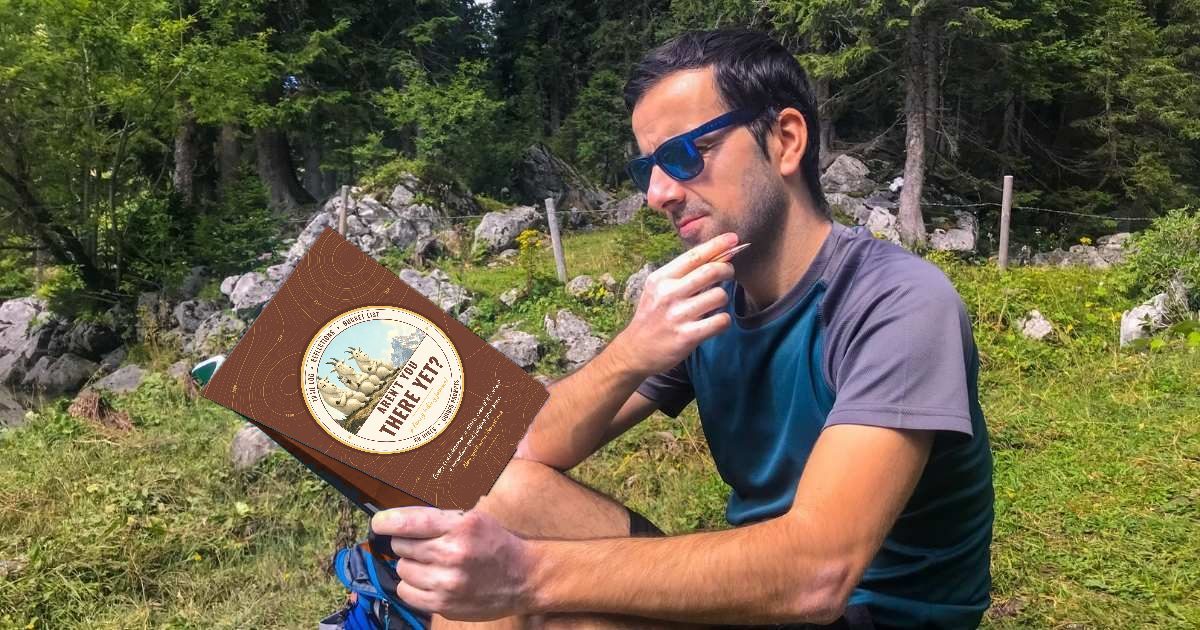
I love keeping a hiking journal. It’s a great way to relive your adventures and help you plan future hikes. Plus, it’s a thoughtful gift idea for either yourself or the hiker in your life.
Keep reading to find out why you should keep a hiking journal, the best one (in my humble opinion). Plus other tips to get the most out of your journaling.
A hiking journal helps you record past hikes, relive the experiences, and plan future ones by tracking details like trail conditions, weather, gear, and personal reflections. It can also serve as a thoughtful gift idea and prompt creativity during and after hikes.
Read on to see which trail journal features matter most, discover which (in our opinion) is the best hiking logbook with prompts, and learn practical tips for using it effectively on your next adventure.
Our pick: the Monkeys and Mountains hiking journal, now in four editions (everyone, women, men and a funny one), in paperback and hardcover.
What to Look for in a Trail Journal
This is such a personal thing. And everyone will want something slightly different so check out a few and notice what appeals to you and what doesn’t. Also, consider what details are important to you and ensure that the logbook has enough room to record those details. For example, if spotting wildlife is a highlight, ensure there’s a spot to note this.
You can also find hiking journals for kids. Check out the inside of a few first to ensure that it’s age-appropriate. It should also be fun for a child to fill out so that it doesn’t become a chore.
Some hikers like leather journals, others spiral or softcover. This is really a personal preference and totally up to you.
I think a guided journal is a good way to start writing. After a long day of hiking, I appreciate prompts. Whereas a blank empty page would intimidate me, but it’s a matter of preference.
One thing to look for that will be universal to look for? Ensure that you have enough room to write. In some, the lines are so close together making it really hard to write. Or you have to write so small that it’s hard to read afterwards.
Why I Created a Hiking Journal
After more than 1,000 hikes in 25 years, from the Canadian Rockies to the Himalayas, the trails started to blur. The brilliant ideas I had halfway up a mountain vanished the second I reached the parking lot. And the mountain goat that watched me wheeze up the last few steps, as if to say, “Aren’t you here yet?” Two weeks later, I’d forgotten him too. (He hasn’t forgotten me.)
I couldn’t find a hiking journal that kept the facts and the feelings, so I made my own. Then I rebuilt it from scratch for 2027. The new hiking logbook and journal comes in four editions, and two of them now come in hardcover too.
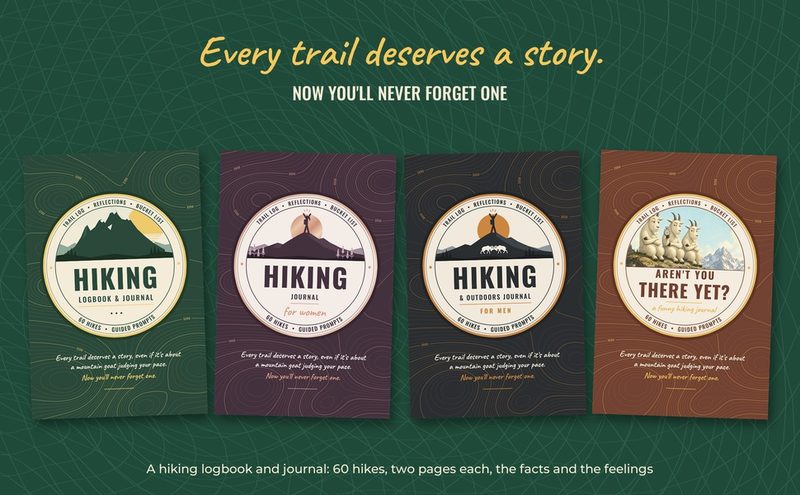
The Best Hiking Journals for 2027: Pick Your Edition
All four have the same heart: 60 hikes, two pages each, guided prompts that make writing easy after a long day on the trail, and room for every summit, view and snack that saved the day. Here’s who each one is for.
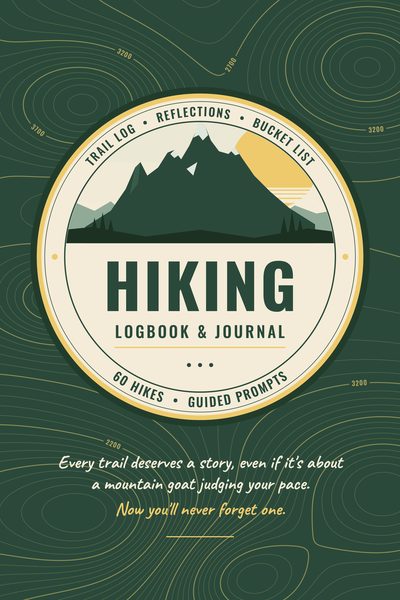
Hiking Logbook & Journal
The classic, in forest green. Log 60 hikes, then fill in your bucket list hikes, the peaks you’ve summited, the wildlife you’ve spotted and your goals for the year. It’s the one I’d hand to any hiker.
Best for: every hiker, from first trail to 100th summit, and couples who hike together.
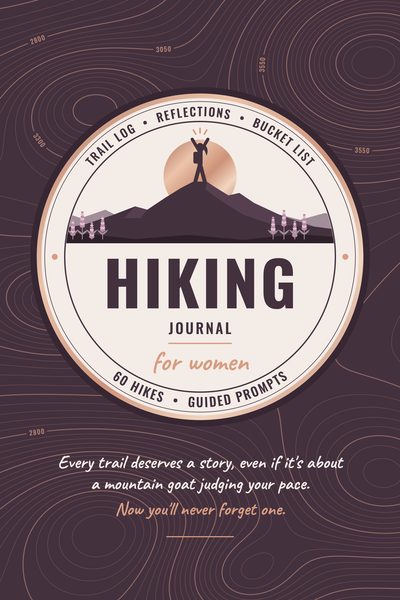
Hiking Journal for Women
Plum with a rose gold summit badge, and every page from the classic inside. Made for the woman who has more summits than socks, or is about to.
Best for: women who hike, and anyone hunting for a hiking gift for her that won’t end up in a drawer.
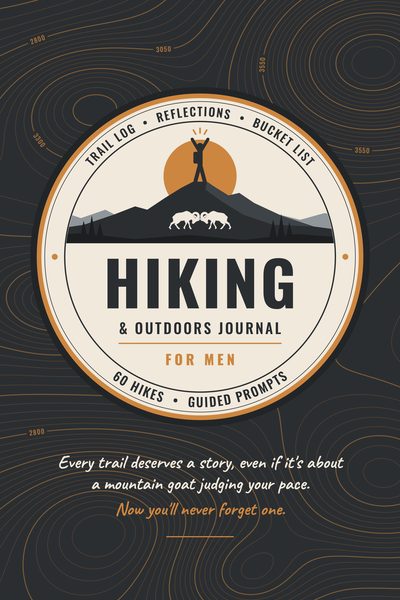
Hiking & Outdoors Journal for Men
Charcoal, with two bighorn rams squaring off on the cover. (We’ve all hiked with that guy.) Same 60 hikes and guided prompts, for the trails he’ll be bragging about for years.
Best for: men who hike, and anyone stuck on “what do you get him?”
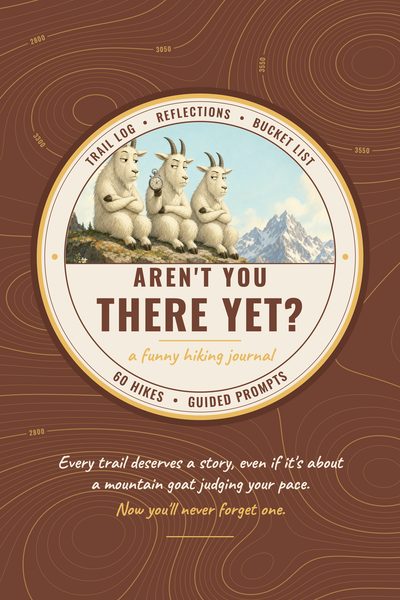
Aren’t You There Yet? A Funny Hiking Journal
Three mountain goats. One stopwatch. Zero patience. This one has its own funny prompts, Trail Excuse Bingo and milestone cheers along the way. (At hike 25, the goat is impressed. Mildly.)
Best for: the friend who’s always last up the hill, or the one who’s always first and won’t stop mentioning it.
Paperback or Hardcover Hiking Journal?
The paperback is light, easy to wrap and a great stocking stuffer. The hardcover is the keepsake: sturdier, made to sit on the shelf for years, so you can pull it down a decade from now and relive every summit. If it’s a gift for a big birthday, a retirement or someone who’s been hiking forever, go hardcover.
What’s Inside the Hiking Journal
Every hike gets two pages. The hiking log page holds the facts: date, location, trailhead and parking, distance (mi or km), elevation gain (ft or m), weather, trail conditions, wildlife, gear and star ratings for scenery, difficulty and the hike overall. Then the big question: would you hike it again?
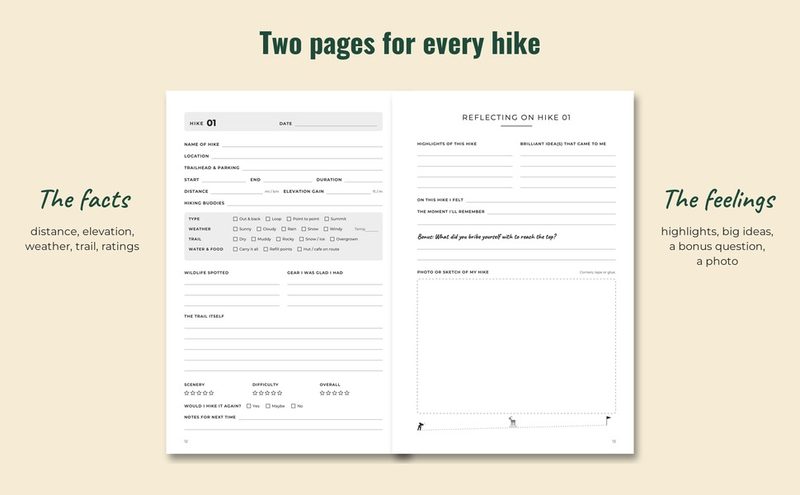
The reflection page is for the good stuff: the highlights of your hike, how you felt, the moment you’ll remember, a fun bonus question and a big box for a photo or sketch. Thinking about what you loved most helps you relive the best moments and stretches out that “I feel so good” feeling. Usually one highlight is the view from the summit. But then you start remembering everything else you enjoyed, and it’s such a good reminder that the joy is in the journey, not just the destination.
I always get great ideas when I’m hiking, so there’s a section to record the brilliant ideas that come to you. I’ll often get several on a single hike, anything from something I should do in my business to a friend I should reach out to.
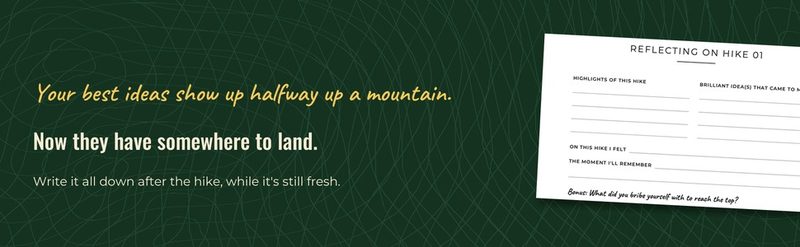
Hiking is also one of my favorite ways to problem-solve. Step by step, the solution to a problem often becomes clearer, almost effortlessly. Sometimes it even seems obvious. That’s why I included this section, something most hiking journals don’t have. I LOVE looking back on all the problems hiking has helped me solve and all the brilliant ideas I’ve had on the trail. I’m confident you will too.
Finally, there’s a box to sketch or attach a photo of your hike. I’m not much of a sketcher, but I know some people find it very therapeutic. And when I do sketch, I notice details I would have missed otherwise. Other days, I’ll just print a photo from my phone and tape it in. Choosing just one picture lets you relive the best parts of the hike all over again.
Also inside your hiking journal:
- A hike index with star ratings, so you can find any hike in seconds and settle the “which trail was that?” debate with proof.
- A day-hike gear checklist built around the Ten Essentials, so you’re never the one borrowing a headlamp at sunset.
- Your bucket list hikes, the trails you keep daydreaming about, ready to turn into ticked boxes and real plans.
- Peaks you’ve summited and wildlife you’ve spotted, from your first local hill to the marmot you heard whistling for ten minutes before you finally spotted it.
- Yearly hiking goals. Writing goals down makes you more likely to reach them, and your hiking logbook tracks your progress, hike by hike.
- A free 6-week custom hiking training plan, built around your hike, your fitness and your schedule. Scan the QR code inside to get yours.
It’s made for after the hike: kick off your boots, put the kettle on and write it all down while it’s fresh. For all these reasons, I think the one I created is the best hiking journal for hikers who want to remember the feelings, not just the miles.
7 Reasons to Use a Hiking Journal
1) A hiking journal is a great way to track what hiking trips you’ve done. After a while, and especially if you’ve been hiking for years, they start to blur together. It’s easy to forget all the places you’ve hiked and which trails you liked and are worth repeating and which aren’t.
The prompts in a good trail logbook make it quick to remember what you’ve just hiked. They also make it easy to repeat since you’ve already got all the details like the trailhead, type of hike etc at your fingertips.
2) Tracking your hikes also helps you plan future ones when it comes to weather. You can look back and see how much snow there was on the hike you did last April. That will help you plan similar hikes to nearby trails or mountains. It also helps you remember what type of gear you want for certain weather. So ensure you’ve noted down what hiking gear you use to help with future planning.
3) Logging your hikes lets you reflect on your progress. This is one of the most rewarding things about keeping a hiking journal, especially if you’re new to hiking. You’ll see how quickly you progress. And how a hike that you rated as difficult just a few months earlier, seems much easier now. Seeing your progression gives you the confidence boost to keep going and to tackle bigger mountains.
4) A trail journal makes it easier to plan your next hike. By tracking how you feel physically you can adjust your next hike accordingly. For example, if you’ve noticed that you’ve rated your last several hikes as “easy”, you could refer back to the length and elevation and increase one or both of those or choose more difficult terrain to make your next one more challenging.
5) Journaling is useful for tracking your emotions. When people talk about the health benefits of hiking they’re usually referring to the physical benefits. But I think the emotional and mental benefits are just as if not even more important.
Perhaps you felt really stressed at the beginning of the day and almost didn’t go because you had so much to do. But then, by the end, you realized that you feel much calmer and able to handle your to-do list.
By actually writing it down you notice the change. And that gives you the motivation to ensure that you make time for hiking on a regular basis. Being in nature is powerful. Combined with the endorphins you get from moving your body, hiking is a powerful elixir. See: How a Trek Can Change Your Life for further inspiration. Plus, a powerful exercise to do while hiking.
6) Relive the experience years after. It’s so much fun to go through old journals and remember the highlights. I.e. “we saw a grizzly bear near the summit. Fortunately he meandered off as soon as he saw us.” It reminds us of how powerful our time outdoors truly is.
7) Fast way to recommend trails to others. I often get asked for recommendations. Sometimes it’s hard to recall the difficulty or how spectacular the scenery was of a specific hike if I haven’t done it in a few years. Logging them makes it easy to look back on and give great recommendations.
I’m all for getting as many people out hiking as possible and tracking your hikes is an easy way to give great recommendations that include incredible scenery. That way the person will enjoy it so much that they’ll want to keep doing it.

How to Log Your Hikes in a Trail Journal
The best time to track them is right after your hike. Otherwise, it’s so easy to forget. And then it takes longer as you have to look up the details that are no longer at the top of your head.
This is also true if you’re doing a multi-day hike like the Tour du Mont Blanc, or Alta Via 1. You’ll be surprised how after a week it’s hard to remember the specifics of each day. Writing in your journal is a great way to record your adventure.
A hiking journal makes a great gift for hikers, including yourself.
Keeping a hiking journal not only lets you relive the memories of previous hikes, but it helps you plan future ones and you’ll be surprised at all the great ideas you get while hiking once you start tracking them.