Training for the Tour du Mont Blanc? Heck yes! Whether you’re gearing up for epic alpine views, the thrill of conquering cols, or just want to feel strong, confident and not like you’re dying halfway up a climb. This is where your TMB prep adventure begins.
We’re talking real plans, legit research, and friendly nudges to get your legs (and lungs) ready. You’ll learn exactly how to train in phases, how to train if your nearest mountain is a parking garage, how to save your knees, and how to make your hike feel easier with smart hacks like luggage transfer.
Training for the Tour du Mont Blanc takes 3 to 6 months. If you’re already in good shape and hike regularly, 3 months (12 weeks) is enough; if not, start earlier. Build up to back-to-back hiking days with 1,200-1,300 m (3,937-4,265 ft) of gain, do 2-3 strength sessions a week, and hike with a backpack that gets heavier over time. The full route has around 10,000 m (32,808 ft) of ascent, so train for the climbing, not just the 170 km (106 mi).
🎁 Grab your FREE 6-week hiking workout plan
🚶♀️ Book our TMB Self-Guided tour – it includes a free personalized training for the Tour du Mont Blanc plan worth €300, tailored to your itinerary, fitness, and even includes flatland training + knee-saving tweaks. (Yes, really.)
What Are You Training For on the Tour du Mont Blanc?
Before we get into Tour du Mont Blanc preparation, let’s look at what you’re up against (in the best way possible):
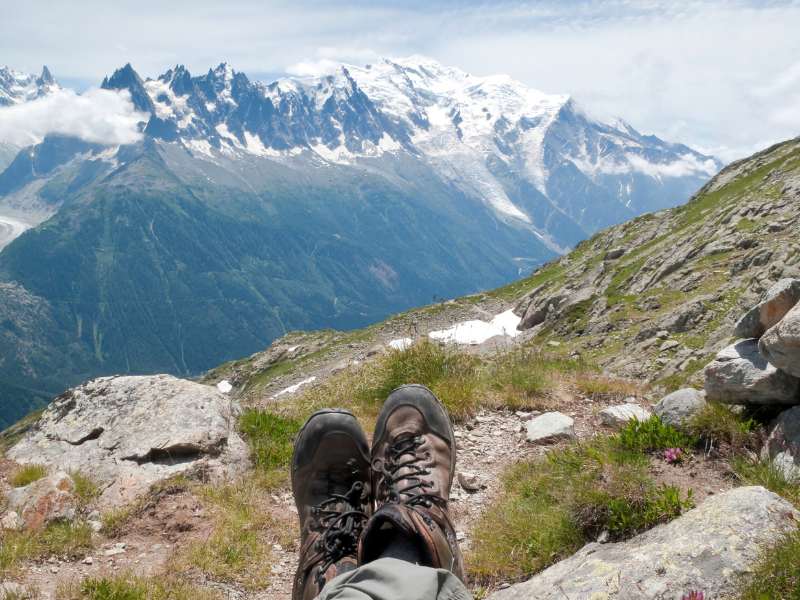
The full Tour du Mont Blanc is 170 km (106 mi) with around 10,000 m (32,808 ft) of ascent. The 6 and 7-day routes have about 5,500-7,000 m (18,000-23,000 ft), and most days climb 800-1,200 m (2,625-3,937 ft).
The TMB is a beast, in the most beautiful way.
- It’s 170 km (106 mi) of pure mountain magic.
- You’ll tackle around 10,000 m (32,808 ft) of elevation gain (and descent, because what goes up… you know the rest).
- Most days? You’ll be climbing 800–1,200 m (2,625–3,937 ft). Yup, it’s no Sunday stroll.
- Want to spice it up with the high variants? Epic views and steeper trails await at places like Fenêtre d’Arpette (2,665 m / 8,743 ft).
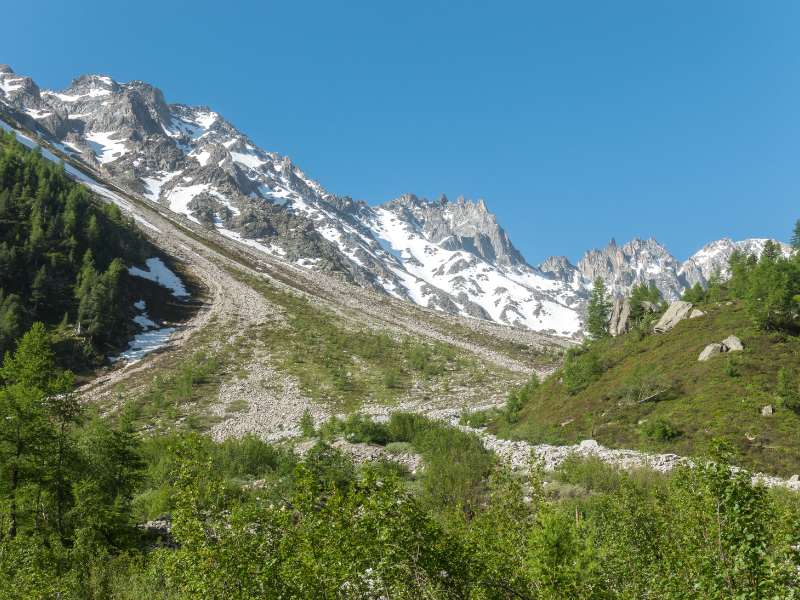
Pro Tip: If you’re concerned about the difficulty of the tour, get luggage transfer – it’s a game-changer! Less weight = more joy and much easier hiking.
Here’s our full guide to luggage transfer on the TMB + our TMB Packing List to get your gear dialed in and pack weight down.
How Long Should You Train for the Tour du Mont Blanc?
Training for the Tour du Mont Blanc takes 3 to 6 months. If you’re already in good shape and a regular hiker, 3 months (12 weeks) is enough, and the plan below is built for exactly that. If you’re not, start earlier and give yourself up to 6 months to build up.
12-Week Training Plan for the Tour du Mont Blanc
This 12-week training routine for the Tour du Mont Blanc builds the one thing the trail really tests: climbing day after day.
This isn’t about punishment. It’s about showing up consistently and building the strength and endurance to soak up every moment of the TMB without turning into a puddle of exhaustion.
| Weeks | Cardio sessions per week | Back-to-back | Strength sessions per week |
| Weeks 1-2 | 3 (1 includes strength) | – | 2 |
| Weeks 3-5 | 4 | 2-3 back to back | 3 |
| Weeks 6-9 | 5 | 3-4 back to back | 3 |
| Weeks 10-11 | 4 | 2-3 back to back | 3 |
| Week 12 (taper) | 3 easy | – | 2 light |
Count 1-2 hikes a week as cardio sessions, and carry a backpack that gets progressively heavier. Back-to-back sessions simulate hiking day after day on the trail. Other cardio can be incline walking (a treadmill at 10-15%), stairs, cycling or rowing. The weighted backpack matters most if you’re carrying your own bag rather than using luggage transfer.
Hike Targets for Your Tour du Mont Blanc Training
- By the end of week 5: hike 3-4 hours with 400-700 m (1,312-2,297 ft) of gain, and do one incline cardio session of 45-60 minutes (hands off the rails!).
- Weeks 6-9, your peak: build your long hikes to 5-7 hours with 800-1,000 m (2,625-3,281 ft) of gain, and practise with poles and downhill technique. Aim for at least one day with 1,200-1,300 m (3,937-4,265 ft) of gain, plus a full gear dress rehearsal.
- Weeks 10-11: keep hiking back to back with your full pack.
- Week 12: cut your volume by 40-60%, carb up, sleep more, stretch gently, and keep moving but stay chill.
Example Training Week for the Tour du Mont Blanc (Weeks 6-9)
Here’s how a peak week fits 5 cardio sessions and 3 strength sessions. On days with both, do them back to back or combine them into circuit training.
| Day | Session |
| Monday | Rest |
| Tuesday | Cardio (incline walk or stairs) + strength |
| Wednesday | Strength |
| Thursday | Cardio: incline treadmill at 10-15%, stairs, cycling or rowing |
| Friday | Cardio + strength, or circuit training |
| Saturday | Hike with a weighted backpack |
| Sunday | Hike with a weighted backpack |
Thursday to Sunday gives you 4 back-to-back days, and the weekend hikes count as 2 of your 5 cardio sessions.
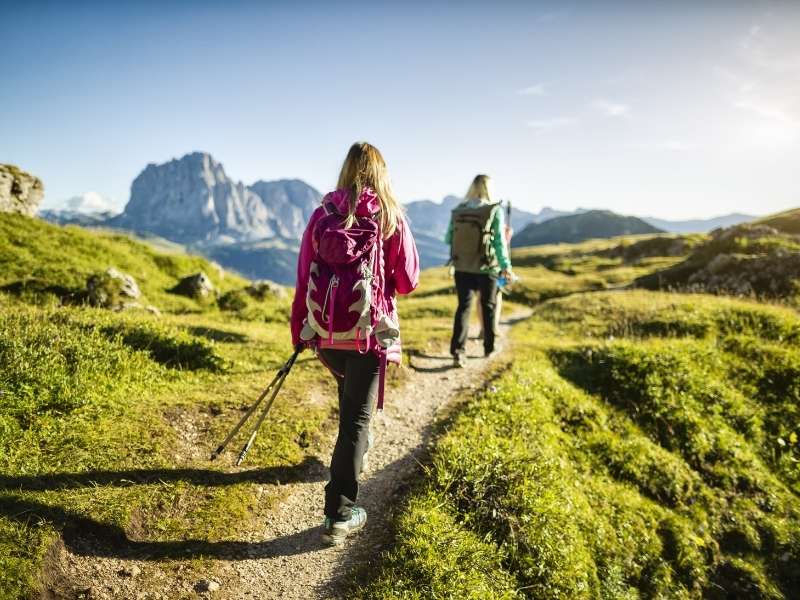
Book your TMB tour with Monkeys and Mountains Hiking Tours and get a free custom training for the Tour du Mont Blanc plan worth €300.
It’s built around your itinerary, fitness level, and goals – whether that’s crushing cols or not crying on descents. Includes flatland workarounds + knee-friendly progressions if you need them.
6-Week Training for the Tour du Mont Blanc: The Fast-Track Option
Maybe you just discovered the Tour du Mont Blanc and went, “OMG, I have to do this.” No stress – if you’re already really fit, this fast-track version will still get you ready, as long as you stay consistent.
Each Week:
- 1 hike
- 2 strength sessions
- 2 cardio sessions (incline, stairs)
By Week 5: Add a back-to-back hike to simulate that sweet TMB fatigue
By Week 6: Aim for 5–6 hours with 800–1,000 m (2,625–3,281 ft) of gain
We also have a FREE 6-week hiking workout plan for shorter hikes, or if you’re already really fit.
Or better yet, book your TMB tour with Monkeys and Mountains Hiking Tours and you’ll get a much more detailed custom training for the Tour du Mont Blanc plan adapted to your route, fitness level, terrain where you live and addresses any concerns or fears that you may have.
Training for the Tour du Mont Blanc on Flat Terrain
If you live somewhere flat, train for the climbing rather than the distance. It’s the first thing our custom training plan asks: do you live somewhere flat, hilly or mountainous?
No hills? No worries. Here’s how to fake it ‘til you hike it:
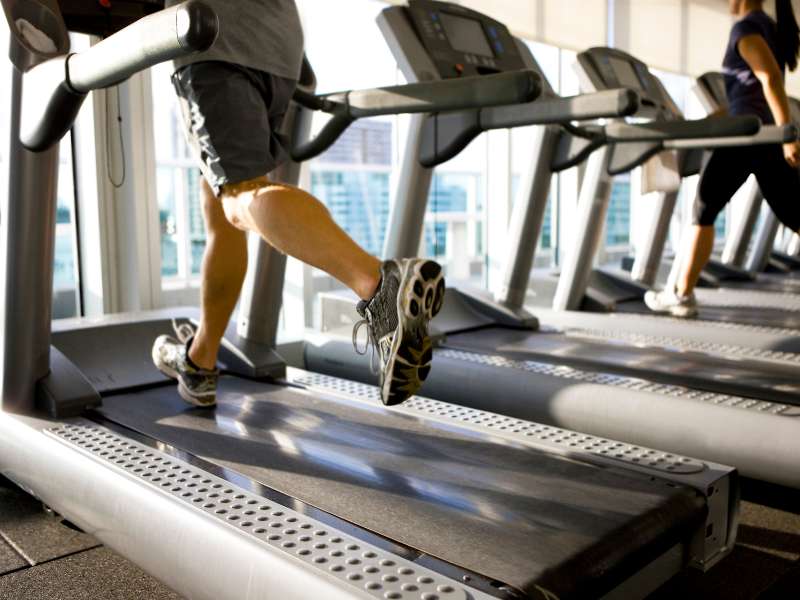
🟢 Treadmill at 10–15% for 40–90 minutes (no rail grabbing!)
🟢 Stadium stairs with controlled descents
🟢 Step-up ladders (300–800 reps, vary height)
🟢 Weighted pack walks (start light, build slowly)
🟢 Repeat overpasses, bridges, or any incline with poles
🟢 Try to hit outdoor trails every 1-2 weeks for footwork + ankles
How to Protect Your Knees When Training for the Tour du Mont Blanc
Your Tour du Mont Blanc preparation isn’t complete without dialling in knee protection + pole technique:
Strength for knee health:
- Spanish squats
- Eccentric step-downs
- Split squats
- Hip bands
- Core carries
Downhill tips:
- Shorter steps
- Feet under hips
- Bent knees + engaged poles
Use Trekking poles
- Trekking poles reduce knee forces by 12–25% on descents according to the National Library of Medicine.
- They shift effort to upper body without feeling harder
- They protect your joints on long days (thank you, science!)
Start practicing now so your poles feel like extensions of your arms come Day 1.

Are You Ready? Benchmarks Before You Hike the Tour du Mont Blanc
Before your taper week, you should be able to:
- Climb 1,200-1,300 m (3,937-4,265 ft) in a single day
- Hike back-to-back days without needing a rest day between them
- Carry your trail weight: 8-9.5 kg (18-21 lb) with your own gear, or a 5-8 kg (11-18 lb) daypack with luggage transfer
- Hike the daily moving time your tour asks for, which depends on which tour you’re doing: about 6 hours a day on our 6 and 7-day tours, and up to 8 hours on our 10-day tour (moving time only, breaks not included)
Training With a Backpack for the Tour du Mont Blanc
Start light and add weight gradually until you’re training with the weight you’ll carry on the trail.
Without luggage transfer:
- Base weight: 5.5–7.5 kg (12–16.5 lb)
- Add 2L water + snacks = 8–9.5 kg (18–21 lb)
With luggage transfer:
Daypack only: 5–8 kg (11–18 lb)
✅ You’ll feel lighter and recover faster!
If you want to make the TMB easier, learn more about luggage transfer.
Your Free Custom Training Plan for the Tour du Mont Blanc
I’ve done countless multi-day hikes, including the Tour du Mont Blanc, and every Monkeys and Mountains Tour du Mont Blanc client gets a free custom training plan, worth €300. It’s built around four questions:
- Do you live somewhere flat, hilly or mountainous?
- What type of exercise do you enjoy? You’re far more likely to stick with a plan you enjoy doing.
- Do you prefer high impact, low impact or a mix of both?
- Do you have access to a gym or classes?
Not booking a tour yet? Our free 6-week hiking workout plan is the simpler version.

Preparing for the Tour du Mont Blanc: Training FAQs
How do I train for the Tour du Mont Blanc if I live somewhere flat?
To train for the Tour du Mont Blanc somewhere flat, swap hills for incline: walk on a treadmill at 10-15% for 40-90 minutes, climb stadium stairs with controlled descents, do step-ups, and walk with a weighted backpack. Get onto real trails every 1-2 weeks for your feet and ankles.
What are the best strength exercises for the Tour du Mont Blanc?
The best strength exercises for the Tour du Mont Blanc are step-ups, split squats, eccentric step-downs, single-leg Romanian deadlifts, hip band work and loaded core carries. Do 2-3 strength sessions a week, following the 12-week plan above.
Do trekking poles help on the Tour du Mont Blanc?
Yes, trekking poles help on the Tour du Mont Blanc: they reduce knee forces on descents by 12-25%, according to research published by the National Library of Medicine. Train with them so they feel natural from day one.
Should I run as part of training for the Tour du Mont Blanc?
Running isn’t necessary when training for the Tour du Mont Blanc. Hiking-specific work does more: incline walking, stairs and back-to-back hikes with a backpack. If you love running, keep it as one of your weekly cardio sessions.
How heavy should my backpack be when training for the Tour du Mont Blanc?
Train up to the weight you’ll carry on the Tour du Mont Blanc: 8-9.5 kg (18-21 lb) including 2 litres of water and snacks if you carry your own gear, or a 5-8 kg (11-18 lb) daypack if you use luggage transfer. Start light and add weight gradually.
How long should you train for the Tour du Mont Blanc?
Train for the Tour du Mont Blanc for 3 to 6 months. If you’re already in good shape and hike regularly, 3 months (12 weeks) is enough; if not, start earlier.
Training for the Tour du Mont Blanc Starts Today
Get moving, keep showing up, and let us take care of the planning. Your Tour du Mont Blanc journey starts with one step. Let’s make it a strong one.
👉 Book your Tour du Mont Blanc Self-Guided tour
📥 Download your FREE 6-week plan
🎒 Check the TMB Packing List
📦 Read our luggage transfer guide
🪜 Should you fear the TMB ladders?
✈️ Getting from Geneva to Chamonix
📅 Pick the best time to hike the Tour du Mont Blanc
🛏️ Compare Tour du Mont Blanc accommodations
🧭 What you actually get on a self-guided hiking tour