Mont Blanc is the one mountain in the Alps that won’t hold still. Its official height gets re-surveyed every two years and the answer comes back different every time, because the summit everyone photographs is a cap of snow and ice rather than bare rock. Mont Blanc wears a hat, and the hat changes size. So these 25 Mont Blanc facts start with the current number, explain why it keeps moving, and settle the question of whether Mont Blanc really is the highest mountain in Europe. The honest answer to that one depends on where you decide Europe ends.
We run self-guided hiking tours around this mountain, so a few of these come from the trail rather than a textbook.
TL;DR: the main Mont Blanc facts
Mont Blanc is officially 4,805.59 m (15,766 ft) tall, the figure announced after the September 2023 survey, and a new official figure is due on October 14th, 2026. It sits on the border between France and Italy with the massif reaching into Switzerland, its name means “white mountain,” and it’s the highest peak in the Alps and in Western Europe. It is not the highest mountain in Europe overall if you count the Caucasus, where Mount Elbrus, in Russia, reaches 5,642 m (18,510 ft).
How tall is Mont Blanc?
Officially 4,805.59 m (15,766 ft), the figure announced after the September 2023 survey. It’s re-measured about every two years and comes back different every time, because the summit is a cap of wind-blown snow and ice. The rock underneath sits at 4,792 m (15,722 ft) and doesn’t move. The next official figure is announced on October 14th, 2026.
Where is Mont Blanc?
In the Alps, on the France-Italy border, between Chamonix in France and Courmayeur in Italy. The wider Mont Blanc massif also extends into Switzerland. France and Italy have never agreed on exactly where the border crosses the summit.
Is Mont Blanc the highest mountain in Europe?
It’s the highest in the Alps, in Western Europe and in the European Union. Mount Elbrus in Russia is higher at 5,642 m (18,510 ft), and so are nine other Caucasus peaks, but whether the Caucasus counts as Europe is a genuine geographic argument.
Can you hike Mont Blanc?
No, you can’t hike to the summit of Mont Blanc. Reaching the top is a mountaineering climb on glaciers that needs crampons, a rope, an ice axe and almost always a guide. What you can do is hike all the way around the mountain on the Tour du Mont Blanc, a 170 km (106 mile) circuit through France, Italy and Switzerland. It’s the most famous hike in Europe and it needs no mountaineering skills at all.
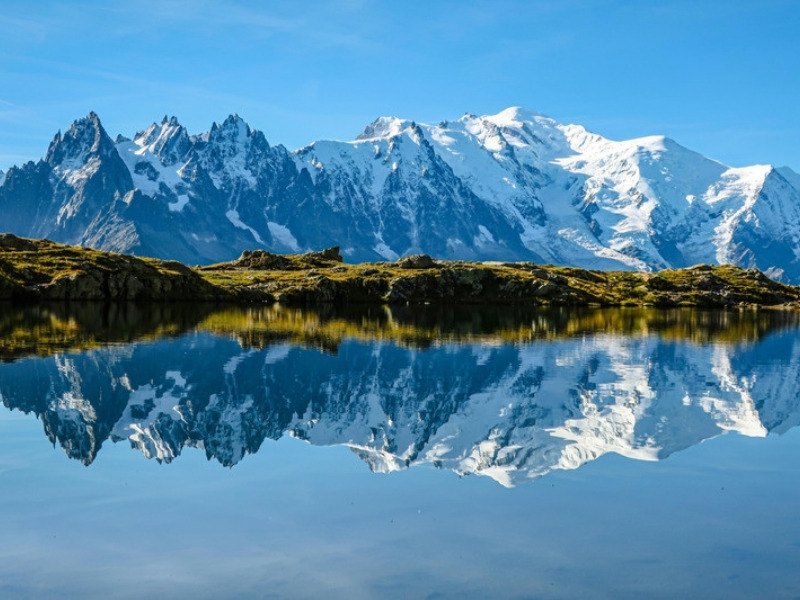
How High Is Mont Blanc Compared to Chamonix and Courmayeur?
Numbers on a page don’t really land until you see them stacked up. Chamonix sits at 1,035 m (3,396 ft) and Courmayeur at 1,224 m (4,016 ft), which means the summit stands roughly 3,770 m (12,370 ft) above the valley floor you’ll be standing in when you first look up at it. That’s nearly two and a half vertical miles of mountain, straight up, from where you’re drinking your morning coffee.
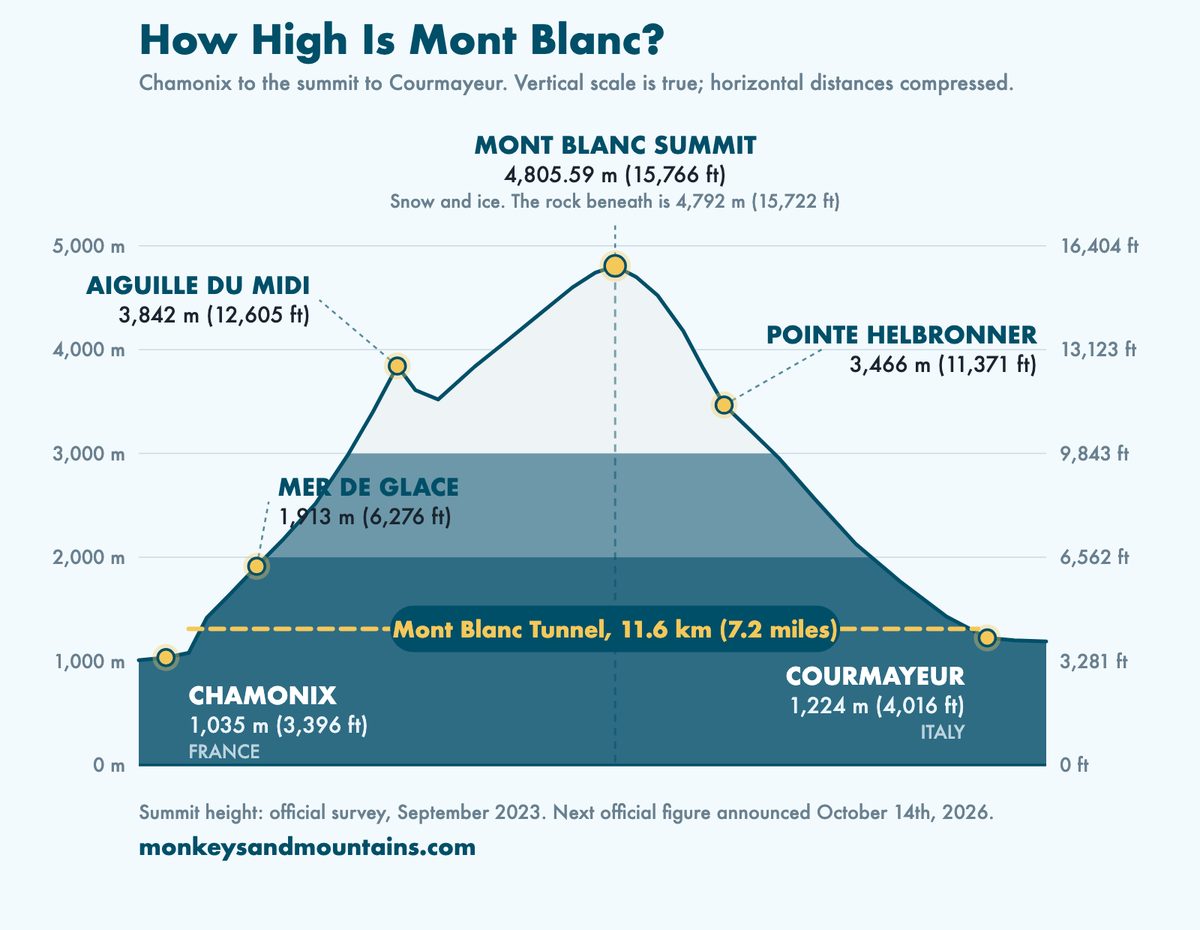
From Chamonix in the French Alps, over the summit, down to Courmayeur in the Italian Alps. Vertical scale is true; horizontal distances are compressed.
Mont Blanc Facts at a Glance
| Fact | Detail |
|---|---|
| Height | 4,805.59 m (15,766 ft), the figure announced after the September 2023 survey. A new figure is announced October 14th, 2026 |
| Rock summit beneath the ice | 4,792 m (15,722 ft) |
| Countries | France and Italy at the summit; the massif also reaches Switzerland |
| Mountain range | The Alps, highest point of the range |
| Nearest towns | Chamonix, France, 1,035 m (3,396 ft) and Courmayeur, Italy, 1,224 m (4,016 ft) |
| Name meaning | “White mountain” in French; Monte Bianco in Italian |
| First ascent | August 8th, 1786, by Jacques Balmat and Michel-Gabriel Paccard |
| Summits per year | About 20,000 mountaineers |
| Hiking it (no mountaineering) | The Tour du Mont Blanc goes around the mountain, not up it. 170 km (106 miles), 6 to 11 days, on marked hiking trails |
| Best time to hike the Tour du Mont Blanc | Mid-June to mid-September, once the high passes are clear of snow |
| Climbing it (summit) | A glacier mountaineering route. Crampons, rope, ice axe, a guide and a Goûter Hut reservation. Two days from Chamonix |
| Best time to climb Mont Blanc | Mid-June to mid-September, with late June, July and early September the most settled. Guides increasingly avoid high summer, when heat loosens rockfall on the Goûter route |
How Tall Is Mont Blanc? The Facts About Its Changing Height
1. Mont Blanc Is Officially 4,805.59 m (15,766 ft) Tall
That’s the figure announced after the September 2023 survey, and it’s the official altitude until the next one is published. A fresh measurement campaign finished on the summit on September 17th, 2026, and the new official figure is announced on October 14th, 2026. If you see 4,810 m or 4,808 m quoted somewhere, it isn’t wrong exactly. It’s just an earlier survey, which on this particular mountain is a distinction worth making.
2. Mont Blanc’s Height Is Officially Remeasured Every Two Years
Since 2001 the Ordre des Géomètres-Experts, the French national body of chartered surveyors, has sent a team to the top every second September with GNSS satellite equipment accurate to within a few centimeters, and measured the summit again. Thirty-three people on the 2026 campaign, satellite gear, a drone and ground-penetrating radar, and a climb to nearly 4,800 m (15,750 ft), to settle an argument about centimeters. It’s the most Alpine thing imaginable. The point isn’t bureaucratic tidiness: it’s one of the longest-running direct records of what the climate is doing to the high Alps.
| Survey | Height in meters | Height in feet |
|---|---|---|
| September 2015 | 4,808.73 m | 15,777 ft |
| September 2017 | 4,808.72 m | 15,777 ft |
| September 2021 | 4,807.81 m | 15,774 ft |
| September 2023 | 4,805.59 m | 15,766 ft |
| September 2026 | Measured on the summit September 17th, 2026 | Announced October 14th, 2026 |
3. The Rock Summit of Mont Blanc Is 4,792 m (15,722 ft) and Never Moves
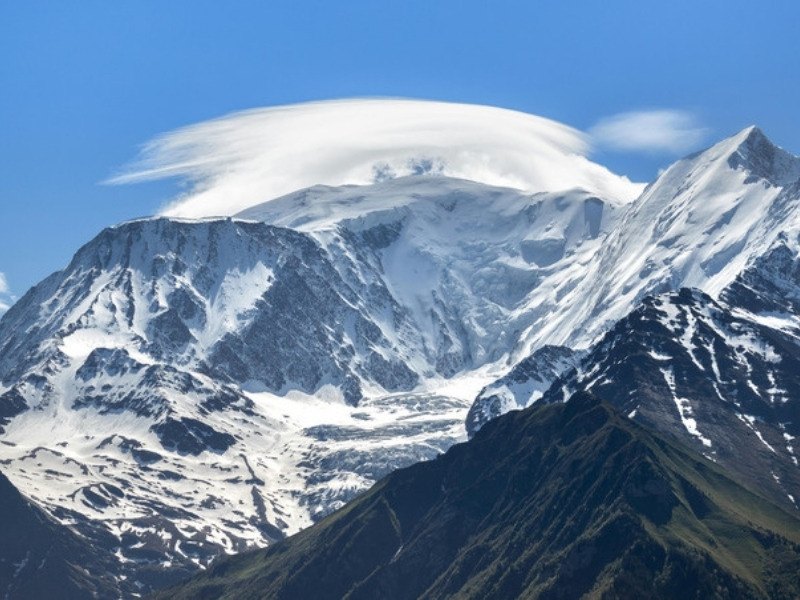
What’s actually changing is the snow and ice cap sitting on top. The highest rock on Mont Blanc is at 4,792 m (15,722 ft), roughly 40 m (130 ft) west of the ice-covered summit, and that figure stays put. Everything above it is a dome of wind-packed snow that builds up in some years and gets stripped away in others. When headlines say Mont Blanc has shrunk, they mean the weather moved the hat, not that the mountain sank.
4. Mont Blanc’s Official Height Has Swung by Over 5 m (17 ft) Since 2001
Since 2001 the official figure has ranged from 4,805.59 m (15,766 ft) at its lowest to 4,810.90 m (15,784 ft) at its highest, a swing of 5.31 m (17 ft). Every centimeter of that is snow and ice, because the rock underneath hasn’t moved. The 2023 low made headlines around the world as proof the Alps were melting. The honest reading is that the snow cap responds to how much snow fell and how hard the wind blew, so a single survey tells you about one winter rather than one century.
5. Mont Blanc Is the 11th Most Prominent Mountain in the World
Prominence measures how far a peak rises above the highest pass connecting it to anything taller, which is a better measure of how much a mountain dominates its surroundings than raw elevation. Mont Blanc ranks 11th globally. It’s why the thing looks so absurdly large from Chamonix: there is nothing nearby to give your eye a sense of scale, so your brain just gives up and files it under “that can’t be real.”
Is Mont Blanc the Highest Mountain in Europe?
6. Mont Blanc Is the Highest Mountain in Western Europe, Not in Europe Overall
There’s a real piece of geography underneath this one, which is why it gets argued about. Mont Blanc is unquestionably the highest peak in the Alps, in Western Europe and in the European Union. But Mount Elbrus in Russia is 5,642 m (18,510 ft), which is 835 m (2,740 ft) taller, and it’s one of ten Caucasus peaks that beat Mont Blanc.
Whether those count depends on where you draw the line between Europe and Asia. The most widely used convention puts the boundary along the Caucasus watershed, which places Elbrus in Europe and makes it the continent’s highest mountain. It’s why Elbrus, not Mont Blanc, is on the Seven Summits list, which is a slightly awkward thing to bring up over dinner in Chamonix.
| Rank | Mountain | Height | Country and range |
|---|---|---|---|
| 1 | Mount Elbrus | 5,642 m (18,510 ft) | Russia, Caucasus |
| 2 | Dykh-Tau | 5,205 m (17,077 ft) | Russia, Caucasus |
| 3 | Shkhara | 5,193 m (17,037 ft) | Georgia and Russia, Caucasus |
| 4 | Koshtan-Tau | 5,152 m (16,903 ft) | Russia, Caucasus |
| 5 | Pushkin Peak | 5,100 m (16,732 ft) | Russia, Caucasus |
| 6 | Janga (Dzhangi-Tau) | 5,085 m (16,683 ft) | Georgia and Russia, Caucasus |
| 7 | Mizhirgi | 5,047 m (16,558 ft) | Russia, Caucasus |
| 8 | Kazbek | 5,034 m (16,516 ft) | Georgia and Russia, Caucasus |
| 9 | Katyn-Tau | 4,979 m (16,335 ft) | Georgia and Russia, Caucasus |
| 10 | Kukurtlu Dome | 4,978 m (16,332 ft) | Russia, Caucasus |
| 11 | Mont Blanc | 4,805.59 m (15,766 ft) | France and Italy, the Alps. Highest in Western Europe. |
All ten peaks above Mont Blanc are in the Caucasus. Exclude that range from Europe and Mont Blanc goes straight to number one, so both answers have a real case behind them.
7. Mont Blanc Is the Highest Peak in the Alps by Nearly 200 m (650 ft)
Within the Alps there’s no argument at all. The next highest is Dufourspitze on the Swiss-Italian border at 4,634 m (15,203 ft), so Mont Blanc clears it by 172 m (564 ft). For context, the Matterhorn, which most people picture as the big one, is 4,478 m (14,692 ft) and comes in well behind both. The Matterhorn simply has better marketing.
You don’t have to climb Mont Blanc to stand in its shadow
Our self-guided Tour du Mont Blanc hikes the full 170 km (106 mile) circuit around the mountain through France, Italy and Switzerland. No ropes, no crampons, no guide and no group. We book every night for you, send GPX tracks and route notes, and you get a free custom training plan worth €300. 6, 7 or 10 days from €1,295.
Where Is Mont Blanc? Facts About Its Location and Name
8. Mont Blanc Sits on the Border Between France and Italy
Mont Blanc is in the Alps on the France-Italy border, with Chamonix in France on the north side and Courmayeur in Italy’s Aosta Valley on the south side. The wider Mont Blanc massif, the whole cluster of peaks and glaciers around it, also extends into Switzerland, which is why the hiking circuit around the mountain passes through three countries.
9. France and Italy Still Don’t Agree on Who Owns the Summit
This one is genuinely unresolved. France maintains the border curves around the summit, placing the top entirely in French territory, and cites the Treaty of Paris of 1796. Italy maintains the border follows the watershed, which would split the summit between the two countries, and cites the Treaty of Turin of 1860. About 65 hectares (160 acres) on Mont Blanc itself and another 10 hectares (25 acres) on the Dôme du Goûter are disputed.
Italy’s objection centers on an 1865 survey by a French army cartographer, Captain J. J. Mieulet, which it says moved the line in France’s favor. Two centuries on, French and Italian maps of the same mountain still don’t match. Nobody is fighting about it, but nobody has settled it either. Stand on the summit and you’re either definitely in France or possibly in two countries at once, depending on whose map is in your pocket.
10. “Mont Blanc” Means “White Mountain”
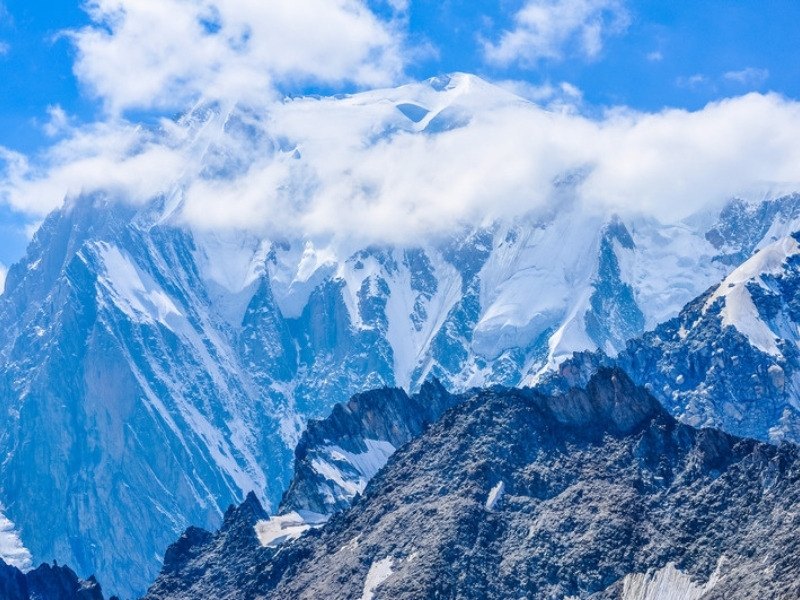
It’s French for white mountain, which is about as literal as mountain names get. In Italian it’s Monte Bianco, which means the same thing. Local Savoyard dialect had it as Mont Maudit, “cursed mountain,” a name that survives today on a neighboring 4,465 m (14,649 ft) peak on the classic climbing route.
11. Here’s How to Pronounce Mont Blanc and Chamonix
Mont Blanc is “mon blon,” with both final consonants silent and the vowels nasal. Not “mont blank.” Chamonix is “sha-mo-nee,” with the x silent, and locals routinely shorten it to “Cham,” pronounced “sham.” Courmayeur is “koor-ma-yur.” Getting these right won’t make the climb any easier, but it will make buying a lift ticket noticeably smoother.
Mont Blanc Climbing Facts: First Ascents and Who Goes Up Today
12. Mont Blanc Was First Climbed in 1786, and It Started Modern Mountaineering
Jacques Balmat, a local crystal hunter, and Michel-Gabriel Paccard, a Chamonix doctor, reached the summit on August 8th, 1786. They were chasing a prize put up by the Swiss scientist Horace-Bénédict de Saussure, who wanted the mountain measured. He’d offered that prize back in 1760, when he was 20 years old, and then waited 26 years for anyone to collect it, which tells you how the idea of climbing a mountain on purpose was going at the time. That ascent is widely treated as the birth of mountaineering as a sport, which makes Chamonix something like the sport’s hometown.
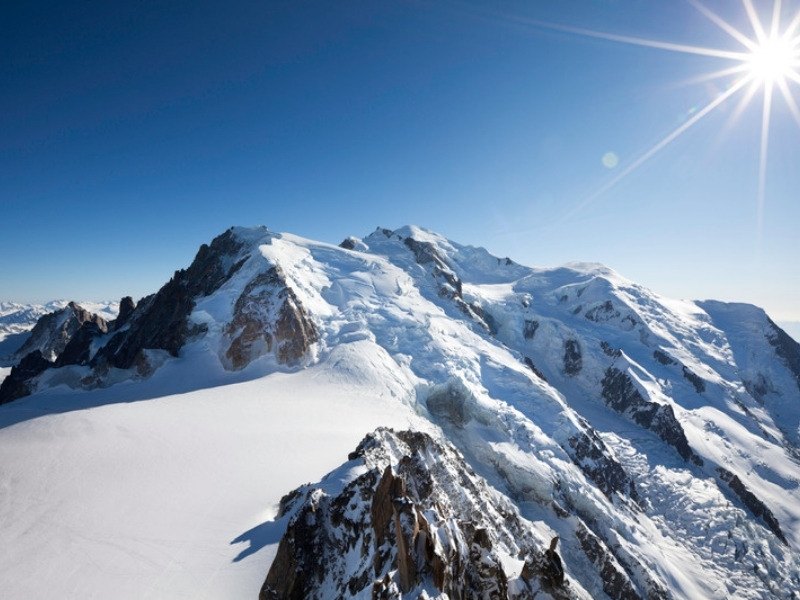
13. The First Woman to Summit Mont Blanc Did It in 1808
Marie Paradis, a Chamonix maidservant, summited in 1808, just 22 years after the first ascent. Thirty years then passed before another woman repeated it: Henriette d’Angeville in 1838, who planned and funded her own expedition and is often credited as the first woman to climb it on her own initiative. Marie Paradis was taken up by a group of guides; Henriette d’Angeville organized and paid for her own expedition and walked up under her own steam. Thirty years apart, and between them they put to rest the idea that the summit was no place for a woman.
14. About 20,000 People Reach the Summit of Mont Blanc Every Year
Roughly 20,000 mountaineers stand on top each year, overwhelmingly in a short summer window. It isn’t a technical climb by alpine standards, so it draws far more people than the harder 4,000 m peaks around it, and what it does ask for is real glacier experience. Reported deaths have run between 10 and 20 a year since the 1990s. In 2017, 14 people died out of about 20,000 summit attempts and two more were never found.
15. You Need a Hut Reservation to Climb Mont Blanc’s Normal Route
After years of overcrowding on the Goûter route, access is now controlled. Climbers have to show a confirmed reservation at the Goûter Hut, which sits at 3,835 m (12,582 ft), before they’re allowed above the Tête Rousse glacier. There’s also a municipal order from the mayor of Saint-Gervais, in force since August 2017, setting a minimum standard of equipment and clothing, with a 38 euro fine for turning up without it. Worth knowing before you plan a summit attempt, and completely irrelevant if you’re hiking the trail around the mountain instead.
16. The Speed Record Up Mont Blanc Is Under Five Hours
Pierre-André Gobet ran from Chamonix to the summit and back in 5 hours 10 minutes 14 seconds in 1990. Kilian Jornet took it down to 4 hours 57 minutes 40 seconds in 2013. That’s nearly 3,800 m (12,500 ft) of ascent and the same again back down, in less time than most people need for a single day of the hiking circuit. Something to think about on the uphill sections.
Mont Blanc Glacier and Weather Facts
17. The Coldest Temperature Recorded on Mont Blanc Is -43°C (-45°F)
That reading comes from the cold wave of January 1893 and remains the lowest ever recorded on the mountain. For a sense of scale, that’s colder than the average winter day at the South Pole’s coastal stations. Nobody is hiking in that, which is part of why the trekking season is so short.
18. The Mer de Glace Now Takes About 580 Steps to Reach, Against 3 Steps in 1988
This is the Mont Blanc fact that tends to stay with people. The Mer de Glace is France’s largest glacier, reached by the little red rack railway from Chamonix up to Montenvers at 1,913 m (6,276 ft). At the bottom there’s an ice cave carved fresh into the glacier each year. In 1988 you stepped down three steps to get into it. Today it’s a staircase of around 580 steps, and roughly 30 to 40 more get added every year as the ice pulls away.
If you’ve ever wanted a single, physical, countable measure of what’s happening in the Alps, it’s that staircase. Go and count it while it’s still a staircase.
19. The Mer de Glace Is Retreating 30 to 40 m (100 to 130 ft) a Year
As well as getting shorter by 30 to 40 m (100 to 130 ft) annually, the glacier is losing several meters of thickness each year at its lower end. The research centre CREA Mont-Blanc tracks every glacier in the massif if you want to follow the numbers yourself. It’s still an extraordinary thing to stand next to, and the Lac Blanc hike on the opposite side of the Chamonix valley gives you the best head-on view of the whole Mont Blanc massif without setting foot on ice.
Facts About Getting Up, Over and Through Mont Blanc
20. There’s an 11.6 km (7.2 Mile) Road Tunnel Underneath Mont Blanc
The Mont Blanc Tunnel runs 11,611 m (7.2 miles) from Chamonix to Courmayeur, straight under the mountain, and opened to traffic in 1965. It cut the road journey between France and Italy from a long haul over mountain passes to about 20 minutes, and it’s still one of the most important freight routes in the Alps. It’s also, for about 20 minutes, comfortably the least scenic way to experience the highest mountain in the Alps.
21. A Fire in the Mont Blanc Tunnel in 1999 Killed 39 People
In March 1999 a transport truck caught fire inside the tunnel. Thirty-nine people died, and the tunnel stayed closed for three years while it was rebuilt with a completely new safety system. It’s now one of the most heavily monitored road tunnels in the world, with pressurized refuges, mandatory spacing between vehicles and a permanent fire crew stationed inside the mountain.
22. The Aiguille du Midi Cable Car Climbs to 3,842 m (12,605 ft)
From Chamonix at 1,035 m (3,396 ft), the Aiguille du Midi cable car lifts you 2,807 m (9,209 ft) in about 20 minutes to a rock needle at 3,842 m (12,605 ft). It’s the highest point you can reach by cable car in Europe, and it’s the easiest way to stand in real high-mountain terrain with Mont Blanc filling the sky in front of you, no rope or glacier skills required. It’s about 15°C (27°F) colder at the top than in the valley, so take a warm layer even in August.
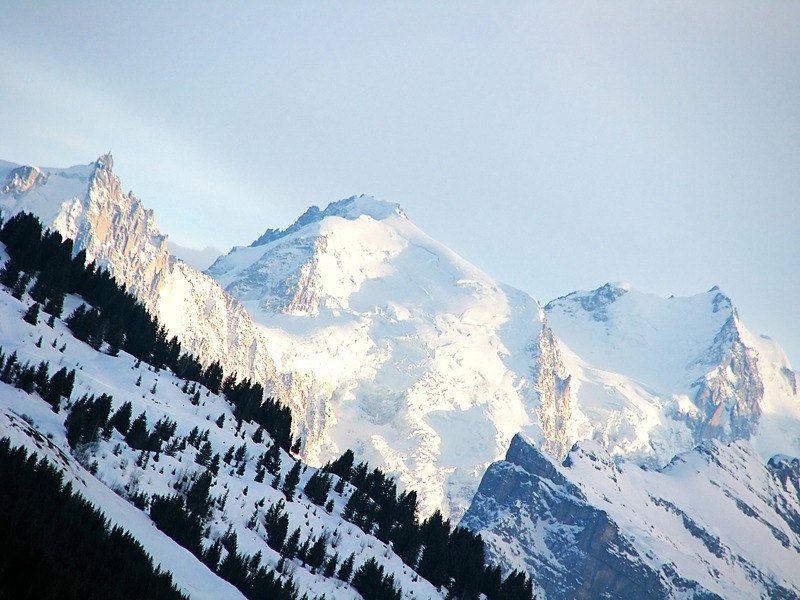
23. You Can Cross From France to Italy Over Mont Blanc by Cable Car
In summer, the Panoramic Mont Blanc gondola runs about 5 km (3 miles) from the Aiguille du Midi across the glacier basin to Pointe Helbronner at 3,466 m (11,371 ft) on the Italian side, where the Skyway Monte Bianco carries on down to Courmayeur. So you can start your morning with a coffee in France and have lunch in Italy having crossed the roof of the Alps without a rope. Few border crossings on earth are a better use of an afternoon.
24. Chamonix Hosted the First Ever Winter Olympics in 1924
The inaugural Winter Olympic Games were held in Chamonix in 1924, which is a reasonable claim to being the birthplace of winter sport as a spectacle, and pairs neatly with the town’s claim to being the birthplace of mountaineering. Not a bad record for a town of under 9,000 people.
Can You Hike Mont Blanc? Why You Go Around It, Not Up It
25. The Tour du Mont Blanc Circles the Mountain in 170 km (106 Miles) Through Three Countries
Worth being clear about, because the two get mixed up constantly: you can’t hike to the summit of Mont Blanc. The top is a glacier mountaineering route, and that’s a different sport with different gear. What you can do is hike the whole way around the mountain, and that’s the trip almost everyone actually means. The Tour du Mont Blanc is a 170 km (106 mile) hiking circuit all the way around the massif, crossing France, Italy and Switzerland, and it’s the most famous hike in Europe. It follows trading and herding paths that linked these valleys long before anyone climbed anything for fun.
What catches people out isn’t the distance, it’s the ascent: roughly 5,500 to 7,000 m (18,000 to 23,000 ft) over a 6 or 7-day route, and about 10,000 m (33,000 ft) on the full 10-day circuit, done on consecutive days. The legs feel that more than the kilometers.
The best time to hike the Tour du Mont Blanc is mid-June to mid-September, and if you want to know what you’re sleeping in along the way, our guide to Tour du Mont Blanc accommodation breaks down the four options from dormitory to 5-star.
Mont Blanc FAQs
How tall is Mont Blanc?
Mont Blanc is officially 4,805.59 m (15,766 ft) tall, the figure announced after the September 2023 survey by the Ordre des Geometres-Experts. A new measurement campaign finished on the summit on September 17th, 2026, and the new official figure is announced on October 14th, 2026. The number changes because the summit is a cap of wind-blown snow and ice, not bare rock. The highest rock sits at 4,792 m (15,722 ft), about 40 m (130 ft) west of the ice summit, and that number does not change.
Why does the height of Mont Blanc keep changing?
The height of Mont Blanc keeps changing because what gets measured is the dome of snow and ice on top, not the rock beneath it. Surveyors have climbed to the summit every second September since 2001 to re-measure it with satellite equipment accurate to a few centimeters. Since then the official figure has ranged from 4,805.59 m (15,766 ft) at its lowest to 4,810.90 m (15,784 ft) at its highest, a swing of 5.31 m (17 ft), driven entirely by how much snow fell and how hard the wind blew that year.
Is Mont Blanc the highest mountain in Europe?
Mont Blanc is the highest mountain in Western Europe, in the European Union and in the Alps, but it is not the highest mountain in Europe overall. Mount Elbrus in Russia is 5,642 m (18,510 ft), some 835 m (2,740 ft) taller, and nine other Caucasus peaks also beat Mont Blanc. Whether those count depends on where the Europe-Asia boundary is drawn, and the most widely used convention runs it along the Caucasus watershed, which puts Elbrus in Europe and on the Seven Summits list.
Where is Mont Blanc located?
Mont Blanc is located in the Alps on the border between France and Italy, with the town of Chamonix at 1,035 m (3,396 ft) on the French side and Courmayeur at 1,224 m (4,016 ft) in Italy’s Aosta Valley on the other. The wider Mont Blanc massif also extends into Switzerland, which is why the hiking circuit around the mountain crosses three countries. Geneva is the nearest major international airport, about 90 minutes from Chamonix.
What is the highest mountain in the Alps?
Mont Blanc is the highest mountain in the Alps at 4,805.59 m (15,766 ft). The second highest is Dufourspitze on the Swiss-Italian border at 4,634 m (15,203 ft), which Mont Blanc clears by 172 m (564 ft). The Matterhorn, which most people picture as the tallest Alpine peak, is 4,478 m (14,692 ft) and comes in behind both.
What does Mont Blanc mean in English?
Mont Blanc means “white mountain” in French, a reference to its permanent cap of snow and ice. In Italian the same mountain is Monte Bianco, which translates identically. The older Savoyard name for the peak was Mont Maudit, meaning “cursed mountain,” which survives today on a neighboring 4,465 m (14,649 ft) summit on the normal climbing route.
How do you pronounce Mont Blanc and Chamonix?
Mont Blanc is pronounced “mon blon,” with both final consonants silent and the vowels nasal, not “mont blank.” Chamonix is pronounced “sha-mo-nee,” with the x silent, and locals usually shorten it to “Cham,” said as “sham.” Courmayeur, the town on the Italian side, is “koor-ma-yur.”
Is Mont Blanc in France or Italy?
Mont Blanc is in both France and Italy, and the two countries have never agreed on exactly where the border crosses the summit. France says the border curves around the top, placing the summit entirely in France, and cites the Treaty of Paris of 1796. Italy says the border follows the watershed, which would split the summit between them, and cites the Treaty of Turin of 1860. Around 65 hectares (160 acres) on Mont Blanc and 10 hectares (25 acres) on the Dome du Gouter remain disputed, and French and Italian maps of the mountain still disagree. The wider Mont Blanc massif also extends into Switzerland.
Can you hike Mont Blanc?
No. You absolutely cannot hike Mont Blanc. Reaching the 4,805.59 m (15,766 ft) summit is glacier mountaineering, not hiking: it needs crampons, a rope, an ice axe, a Gouter Hut reservation and almost always a qualified guide, and between 10 and 20 people die attempting it every year. What you can hike is the Tour du Mont Blanc, which goes all the way around the mountain rather than up it. That is a 170 km (106 mile) trail through France, Italy and Switzerland on marked hiking paths, it is the most famous hike in Europe, and it needs no ropes, crampons or technical skills whatsoever. The two get confused constantly and they are completely different trips.
How many people climb Mont Blanc each year, and how dangerous is it?
About 20,000 mountaineers reach the summit of Mont Blanc each year, almost all of them in a short summer window, and reported deaths have run between 10 and 20 annually since the 1990s. In 2017, 14 people died out of roughly 20,000 summit attempts and two others were never found. Access to the normal Gouter route is now controlled: climbers must show a confirmed reservation at the Gouter Hut at 3,835 m (12,582 ft) to go above the Tete Rousse glacier, and a municipal order in force since August 2017 sets a minimum equipment standard with a 38 euro fine for non-compliance.
What is the best way to see Mont Blanc without climbing it?
The best way to see Mont Blanc without climbing it is the Aiguille du Midi cable car from Chamonix, which lifts you 2,807 m (9,209 ft) to a rock needle at 3,842 m (12,605 ft) in about 20 minutes. In summer you can carry on across the glacier basin by gondola to Pointe Helbronner at 3,466 m (11,371 ft) and down the Italian side to Courmayeur. For a head-on view of the whole massif on foot, the Lac Blanc hike on the opposite side of the Chamonix valley is the classic.
When is the best time to hike the Tour du Mont Blanc, and when is the best time to climb Mont Blanc?
They are two different trips with two different answers. The best time to hike the Tour du Mont Blanc, the trail that circles the mountain, is mid-June to mid-September, when the high passes are clear of snow and the mountain accommodations are open and staffed; our self-guided Tour du Mont Blanc season runs June 13th to September 13th. The best time to climb Mont Blanc itself, which is mountaineering rather than hiking, is also mid-June to mid-September, with late June, July and early September the most settled, and guides increasingly steering clients away from high summer because heat loosens rockfall on the Gouter route. Outside that window the cable cars still run for winter sports, but neither the trail nor the summit is passable without winter mountaineering skills.
Want to Spend a Week With This Mountain?
Reading about this mountain is one thing. Standing at the Col de la Seigne with France behind you and Italy opening up in front is another.
The hard part of the Tour du Mont Blanc has never been the hiking. It’s that the accommodations along the route book up 9 to 12 months ahead, they open reservations on different dates, and at a few key stages there are only a handful of beds in total. If those go, there’s no alternative on that stage. That’s the part we take off your hands.
The Tour du Mont Blanc, self-guided
6, 7 or 10 days around the highest mountain in the Alps, through France, Italy and Switzerland. Every night booked for you, GPX tracks and route notes, WhatsApp support throughout your trip, and a free custom training plan worth €300. From €1,295.
Where to Stay in Chamonix
Where to stay
Chamonix and Les Houches, at the foot of Mont Blanc
TL;DR: stay in Chamonix town if you want the Aiguille du Midi, the Montenvers railway, restaurants and the bus network on your doorstep. Stay in Les Houches, 15 minutes down the valley, if you’re starting the Tour du Mont Blanc, because that’s where the trail begins and it’s quieter and better value.
Our full guide covers every tier, from 5-star and 4-star hotels in Chamonix down to 3-star places and the Chamonix Lodge Hostel, plus the Les Houches options we book for our own clients: the RockyPop Hotel, Chalet Hôtel du Bois and Fontaine du Mont Blanc Hotel & Spa.
Or compare what’s available on your dates across the whole valley: